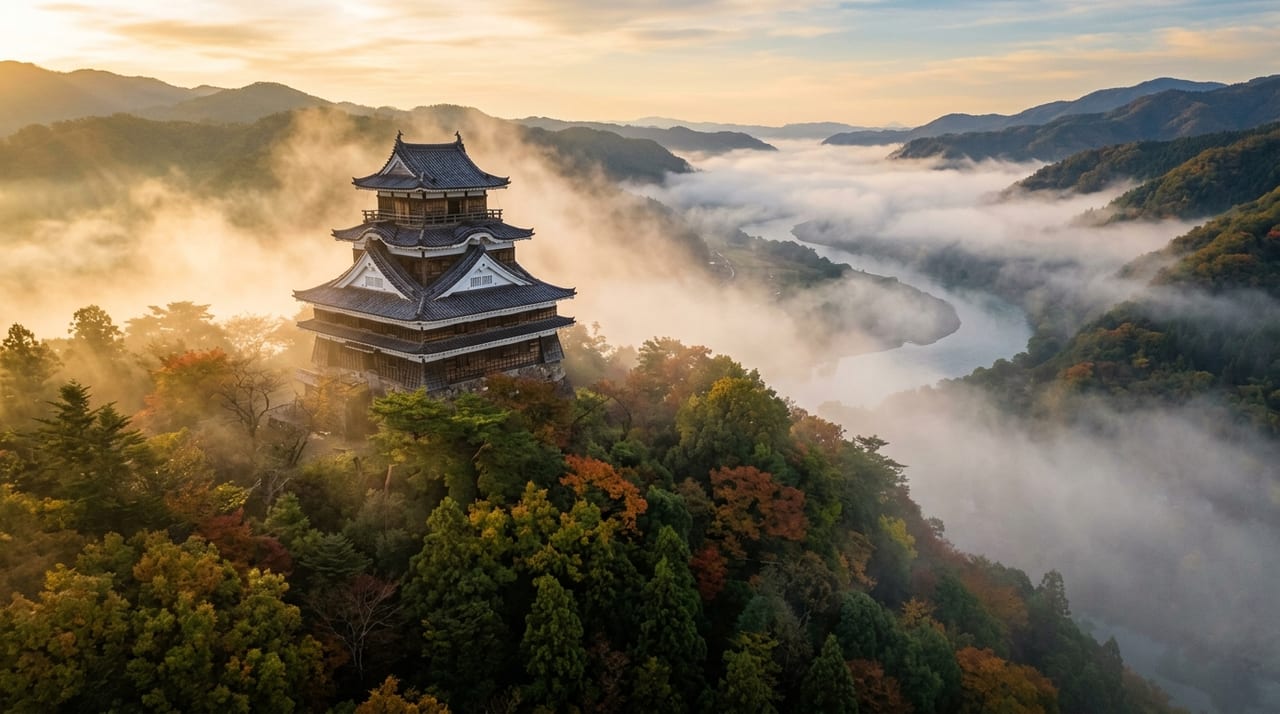
 * Image is for illustrative purposes only.
Ōzu Castle
大洲城
Ōzu Castle is a historic castle in the Shikoku region (Built circa 1331 (Genkō 1)). Its lord was Katō Sadayasu.
Overview
About the Castle
Ōzu Castle stands on a hill on the bank of the Hijikawa River in Ōzu, Ehime Prefecture. It is a hilltop castle (hirayamajō) that watches over the town of Ōzu, known as "the Little Kyoto of Iyo," and is one of Shikoku's foremost castles. It originated around 1331 (Genkō 1) as a fortification built by Utsunomiya Toyofusa. In the Sengoku period it was held by Tōdō Takatora, then passed to Wakisaka Yasuharu. In 1617 (Genna 3), Katō Sadayasu entered the castle as lord. His son, Katō Yasaoki, consolidated the 60,000-koku Ōzu domain, and the Katō family governed it until the Bakumatsu period. The four-story, four-level tenshu was dismantled in 1888 (Meiji 21) because of deterioration. In 2004 (Heisei 16) it was fully rebuilt in wood, based on detailed historical records such as Edo-period photographs and wooden structural models (hinagata) of the keep. This restoration has received the National Land Technology Development Award.
The Hijikawa Mist and Sky Castle
Inseparable from the beauty of Ōzu Castle is the fantastical landscape of the "Hijikawa mist" and the "cloud-sea castle." From autumn through winter, at dawn, dense fog rising from the Hijikawa covers the Ōzu basin, and the wooden tenshu appears to float above the mist, creating the spectacular view of the "Sky Castle." In recent years this scene has grown in nationwide renown as a photogenic spectacle on social media, and many photography enthusiasts gather from early morning to photograph the castle in the mist. At night the tenshu is also illuminated, and the beauty of the illuminated castle reflected in the Hijikawa is exceptional.
The Achievement of the Fully Wooden Reconstructed Tenshu
The fully wooden reconstructed tenshu of Ōzu Castle, completed in 2004 (Heisei 16), was a landmark event in the history of castle reconstruction in Japan. Photographs taken in 1888 (Meiji 21), before the dismantling, and wooden structural models (hinagata) of the keep handed down by the Nakamura family, chief carpenters (sakuji tōryō) of the Ōzu domain, survived. This made a highly accurate and faithful reconstruction possible. The reconstruction involved local master carpenters and traditional builders from across Japan, who recreated Edo-period construction methods and materials as closely as possible. As the only fully wooden reconstructed tenshu in Shikoku, the completed tenshu has received high scholarly praise from the perspectives of castle-architecture history and traditional building techniques.
Ōzu's Castle-Town Culture
Ōzu preserves its historic streetscape, known as "the Little Kyoto of Iyo," in good condition, and many historic buildings remain, including samurai residences, merchant houses, and the former Garyū Sansō (Garyūin). Garyū Sansō is a villa completed in 1907 (Meiji 40). On a site overlooking the Hijikawa stand the Garyūin, Furōan, and Chishian. Three buildings, the Garyūin, the Furōan, and the bunko storehouse, are designated Important Cultural Properties. The Furōan is a sukiya-style tea room that projects out over the river. Tea ceremony experiences there, amid autumn foliage, river mist, and moonlight, can be called the pinnacle of Japanese aesthetic sensibility. Ōzu is famous for its ayu (sweetfish) salt-grilled (shioyaki) and imotaki (taro stew). Naturally raised ayu from the clear waters of the Hijikawa are a distinctive Ōzu specialty with many devoted fans.
The Katō Family and Ōzu Domain Culture
The Katō family of Ōzu domain served as domain lords from the first lord, Katō Sadayasu, until the Meiji Restoration. The family encouraged martial arts and scholarship. In 1747 (Enkyō 4), the domain school, Shizen Shoin Meirindō, was established. In the late Edo period, Ōzu domain also took part in the movement to overthrow the shogunate, and loyalist factions within the domain were active.
Connection to Swords
The connection between Ōzu Castle and swords can be discussed from three aspects: Tōdō Takatora, who was deeply involved in the development of Ōzu Castle; the Katō family, who governed Ōzu domain; and the sword-smithing culture of Iyo. Tōdō Takatora, who was deeply involved in the development of Ōzu Castle, is known as a "master of castle-building." The Katō family, who became the lords of Ōzu domain, encouraged martial arts and scholarship among their retainers throughout the Edo period. Records of Iyo swordsmiths of the old-sword period are scarce, and their true character has not been fully clarified. Visitors with an interest in swords who go to the fully wooden reconstructed tenshu of Ōzu Castle can enjoy the displays inside the tenshu. Through the Katō family and the sword-smithing culture of Iyo, they can also sense the depth of Shikoku's samurai culture. Combined with a tea ceremony experience at Garyū Sansō, it would make a luxurious journey through which one can experience the essence of Japan's samurai culture, in which the beauty of swords and the beauty of tea resonate.
Highlights
- Fully wooden reconstructed tenshu — Shikoku's only fully wooden reconstructed tenshu. A highly accurate reconstruction based on Edo-period wooden structural models (hinagata) of the keep and Meiji-era photographs
- Hijikawa mist and 'Sky Castle' — The tenshu floating above the mist on early autumn and winter mornings is one of Japan's finest scenic views. Exceptionally photogenic on social media
- Garyū Sansō (Important Cultural Property) — Sukiya-style architecture on a cliff overlooking the Hijikawa. A tea ceremony experience at Furōan is a lifetime memory
- Ōzu's historic streetscape — Stroll past the samurai residences and merchant houses of the castle town known as 'the Little Kyoto of Iyo'
- Wild Hijikawa ayu and imotaki — Ōzu's two signature dishes. Salt-grilled ayu from the clear waters and the autumn imotaki hotpot are exquisite
- Hijikawa Line boat tour — Sightseeing by boat down the Hijikawa, enjoying Ōzu Castle and the natural scenery from the water
* Opening hours and admission fees are subject to change. Please check the official website before visiting.