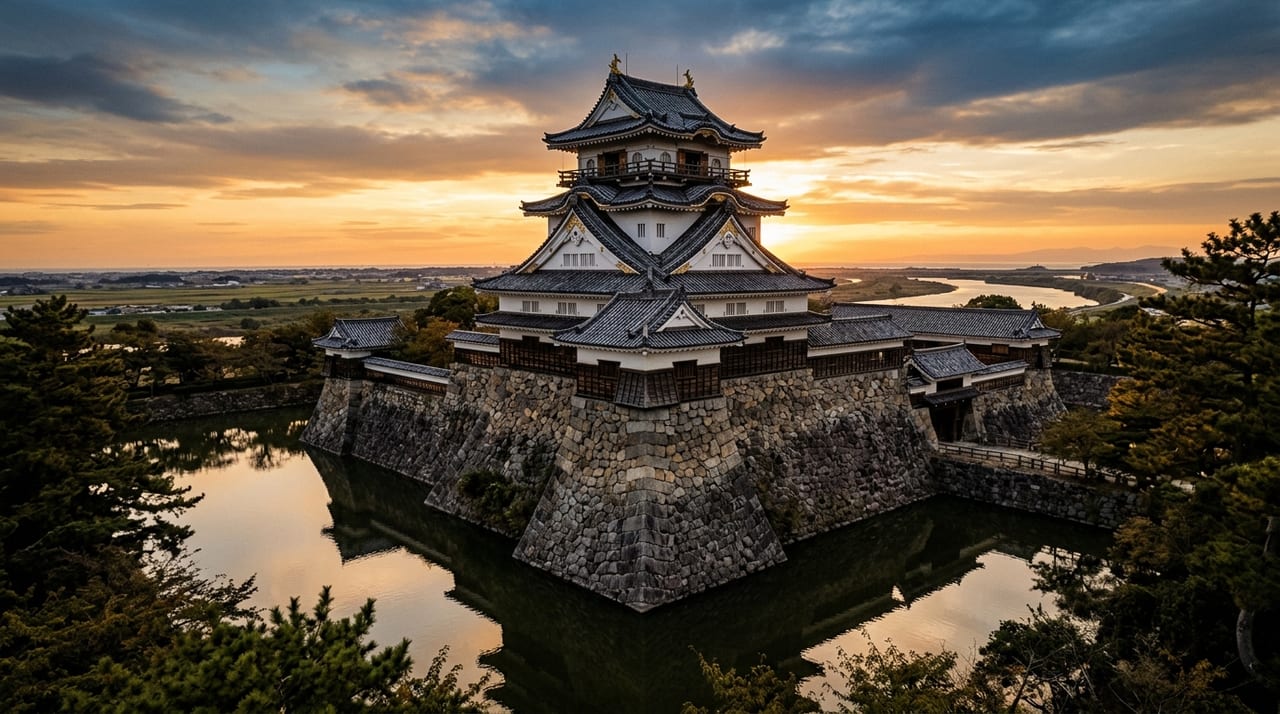
 * Image is for illustrative purposes only.
Kagomori Castle
河後森城
Kagomori Castle is a historic castle in the Shikoku region (Construction date unknown; abandoned in 1615 (Genna 1)). Its lord was The Watanabe clan; the Shiba clan; Toda Katsutaka; Tōdō Takatora; the Kori clan (chief retainers assigned to Date Munemune).
Overview
Overview
Kagomori Castle was a mountain castle located in Matsumaru, Matsuno Town, Kita-Uwa District, Ehime Prefecture. It was built on a horseshoe-shaped isolated hill surrounded on three sides by the Hiromi River, a tributary of the Shimanto River, and its tributaries the Horikiri River and the Iwashi River. It was designated a National Historic Site as a remnant that well conveys the overall picture of a medieval mountain castle, and it has also been selected as one of the Continuation of the 100 Fine Castles of Japan.
Construction and the Watanabe Clan
The construction date is unknown, and the castle mainly functioned from the late Tenbun period to the Tenshō period. The Watanabe were called the "Kawaharabuchi-dono," and for generations they made this castle their seat.
Succession of Lords
Around 1580–1581 (Tenshō 8–9), Shiba Gensaburō, a page of castellan Watanabe Noritada, defected to the Chōsokabe clan and seized the castle through a stratagem. Under the Toyotomi regime, Toda Katsutaka expelled the Shiba and governed the area. This was followed by rule under Tōdō Takatora. When Date Hidemune established the Uwajima Domain in 1614 (Keichō 19), his chief retainer Kori Kageyori took up residence in the castle.
Structure
Centered on the Honmaru, the castle has a group of baileys numbered West 2 to West 10 on the west side, East 2 to East 4 and Old Castle through Old Castle 4 on the east side, and the New Castle group of baileys on the south side. The Old Castle, Main Castle, and New Castle are linked in a horseshoe-shaped layout, forming its nawabari (enclosure layout). Excavations have confirmed the remains of post-pit (horidatebashira) buildings in several baileys, and based on the survey results, gates and buildings have been reconstructed within the castle.
Abandonment
The castle was abandoned in 1615 (Genna 1) under the One Castle per Province Edict issued by the Edo shogunate.
Designation and Present State
It was designated a National Historic Site on September 11, 1997. On April 6, 2017, it was selected as No. 179 in the Continuation of the 100 Fine Castles of Japan. Mountain trails and reconstructed buildings are currently maintained, and some excavated artifacts can be viewed at facilities in the town.
Access
About a 30-minute walk from Matsumaru Station on the JR Yodo Line. About 15 kilometers by car from the Mima Interchange on the Matsuyama Expressway; the castle can be climbed from the Furogatani parking area.
Highlights
- A mountain castle built on a horseshoe-shaped isolated hill surrounded on three sides by the Hiromi, Horikiri, and Iwashi rivers
- A castle that the Watanabe clan, known as the Lords of Kawaharabuchi, held as its seat for generations
- Passed through the Chōsokabe clan, Toda Katsutaka, and Tōdō Takatora before the Kori clan, chief retainers of the Uwajima domain, took up residence
- A horseshoe-shaped layout linking the Old Castle, Main Castle, and New Castle sections, with gates and buildings reconstructed based on excavation results
- A National Historic Site and No. 179 in the Continuation of the 100 Fine Castles of Japan
* Opening hours and admission fees are subject to change. Please check the official website before visiting.