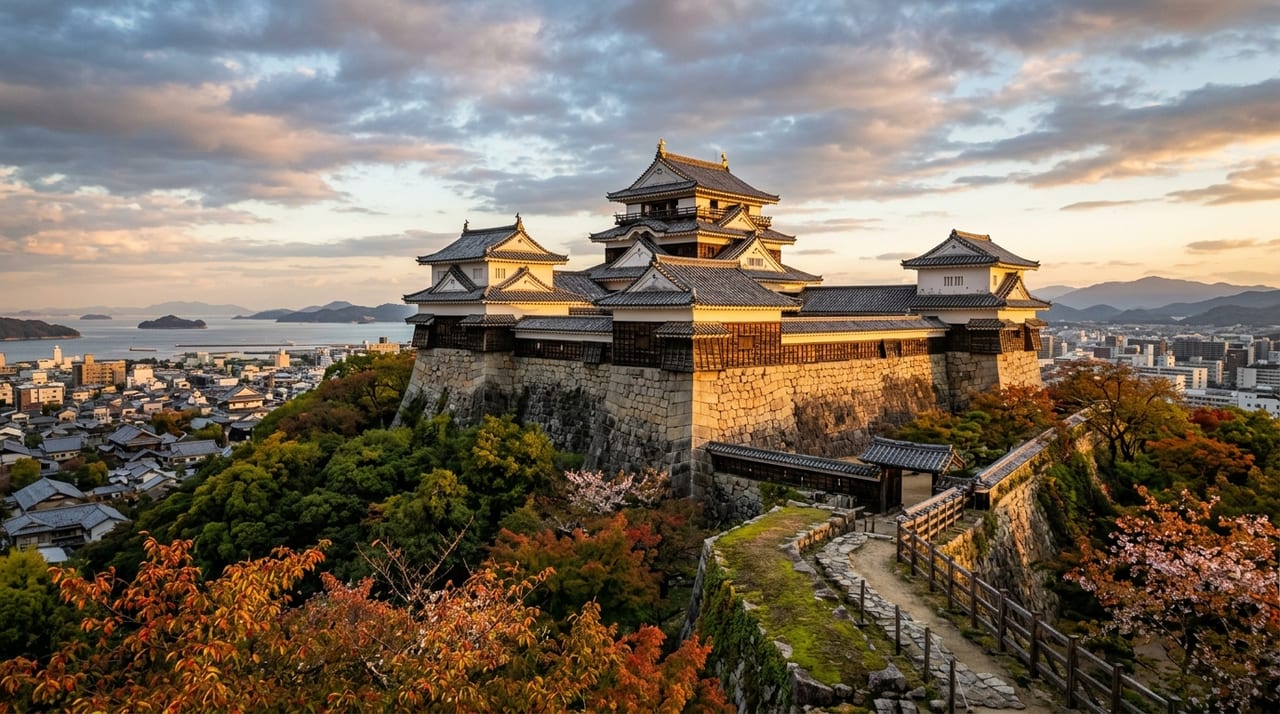
 * Image is for illustrative purposes only.
Matsuyama Castle
松山城
Matsuyama Castle is a historic castle in the Shikoku region (Construction began in 1602 (Keichō 7)). Its lord was Katō Yoshiaki / Matsudaira clan.
Overview
About the Castle
Matsuyama Castle is a grand castle whose construction began in Keichō 7 (1602), under Katō Yoshiaki, who received 200,000 koku of Iyo Province for his service at the Battle of Sekigahara. It is the largest famous castle in Shikoku, with a renritsu-shiki tenshu (connected keep complex) atop Mount Katsuyama, 132 m high. It is counted among Japan's twelve surviving tenshu (main keeps). In this complex, the main keep, the small keep, the corner turrets (sumi-yagura) and the connecting turrets (watari-yagura) are linked in a square, and its intricate structure and beauty rival those of Himeji Castle. Katō Yoshiaki was recognized by Toyotomi Hideyoshi as one of the Seven Spears of Shizugatake, and he also fought as a naval commander in the Korean campaigns. Yoshiaki spent 25 years firming up the castle's foundations after construction began, but in Kan'ei 4 (1627) he was reassigned to Aizu, and Gamō Tadatomo took his place.
Architecture and Structure
After the Gamō family line ended, Matsudaira Sadayuki (of the Hisamatsu Matsudaira family) entered the castle in Kan'ei 12 (1635). From then on, the Matsudaira family governed the Matsuyama domain of 150,000 koku until the Meiji Restoration. The tenshu was rebuilt in Ansei 1 (1854). It is one of the last tenshu built in the late Edo period and shows the final brilliance of traditional castle architecture. Twenty-one buildings within the castle are designated Important Cultural Properties, a number that ranks among the highest of any castle in Japan. From the top floor of the tenshu, visitors can take in the full view of Matsuyama city and the beautiful archipelago of the Seto Inland Sea. On clear days, the mountain ranges of the Chūgoku region can be seen in the distance.
Development of the Castle Town
Matsuyama is a city of literature, known for Natsume Sōseki's Botchan and Masaoka Shiki's haiku. Dōgo Onsen, one of Japan's oldest hot springs, is within walking distance of the castle. A ropeway or chairlift takes visitors up to the area near the summit, and the castle welcomes visitors throughout the year. The beauty of the castle is especially highlighted in spring, when the cherry blossoms bloom, and in autumn, when the leaves change color. In the castle town, the Ninomaru Historic Garden has been developed, where visitors can see up close the remains of the Ninomaru, the living quarters of the domain lord. Matsuyama is also a sacred place of haiku, known for Shiki's verse "Kaki kuhe ba / kane ga naru nari / Hōryūji" ("Biting into a persimmon, / the bell tolls— / Hōryū-ji"). It has a distinctive character where literature and samurai culture intersect.
Culture and Crafts
The renritsu-shiki tenshu complex of Matsuyama Castle is a castle that deserves time to explore because of its complex structure. The views from each turret, each offering a different angle, never grow tiresome. Matsuyama Castle is one of the most accessible of Japan's surviving tenshu. It combines the convenience of ropeway access with the authentic castle experience created by 21 Important Cultural Properties. Matsuyama is also a city of haiku, and monuments inscribed with poems about the castle are scattered throughout the town. Shiki's verse "Haru ya mukashi / jūgo man goku no / jōka kana" ("Spring— / long ago, / a castle town of 150,000 koku") concisely expresses the presence of Matsuyama Castle.
Connection to Swords
Katō Yoshiaki, who built Matsuyama Castle, is known as one of the Seven Spears of Shizugatake. He was a capable warrior who enjoyed the deep trust of Toyotomi Hideyoshi and fought in many battles. Yoshiaki had outstanding ability not only on land but also as a naval commander, and during the Imjin War (Bunroku-Keichō campaigns) he fought on the Korean Peninsula as a naval commander. The Iyo Matsuyama domain was later ruled by the Hisamatsu-Matsudaira clan. As a shinpan (related) domain, a branch of the Tokugawa shogunal family, it held high status. In discussing the sword and arms culture of Iyo Province (Ehime Prefecture), the existence of Ōyamazumi Shrine (on Ōmishima Island, Imabari) is decisive. This ancient shrine, located on Ōmishima Island in the Seto Inland Sea, has been revered since antiquity as a deity of mountains, the sea, and war. It is said to have received armor offered by Minamoto no Yoshitsune, and warlords from across the country dedicated arms and armor there to pray for victory. As a result, about 40 percent of the armor designated as National Treasures and Important Cultural Properties is concentrated in this single shrine, making it a great hall of arms unmatched anywhere in the world. The shrine's treasure halls, the Shiyōden and Kokuhōkan treasure halls, display masterpieces of armor and swords from the Heian period through the Sengoku period all in one place, offering a unique space where the history of Japanese martial arts can be experienced in condensed form. The journey from Matsuyama Castle to Ōyamazumi Shrine is also a scenic driving route via the Shimanami Kaidō, an ultimate journey where one can enjoy the history of swords and armor together with the island beauty of the Seto Inland Sea.
Highlights
- Surviving compound tower complex
- 21 Important Cultural Property structures
- Views of Matsuyama city and Seto Inland Sea from the tower
- Ropeway and chairlift access
- Dōgo Onsen (within walking distance)
- Ōyamazumi Shrine (via Shimanami Kaidō)
* Opening hours and admission fees are subject to change. Please check the official website before visiting.