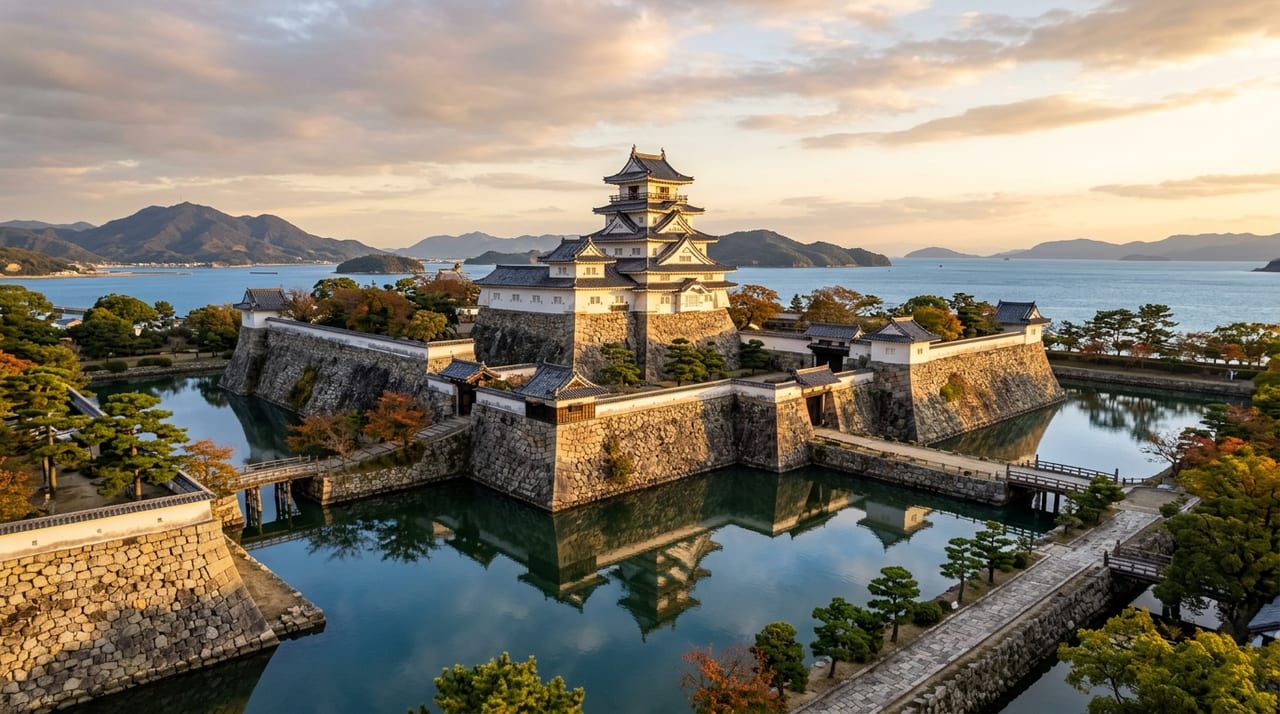
 * Image is for illustrative purposes only.
Imabari Castle
今治城
Imabari Castle is a historic castle in the Shikoku region (Built in 1602 (Keichō 7)). Its lord was Tōdō Takatora.
Overview
A Flatland Castle Floating on the Sea
Imabari Castle is an early-modern flatland castle located in Imabari, Ehime Prefecture, and it has a distinctive structure that counts as one of Japan's 'Three Great Water Castles.' Built on the Imabari coastline in Keichō 7 (1602) by Tōdō Takatora, this castle is known as a 'sea castle' (umijiro), with seawater drawn into all of its inner, middle, and outer moats. Formerly, boats could enter the moats directly from the sea, and there were also funairi (boat docks) within the castle where ships could moor. Seawater is still drawn into the surviving inner moat today, preserving the scenery of a 'water castle.'
Tōdō Takatora, the Master Castle-Builder
Tōdō Takatora (1556–1630), who built Imabari Castle, was a daimyō renowned in the early Edo period as a 'master castle-builder.' Takatora is also famous as the 'man who changed lords seven times.' Serving the Asai, Hashiba, Toyotomi, and Tokugawa in turn, he raised his position through shrewd political skill. In construction, he devised original techniques for high stone walls (takaishigaki), moat design, and donjon structure, and built many famous castles, including Uwajima, Tsu, Sasayama, and Iga-Ueno Castles, in addition to Imabari Castle. Imabari Castle is considered one of his representative works in which his castle-building sense was most fully displayed, and its bold idea of seawater moats is regarded as the best example of Takatora's originality.
Imabari Castle and Control of the Seto Inland Sea
Imabari lies at a strategic point on the Seto Inland Sea and had long been valued as a base for naval forces controlling the Kurushima Strait. During the Sengoku period it served as the home base of the Kurushima naval forces, and Kurushima Michifusa and others controlled waterborne traffic on the Seto Inland Sea. Tōdō Takatora used Imabari as a base to organize control over his domain in Iyo Province (Ehime), advancing the management of maritime traffic and the development of the castle town. After Imabari Castle was completed, Takatora was transferred to Ise Province (Mie Prefecture), and the castle afterward served as the administrative seat of the Imabari Domain until the late Edo period.
Imabari Castle Today
Today's Imabari Castle centers on a reinforced-concrete replica donjon built in 1980. Its stone walls, moats, and gates have been maintained, and the interior of the donjon is a museum introducing the history and culture of Imabari and Iyo. The museum displays armor and materials related to the Imabari Domain.
Connection to Swords
Tōdō Takatora and Swords
Tōdō Takatora is known as a warrior who 'changed lords seven times,' and as a retainer of the Asai and Hashiba he earned distinction in many battles. The bugu-yagura (armory turret) at the northern corner of the Ninomaru of Imabari Castle was left standing after the castle was abandoned in the Meiji period, along with its stored contents. However, in a fire in Meiji 4 (1871), the gunpowder inside ignited, and the turret exploded and burned.
Kurushima Naval Forces and Swords
Before Imabari Castle was built, the Kurushima naval forces, who controlled the Imabari area, were a powerful maritime force on the Seto Inland Sea. Kurushima Michifusa and other Kurushima warriors had tactics specialized for naval combat, and in boarding combat (hand-to-hand fighting in which they boarded enemy ships), swords, naginata, and spears played a decisive role.
Highlights
- One of Japan's Three Great Water Castles — a beautiful 'sea castle' with seawater-filled moats and stone walls
- Tōdō Takatora's castle-building sense — one of the representative works of the 'master castle-builder'
- Imabari Castle Donjon — its interior serves as a museum displaying armor and materials on the Imabari Domain
- Views of the Kurushima Strait — spectacular vistas of the Seto Inland Sea and its islands from the donjon
- Combine Imabari towels with sword tourism — enjoy the city's signature craft and samurai culture in one visit
* Opening hours and admission fees are subject to change. Please check the official website before visiting.