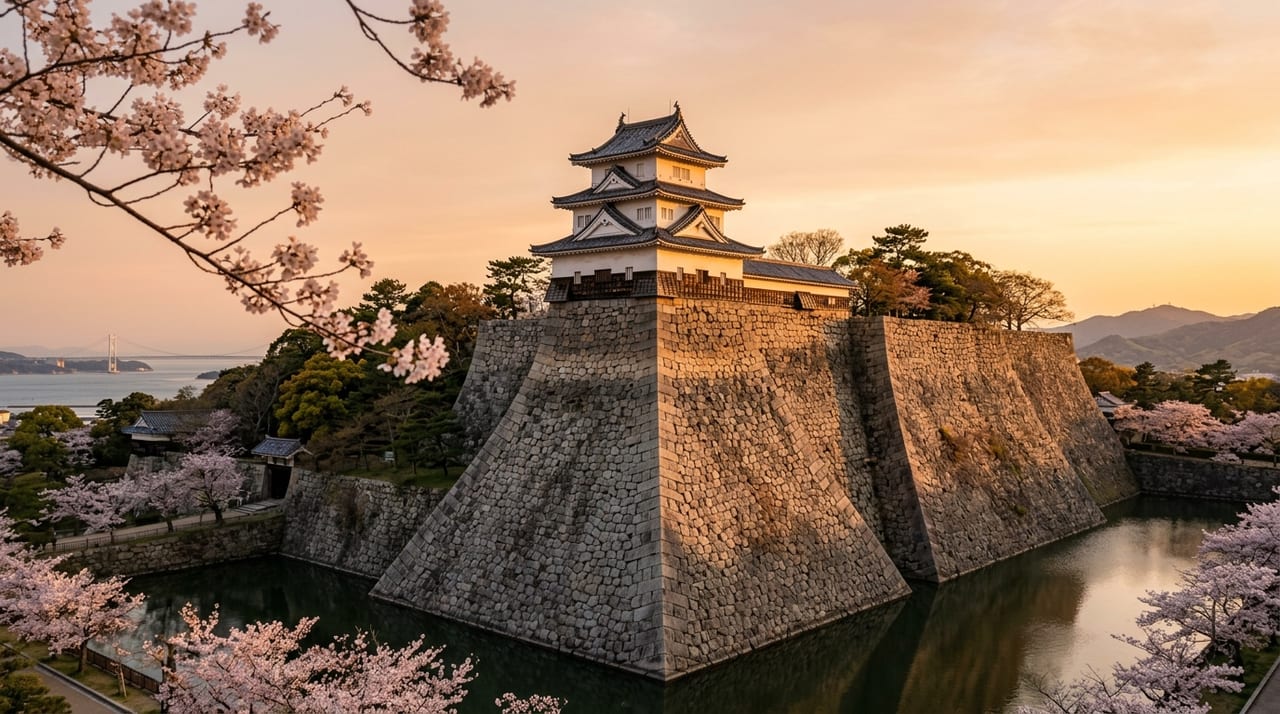
 * Image is for illustrative purposes only.
Marugame Castle
丸亀城
Marugame Castle is a historic castle in the Shikoku region (Built in 1597 (Keichō 2)). Its lord was Ikoma Chikamasa / Kyōgoku clan.
Overview
About the Castle
Marugame Castle is a renowned Sanuki castle, famous nationwide as a "castle of famous stone walls." Its stone walls, stacked in four tiers to a total height of about 60 m, are the tallest among Japanese castles. These overwhelming stone walls give those approaching the castle an imposing sense of a huge wall rising before them. The gently upturned curve known as the "fan-shaped slope" is the pinnacle of stone wall construction. The extant three-tiered, three-story main keep, about 15 m tall, is also known as the smallest extant main keep in Japan. Yet its appearance, standing atop the 60 m stone wall, is full of dignity that seems to pierce the sky despite its small size.
History of Construction
In Keichō 2 (1597), Ikoma Chikamasa, lord of Sanuki Province, began construction of the castle. In Kan'ei 18 (1641), Yamazaki Ieharu entered the domain and began restoration. In Manji 1 (1658), Kyōgoku Takakazu entered the domain. In Enpō 1 (1673), a major renovation was completed, bringing the castle to its present form. The Kyōgoku clan is a distinguished house of the Ōmi Genji. As a family that served as chief of the Samurai-dokoro (military police chief) of the Muromachi shogunate, it holds the honor of the warrior houses. Although the Kyōgoku clan ruled a small domain of 60,000 koku, it made this castle with its magnificent stone walls its seat. From the main keep, the Sanuki Plain spreads out in all directions. One can even see the islands of the Seto Inland Sea and the majestic form of the Seto Ōhashi Bridge.
Architecture and Structure
In Heisei 30 (2018), the stone walls on the southwest side collapsed on a large scale during the West Japan Torrential Rain Disaster, and restoration work is currently underway. This collapse has become a valuable opportunity to re-examine the structure of the stone walls, and public tours of the restoration process are also being held. The castle grounds, developed as Kameyama Park, are also a famous cherry blossom spot. They can be enjoyed together with Marugame's local specialties, in the heartland of Sanuki udon. The stone walls of Marugame Castle preserve the legend of the stonemason Hasaka Jūzaburō, celebrated as a master craftsman. His exquisite skill continues to support the castle to this day.
Development of the Castle Town
In terms of the beauty of its stone walls, no castle surpasses Marugame Castle. For stone wall enthusiasts, it is a place that might be called a "sacred site." In the Edo period, the main pilgrimage route was to land at Marugame Port from Konpira boats sailing from Ōsaka. Pilgrims then walked along the Marugame Kaidō road to worship at Kotohira-gū (Konpira-san). Marugame is also known as a famous producer of fans. The traditional craft of Marugame uchiwa fans carries a part of the castle town's culture to the present day. The beauty of stone walls, the Seto Inland Sea, Sanuki udon, and the home of uchiwa fans: Marugame, though a small town, is full of diverse charms. Marugame's streets are also nationally known as a sacred ground of Sanuki udon. Touring udon shops after gazing at the stone walls is a special pleasure.
Sightseeing and Experiences
Honetsuki-dori is also a Marugame specialty. The combination of the castle and local food makes the trip even richer. Marugame Castle is most beautiful at dusk, when the "fan-shaped slope" stone walls are lit by the setting sun. It is the ultimate photography time for photography enthusiasts.
Connection to Swords
Sanuki Province (Kagawa Prefecture) also has a history of swordsmiths being active there. Sanuki lies geographically across the Seto Inland Sea from Bizen Province, Japan's greatest producing region of Japanese swords. The Kyōgoku clan, lords of the Marugame domain, is a distinguished house among distinguished houses. It considers itself the direct lineal descendant of the Sasaki clan of the Ōmi Genji. In the Muromachi period, it wielded great power as a great shugo daimyō holding the shugo posts of Izumo, Oki, and Hida. The martial traditions of this house were also reflected in its deep appreciation of swords. Sanuki also prospered through pilgrimages to Kotohira-gū (Konpira-san). The route from Marugame Castle across the Seto Ōhashi Bridge to the Bizen Osafune Sword Museum is a journey where one can experience the history of sword distribution through Seto Inland Sea shipping. It is one of the sword travel itineraries recommended by TOUKENZA. At the Marugame City Museum, visitors can see historical materials related to Marugame Castle and the Kyōgoku clan. A journey crossing the calm waters of the Seto Inland Sea toward the land of Bizen is a valuable experience. It retraces the routes of sword distribution from ancient through medieval times. Sanuki Province is also known as the birthplace of Kūkai (Kōbō Daishi). It is a spiritually profound land where the culture of the Shikoku henro pilgrimage has taken root. Sanuki, where the culture of the warrior and the culture of faith coexist, is a region that symbolizes the multifaceted nature of Japanese culture.
Highlights
- Japan's tallest stone walls (approx. 60m total height)
- Smallest surviving castle tower in Japan
- Seto Inland Sea views from the tower
- Main gate (Important Cultural Property)
- Cherry blossoms at Kameyama Park
- Route to Bizen Osafune via the Seto Ōhashi Bridge
* Opening hours and admission fees are subject to change. Please check the official website before visiting.