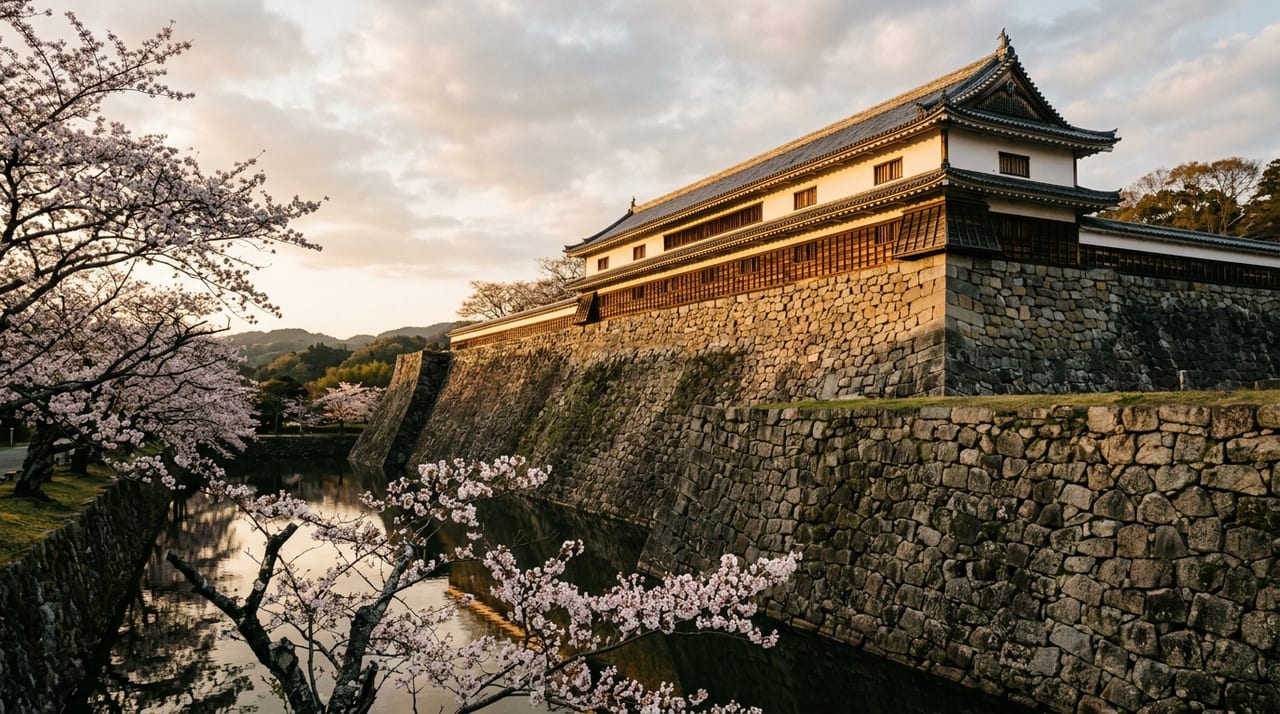
 * Image is for illustrative purposes only.
Yuzuki Castle
湯築城
Yuzuki Castle is a historic castle in the Shikoku region (Built as a base by the Kōno clan in the Nanboku-chō period (first half of the 14th century). In Tenshō 13 (1585), near the end of the Sengoku period, the castle was surrendered during Toyotomi Hideyoshi's conquest of Shikoku, and it was abandoned around Tenshō 15 (1587)). Its lord was Kono Clan (Iyo Kono family).
Overview
Yuzuki Castle is a medieval hirayama castle (a castle on a low hill) located in Dōgo Park in Matsuyama, Ehime Prefecture. It was the main base for about 250 years of the Kōno clan, a powerful family of Iyo Province (present-day Ehime Prefecture). It stands close to Dōgo Onsen. Its outer moat, inner moat and double earthen ramparts remain nearly fully intact, and it is open to the public as a castle ruins park. It is designated as a nationally designated historic site, and in 2006 it was also selected as one of the Nihon Hyakumeijō (Japan's 100 Famous Castles).
The castle's origins go back to the Nanboku-chō period (first half of the 14th century). The Kōno clan was originally a local power in Iyo whose base was Kōno-gō, Kazahaya District (present-day Hōjō district, Matsuyama). During the Genpei War, they commanded naval forces on the Minamoto side, and through the Kamakura and Muromachi periods they expanded their control within Iyo Province. After the turmoil of the Nanboku-chō period, although they went through intervention by the Hosokawa clan and internal feuds within the family, they forged ties with the Ashikaga shogunal family and established their standing as shugo (military governor) of Iyo.
Yuzuki Castle began as a mountain castle using the hill at its center. In the first half of the 16th century an outer moat was dug, turning it into a hirayama castle with double moats and double earthen ramparts surrounding the hill. Excavations have confirmed numerous remains, including buildings with stone foundations, stone paving, wells and samurai residence sites, and it has become an important base for research on medieval castles. Within the castle, a samurai residence has been reconstructed, and exhibition facilities have been set up where visitors can experience the life of warriors of the period.
In Tenshō 13 (1585), when the forces led by Kobayakawa Takakage invaded Iyo during Toyotomi Hideyoshi's conquest of Shikoku, the head of the Kōno clan, Kōno Michinao, surrendered after resistance. Yuzuki Castle was surrendered, and the Kōno clan gave up its position of rule over Iyo. Afterward, rule of Iyo passed from one lord to another: Kobayakawa Takakage, Fukushima Masanori, and Katō Yoshiaki. In Tenshō 15 (1587), Fukushima Masanori, who had become lord of the castle, moved his residence to Kokubuyama Castle, and Yuzuki Castle was abandoned.
Today's Dōgo Park is a rare medieval castle remain in which the former outer moat, inner moat and earthen ramparts have kept nearly their original form. Numerous artifacts excavated by archaeological survey, including ceramics, iron objects and copper coins, are displayed at the Yuzuki Castle Museum (within the castle ruins). Many visitors also go to the castle together with the adjacent Dōgo Onsen Honkan (built in Meiji 27 (1894); nationally designated Important Cultural Property). Together with Matsuyama Castle and Dōgo Onsen, it forms Matsuyama's historical corridor.
Connection to Swords
The connection between Yuzuki Castle and Japanese swords can be traced to the history of the Kōno clan, a samurai family of Iyo, and its naval forces.
Reliable records of swordsmiths of Iyo Province in the Kotō period are scarce, and few comprehensive records of sword-making survive. The sword culture of the Kinai region, beginning with the Rai school of Yamashiro (Kyoto), spread through the Seto Inland Sea to various parts of western Japan.
The Kōno clan was a family that led the naval forces of the Seto Inland Sea, and the Murakami navy was also nominally under Kōno command. Dōgo Onsen, at the foot of the castle, had long been a hot-spring cure destination (tōji no chi) visited by members of the imperial family, court nobles and warlords.
Also, from the Kurushima Murakami clan, a Murakami sea-raider group that had allied with the Kōno clan, Kurushima Michifusa broke away from the Kōno in Tenshō 9 (1581) and later became an independent daimyo. After Hideyoshi's conquest of Shikoku led to the decline of the Kōno clan, the sword culture of Iyo was inherited by the Matsuyama domain (the Katō and Matsudaira houses). The remains of Yuzuki Castle survive as a valuable heritage that conveys to the present day the memory of medieval Iyo's warrior culture and sword traditions.
Highlights
- Remains of double moats and earthen ramparts — outer moat, inner moat and earthen ramparts nearly fully intact; one of the finest sites in Japan where the layout of a medieval castle can be experienced on the ground
- Reconstructed samurai residence exhibit — a warrior residence restored based on archaeological excavation, realistically recreating the living spaces of samurai of the time
- Yuzuki Castle Museum — exhibits the results of excavation and excavated artifacts, explaining the history of the Kōno clan
- Dōgo Onsen Honkan (adjacent) — a nationally designated Important Cultural Property built in Meiji 27 (1894); a classic historical walking course combined with the castle ruins
- Nihon Hyakumeijō — selected in 2006; as a historic site representing medieval castles of Shikoku, castle enthusiasts visit from across the country
- Sightseeing combined with Matsuyama Castle — part of the Matsuyama castle-town historical corridor, combined with Matsuyama Castle (12 surviving original keeps) in the city center
* Opening hours and admission fees are subject to change. Please check the official website before visiting.