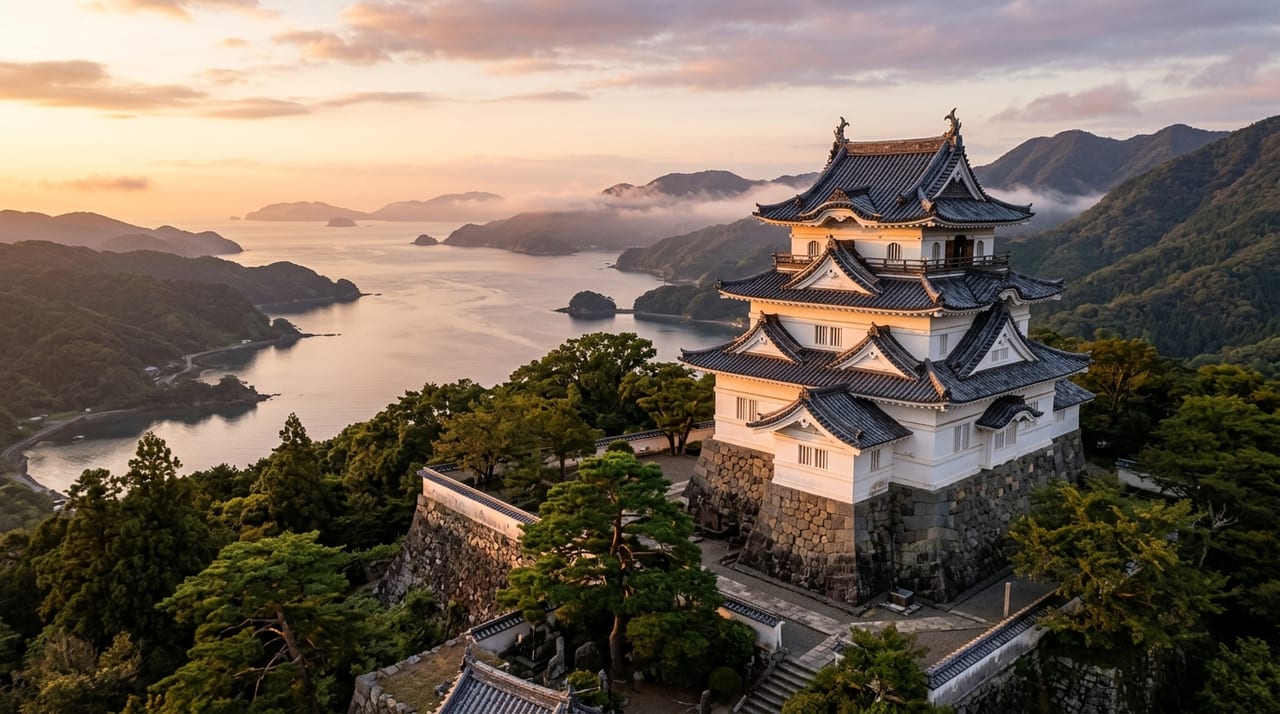
 * Image is for illustrative purposes only.
Uwajima Castle
宇和島城
Uwajima Castle is a historic castle in the Shikoku region (Built in 1601 (Keichō 6)). Its lord was Tōdō Takatora / Date clan (Uwajima).
Overview
About the Castle
Uwajima Castle is a seaside castle built in Keichō 6 (1601) by Tōdō Takatora, the “master of castle construction.” As one of Japan's twelve surviving towers, it radiates quiet dignity at the western tip of Shikoku. Takatora is said to have been involved in building or renovating some 20 castles in his lifetime, and he was a genius of castle construction. Uwajima Castle is one of his representative works. It stands on a hill with the sea on its west side and moats filled with seawater on its east side, and its layout is distinctive: an irregular pentagon. This irregular form is a masterful design typical of Takatora, making the most of the terrain while also guarding against attack from the sea.
History of Construction
Seen from above, the castle is a pentagon, but from ground level it appears square. This visual trick was built in, and it is said to have been a device to keep enemies from grasping the castle's exact shape. After Takatora was transferred to Ise and Iga in Keichō 13 (1608), Tomita Nobutaka entered the castle the same year. Then in Keichō 19 (1614), Date Hidemune, a branch of the Sendai Date family, was granted 100,000 koku at Uwajima, and he entered the castle the following year, Genna 1 (1615). Hidemune was the eldest son of Date Masamune, but as an illegitimate son he could not succeed to the Sendai domain, so he established a new Date house in Uwajima.
Architecture and Structure
The Uwajima Date family governed this land for some 250 years until the Bakumatsu period, nurturing a distinctive culture. In Kanbun 6 (1666), the second lord, Date Munetoshi, rebuilt the tenshu, and the current three-story, three-tier tower was completed. Munetoshi's tower is characterized by a highly decorative, graceful form not intended for combat. Its splendid design, with abundant karahafu and chidorihafu gables, embodies the aesthetic sensibility of daimyo in an age of peace. From the summit of Jōyama, one can take in the calm inlet of Uwajima Bay, with the town of Uwajima, famous for its bullfighting, and the mountains of Nanyo spreading out below.
Development of the Castle Town
In the Bakumatsu period, the eighth lord, Date Munenari, one of the “Four Wise Lords,” promoted domain reform and the argument for opening the country, contributing to the realization of the Meiji Restoration. Munenari's progressive thinking is noteworthy for having moved national politics from a small, remote domain. Uwajima is also known for pearl cultivation and tai-meshi, and the rich nature and food culture of Nanyo add further color to a visit.
Tourism and Experience
Because of its location at the western tip of Shikoku, Uwajima is rarely crowded with tourists, making it a hidden gem where one can enjoy a leisurely castle tour. For castle enthusiasts aiming to complete the “Twelve Surviving Towers,” Uwajima Castle is one of Shikoku's important castles. The “Shikoku Surviving Towers Tour,” combined with Matsuyama, Kōchi, and Marugame castles, is a dream route for castle lovers.
Connection to Swords
The Uwajima Date family was a branch of the Sendai Date family, and its first lord, Date Hidemune, was Masamune's eldest illegitimate son. Tōdō Takatora, who built Uwajima Castle, is famous as a castle architect, but he is also known as a warrior who changed lords seven times in his life. Surviving the Sengoku period by serving successively Asai Nagamasa, Toyotomi Hidenaga, Toyotomi Hideyoshi, and Tokugawa Ieyasu, Takatora took part in numerous battles, including the Battle of Shizugatake, the Bunroku and Keichō campaigns, the Battle of Sekigahara, and the Osaka campaigns, and he wielded many swords in actual combat. Takatora is said to have lost the ring and little fingers of his right hand to battle wounds, and that scar speaks to the ferocity of fighting with a sword in hand. An essential part of the story of sword culture in Iyo Province (Ehime Prefecture) is Ōyamazumi Shrine, enshrined on Ōmishima island in Imabari city. This shrine holds a vast collection of armor and swords dedicated by warriors from across the country to pray for victory. It boasts what is said to be Japan's foremost collection of arms and armor, with about 40% of the armor designated National Treasures or Important Cultural Properties concentrated at this one shrine. There are arms and armor said to have been dedicated by renowned warriors including Minamoto no Yoshitsune, Minamoto no Yoritomo, and the Kōno clan of the Mishima navy, making it a rare place where the martial history of Japan can be seen in one place. A trip combining Uwajima Castle and Ōyamazumi Shrine is the best route for deeply savoring Iyo's martial culture. Although the Uwajima and Sendai Date families were in a main-and-branch relationship, they nurtured distinct cultures. Comparing them offers an interesting perspective for understanding the diversity of the Date family's sword culture.
Highlights
- Surviving tower (three-story, three-tier) — a highly decorative, graceful tower embodying the daimyo aesthetic of an age of peace
- Irregular pentagonal layout — Tōdō Takatora's skillful design, a pentagon discernible only from above
- Views of Uwajima Bay from the tower — a tranquil panorama taking in the calm inlet and the mountains of Nanyo
- Noboritachi Gate — the only surviving castle gate, conveying the look of the domain era
- Ōyamazumi Shrine (Ōmishima island, Imabari) — a hall of arms where about 40% of the National Treasure and Important Cultural Property armor gathers
- Uwajima Bullfighting — traditional cattle horn-butting, a distinctive culture of Nanyo
* Opening hours and admission fees are subject to change. Please check the official website before visiting.