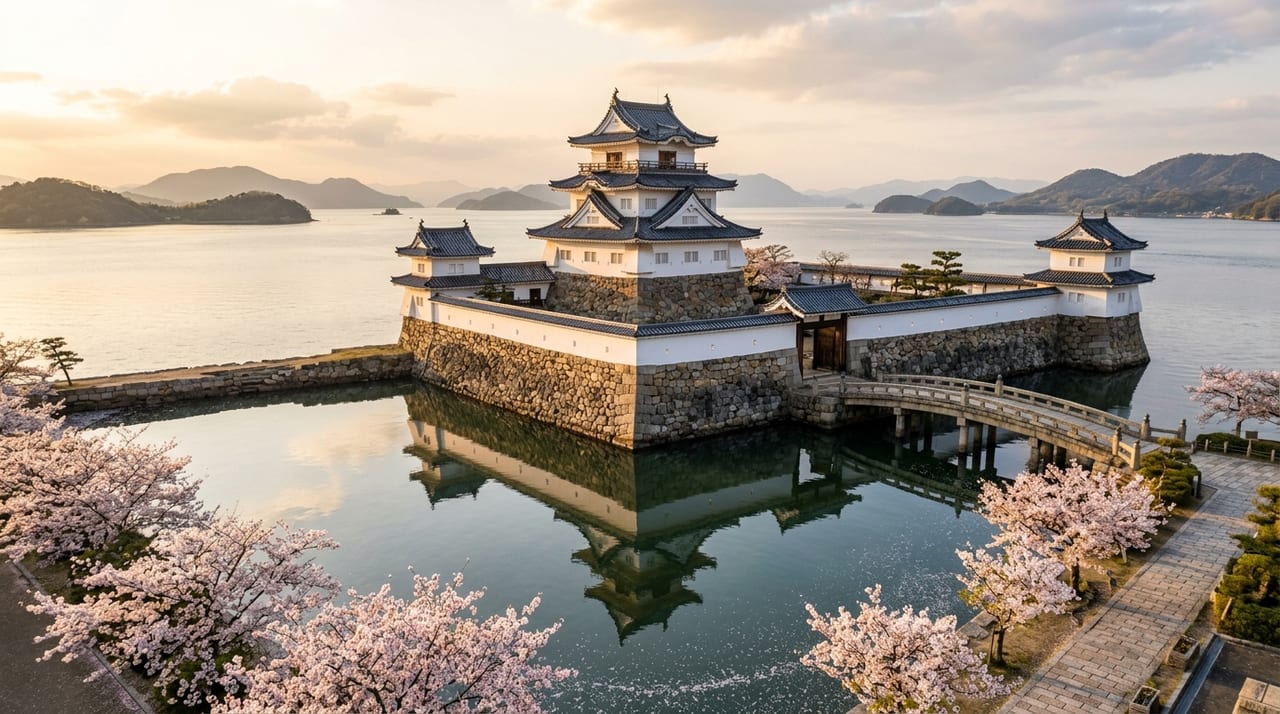
 * Image is for illustrative purposes only.
Takamatsu Castle (Tamamo Castle)
高松城(玉藻城)
Takamatsu Castle (Tamamo Castle) is a historic castle in the Shikoku region (Built in 1588 (Tenshō 16)). Its lord was Ikoma Chikamasa / Matsudaira Yorishige.
Overview
A Castle Floating on the Sea
In 1588 (Tenshō 16), Takamatsu Castle was built by Ikoma Chikamasa, a retainer of Toyotomi Hideyoshi who had been granted Sanuki Province. Known as a "water castle" (mizujiro) with moats that draw seawater directly from the Seto Inland Sea, it is counted, along with Imabari Castle and Nakatsu Castle, among Japan's Three Great Water Castles, making it a renowned fortress. The castle retains surviving structures such as Tsukimi-yagura, Watari-yagura, Mizunote-gomon and Ushitora-yagura. Its unparalleled setting, in which the seawater moats rise and fall with the tides of the Seto Inland Sea, has astonished visitors since ancient times.
A Sea Castle of the Seto Inland Sea
The greatest feature of Takamatsu Castle is that seawater from the Seto Inland Sea is drawn into its moats. In the past, boats could sail directly into the castle grounds, and this defensive system, in which castle and sea formed a single whole, embodied the military thinking of the era, which presupposed the support of naval forces that controlled the sea. After Toyotomi Hideyoshi subjugated Shikoku, Ikoma Chikamasa was granted all of Sanuki Province (later about 170,000 koku) and developed Takamatsu as the base of Sanuki. However, in 1640 (Kan'ei 17), the Ikoma family was transferred to Dewa Province as a result of a family dispute (the Ikoma Disturbance), and Matsudaira Yorishige, grandson of Tokugawa Ieyasu, took up the domain in its place.
The Matsudaira Family and the Takamatsu Domain
Matsudaira Yorishige was born as the eldest son of Tokugawa Yorifusa, the first head of the Mito Tokugawa family, and governed Sanuki as the first lord of the Takamatsu Matsudaira family. Yorishige is known as a lord who excelled in both the literary and martial arts, and he worked to put the domain's administration in order while also devoting himself to promoting culture within the domain. The Takamatsu domain promoted crafts such as Sanuki lacquerware.
The Castle and Its Gardens
At the Takamatsu Castle ruins stands the former Matsudaira family residence known as Hiunkaku, and its garden still conveys the elegance of a daimyo garden. Within the castle ruins park, surviving structures such as Tsukimi-yagura, Mizunote-gomon and Watari-yagura remain, preserving the appearance of the castle in its heyday. Yashima, which spreads to the east of the castle, is renowned as the setting of the Battle of Yashima during the Genpei War in the late Heian period, and the legend of Nasu no Yoichi shooting down the fan target is one of the most famous anecdotes in the history of Japanese archery.
Takamatsu Today
Today the Takamatsu Castle ruins have been developed as Tamamo Park and serve as a place of rest for the citizens of Takamatsu. Visitors are welcomed by the beauty of each season: small boats cruising the seawater moats, cherry blossoms in spring, and autumn foliage. The tenshu platform survives, but the main tower itself has been lost, and research into historical materials such as Edo-period drawings continues in preparation for a wooden reconstruction of the tenshu. Takamatsu, also a hub city of the Setouchi Triennale, attracts many visitors from Japan and abroad as a city with a distinctive appeal that blends contemporary art, history and nature.
Connection to Swords
The beauty of a Japanese sword is completed not only by the forging skill of the smith but also by the advanced craft of the polisher (togishi, sword polisher). The togishi uses several kinds of whetstones to polish the blade through many stages, drawing out to the fullest the beauty of the hamon (tempered edge pattern), the texture of the jihada (steel surface), and the curvature of the blade. In this polishing process, natural whetstones from various regions have been selectively used according to purpose. In the Shikoku and Chūgoku regions, Bizen Province was known as one of the foremost sword-producing areas, and its sword culture influenced surrounding regions as well. Sanuki, which was also the setting of the Genpei War symbolized by the Battle of Yashima, is a land with deep ties to the history of the martial arts.
Highlights
- Seawater Moats (one of Japan's Three Great Water Castles) — Take a boat ride along the moats of this one-of-a-kind sea castle, whose water rises and falls with the tides of the Seto Inland Sea
- Hiunkaku and the Daimyo Garden — The former Matsudaira family residence and a garden designated as a National Place of Scenic Beauty, preserving the essence of Takamatsu's refined culture
- Tsukimi-yagura, Mizunote-gomon and Watari-yagura (Important Cultural Properties) — Surviving castle structures from the Edo period
- Tenshu Platform — Opened to the public after the stone walls were repaired in the Heisei era. Research into historical materials toward a wooden reconstruction of the main tower continues
- Yashima — Site of the Battle of Yashima in the Genpei War, famous for the legend of Nasu no Yoichi and the fan target
* Opening hours and admission fees are subject to change. Please check the official website before visiting.