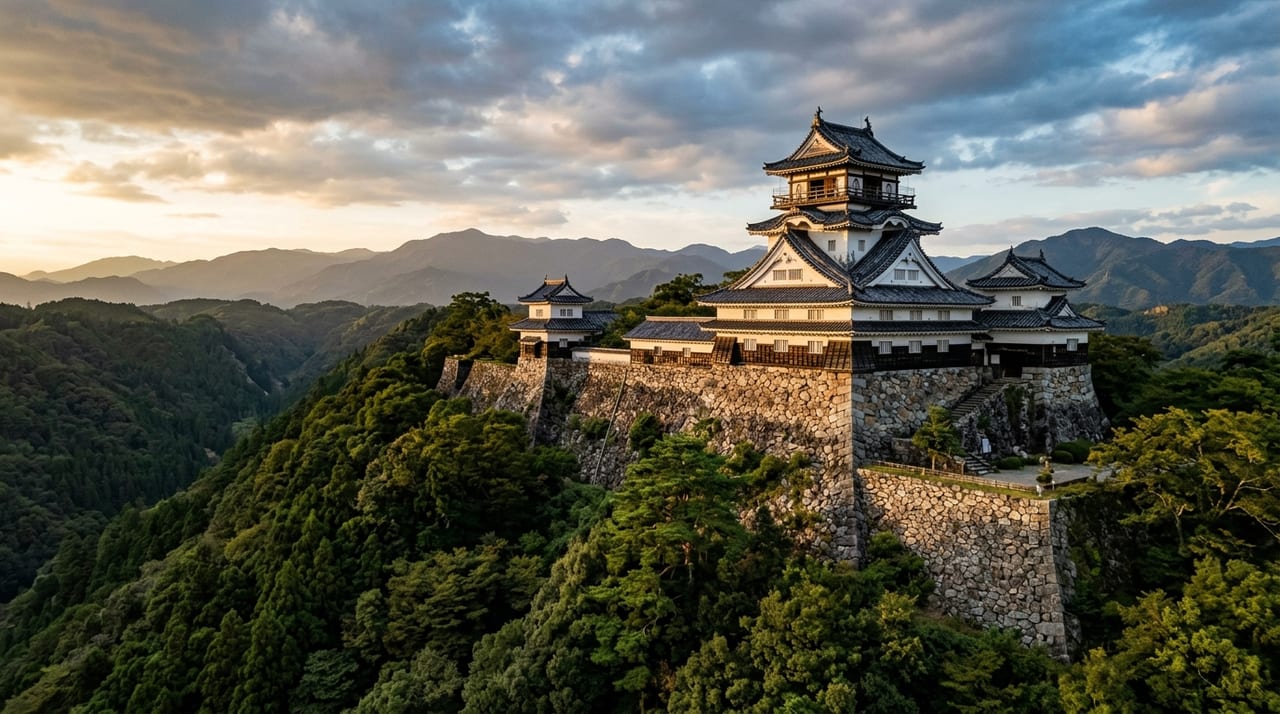
 * Image is for illustrative purposes only.
Okō Castle
岡豊城
Okō Castle is a historic castle in the Shikoku region (From around the Nanboku-chō period through the mid-16th century, when Chōsokabe Motochika expanded and fortified the castle). Its lord was Chōsokabe clan (Chōsokabe Kunichika and Chōsokabe Motochika).
Overview
Okō Castle (Okōjō) is a yamashiro (mountain castle) located in Nankoku, Kōchi Prefecture, and is known as the main castle of the Chōsokabe clan, who unified Shikoku during the Sengoku period. The castle was built on Okōyama, at an elevation of 97 meters on the northwestern edge of the Kachō Plain, and its layout, which makes use of the hilly terrain, is distinctive.
The Chōsokabe were originally minor lords in Tosa, but during the time of Chōsokabe Kunichika they began to extend their power from Okō Castle as their base. His son, Chōsokabe Motochika (1539–1599), was a general of both wisdom and courage who was called 'Tosa no dekibito'. Beginning with his maiden battle, the Battle of Nagahama in Eiroku 3 (1560), in which he defeated the Motoyama clan, he had nearly unified Shikoku by Tenshō 13 (1585). In Tenshō 2 (1574), he expelled Ichijō Kanesada, his overlord, to Bungo and pacified Tosa.
The castle is centered on the tsume (the main enclosure) at its highest point, with the tsume-gedan, ni-no-dan, san-no-dan and yon-no-dan lined up in succession. It is a renkaku-style mountain castle with the den-umayaato kuruwa (the enclosure said to be a stable site) arranged on the western ridge. Large-scale improvements were carried out during the time of Kunichika and Motochika, and defensive features such as stone walls, earthen ramparts and horigiri were installed on each tier. The castle site is now developed adjacent to the Kōchi Prefectural Museum of History, where pottery, ceramics and other artifacts excavated from the site, along with materials related to the Chōsokabe clan, are on display.
Following Toyotomi Hideyoshi's Shikoku campaign (1585), Motochika's domain was reduced to Tosa alone, but he subsequently took part in Hideyoshi's Kyushu conquest, the Odawara campaign, and the Korean invasion. Okō Castle was abandoned in Tenshō 19 (1591), when Motochika moved his seat to Urado Castle. After Motochika's death (1599), the Chōsokabe clan sided with the Western Army at the Battle of Sekigahara and was stripped of its domain.
Connection to Swords
The relationship between Okō Castle and swords lies at the core of the Sengoku warrior culture of the Chōsokabe clan. Chōsokabe Motochika is known for adopting a unique half-farmer, half-warrior system called ichiryō gusoku, through which he organized Tosa's peasants as warriors. Under this system, Tosa's farmers took part in battle equipped with swords and spears alongside their farming tools. A sword was both a weapon and a symbol of samurai status and pride, and for the ichiryō gusoku soldiers the sword was a vessel of the soul.
During the Korean invasion, Chōsokabe Motochika went to the Korean Peninsula under the command of Toyotomi Hideyoshi. At the Chōsokabe exhibition room of the Kōchi Prefectural Museum of History, artifacts excavated from Okō Castle and materials related to the Chōsokabe clan are displayed, allowing visitors to learn concretely about the warrior culture of Tosa during the Sengoku period.
Highlights
- Enclosure ruins of the tsume, ni-no-dan, san-no-dan and yon-no-dan — the layout of the Chōsokabe mountain castle remains
- View from the tsume — a vista over the Kachō Plain
- Kōchi Prefectural Museum of History — systematic display of artifacts excavated from Okō Castle and materials related to the Chōsokabe clan
- Earthen ramparts and horigiri remains — on-site visits where you can experience the defensive engineering of Sengoku mountain castles
- Bronze statue of Chōsokabe Motochika — look up close at the figure of Tosa's hero
* Opening hours and admission fees are subject to change. Please check the official website before visiting.