A Sword Smith's Day: Detailed Explanation of Work Processes from Morning Fire-Building to Evening Finishing
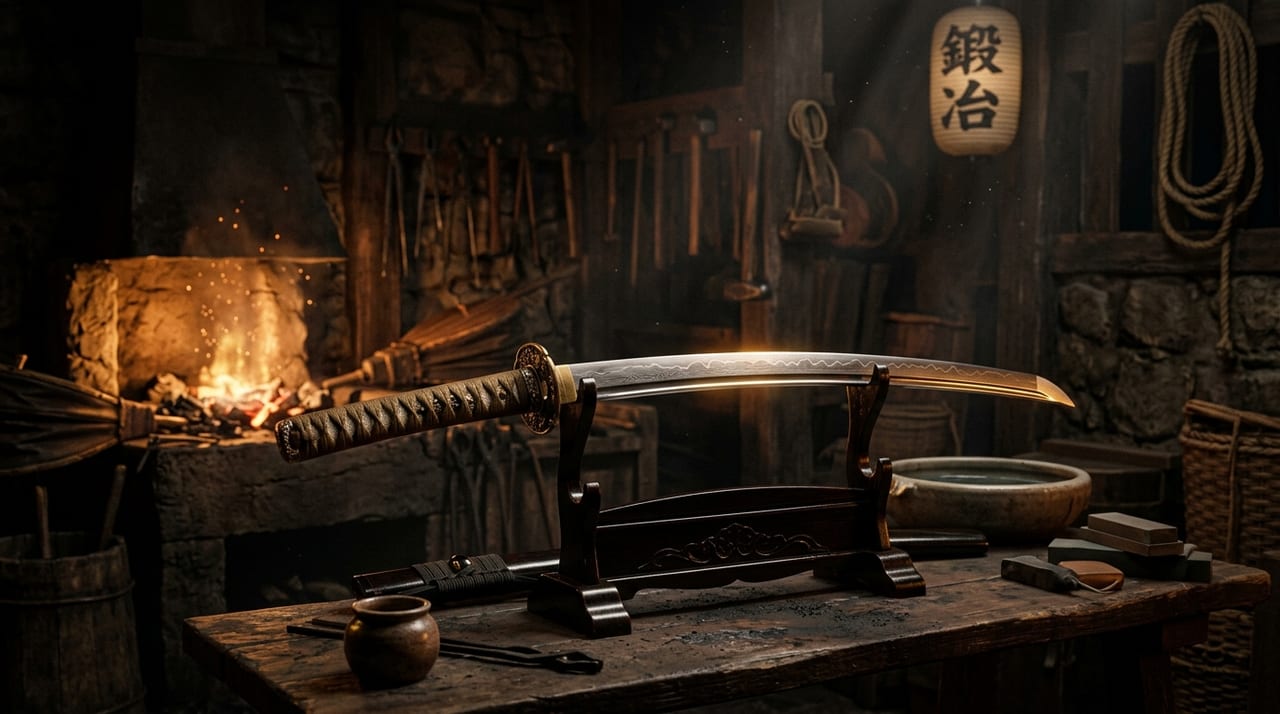 * Image is for illustrative purposes only.
Table of Contents
A Sword Smith's Day: Report from a Modern Smithy
Creating a single Japanese sword takes several weeks to several months. This process consists of daily accumulated work, and each day's tasks are organized according to a highly systematized routine.
This article provides a detailed chronological account of an actual day in the life of a modern sword smith from morning to evening. Modern sword smiths make each sword after receiving production approval for it (Act for Controlling the Possession of Firearms or Swords and Other Such Weapons (e-Gov Law Search), Article 18-2). The Rules on Approval of the Production of Art Swords set no annual cap on the number of swords (Rules on Approval of the Production of Art Swords (e-Gov Law Search)). However, prefectural screening criteria set the number of forging days per sword (15 days or more for tachi, katana, and naginata; 10 days or more for wakizashi, tantō, and the like), so the number that can be made is effectively limited (Aomori Prefecture, "Approval of the Production of Art Swords" screening criteria).
Morning: Furnace Preparation and Fire-Building (5:00-7:00)
Furnace Setup
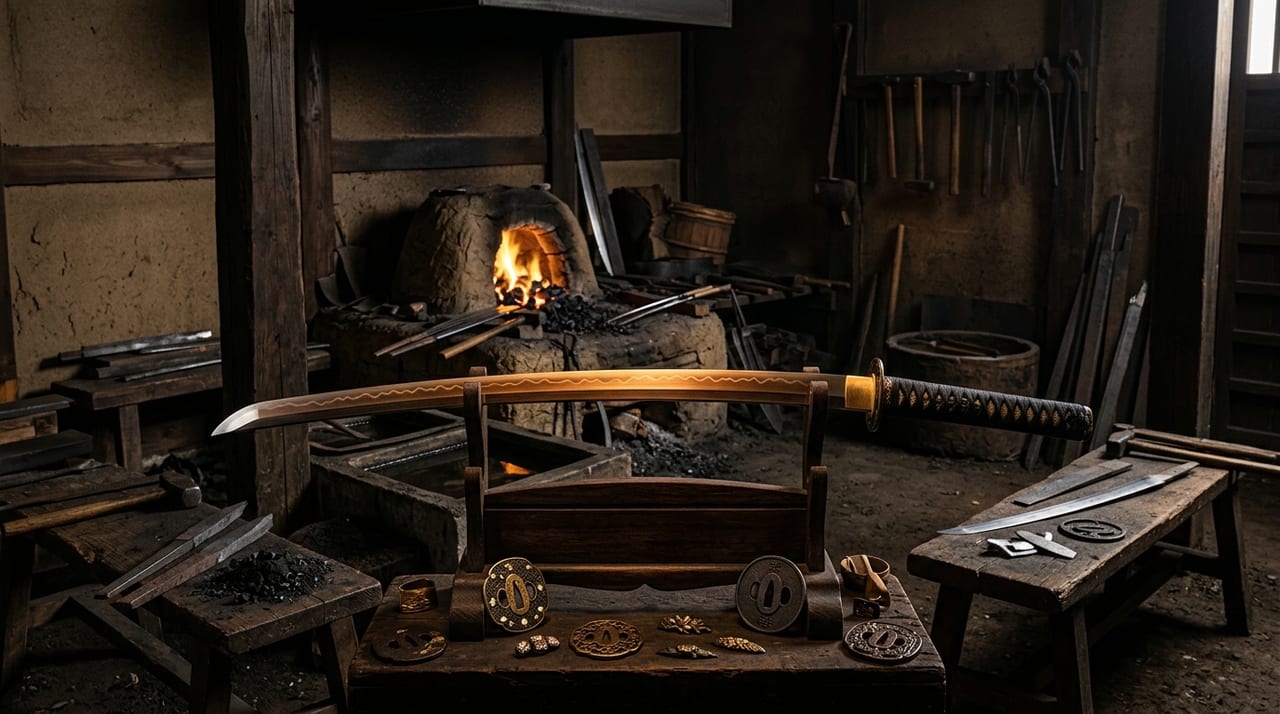
A sword smith's day begins with "furnace preparation" (炉の準備). Modern smithies use forging furnaces fueled primarily by charcoal.
Furnace Types:
- Box Furnace (箱炉): The most common type. A box-shaped furnace filled with charcoal.
- Small Tatara Furnace (たたら炉): Used for primary processing of tamahagane. Modern versions use electric blowers.
- Electric Furnace (補助的): Used supplementarily to assist temperature control during hardening.
Fire-Building Procedure:
- Clear yesterday's ash and clean the furnace bed
- Add fresh charcoal to the furnace (pine charcoal and binchotan are selected based on intended use)
- Ignition: Light from below and gradually raise temperature by directing air from the blower
- Temperature confirmation: Judge temperature by flame color and charcoal condition (white to yellow flames at 1000°C and above)
Time Required: It takes 1-2 hours for the furnace to reach working temperature (1100-1300°C). The smith uses this waiting time to review the previous day's work and mentally organize the day's steps.
Tool Preparation
While the furnace heats, tools are prepared:
| Tool | Purpose |
|---|---|
| Mukoutsuchi (向鎚) (Large Hammer) | A large hammer (3-6kg) swung by the apprentice |
| Tezuchi (手鎚) | A small hammer (0.5-1kg) used by the smith for adjustments |
| Yattoko (鋏) | Long fire tongs for grasping heated steel |
| Various Whetstones | For shaping and edge sharpening |
| Water Buckets | For hardening and cooling |
| Hizumi (樋ゴム) and Anvil (金床) | Forging platform |
Morning: Forging Work (7:00-12:00)
Material Heating
Once the furnace reaches working temperature, the day's tamahagane and steel materials are placed in the furnace for heating. How tamahagane itself is made is summarized in Tamahagane and Tatara Ironmaking.
Heating Guidelines:
- For forging (folding and tempering): 1200-1300°C (orange to yellow)
- For shaping: 1000-1100°C (red to orange)
- For pre-hardening normalization: 850-900°C (dark red)
Sword smiths judge temperature by flame color, heat radiation, and metal color. Temperature gauges are used only supplementarily—this is one aspect of "master craftsmanship." Some modern workshops have begun to use infrared thermometers as a supplementary tool, but the final judgment is still left to the eye and the feel of the skin.
Fold-Forging (Tameshigae)
Tamahagane is refined into uniform steel through "fold-forging" (折り返し鍛錬).
Process:
- Place heated steel on the anvil (金床)
- The smith strikes with a hand hammer while the apprentice strikes with the larger hammer in perfectly coordinated "mutual striking" (相鎚) work
- Fold the steel in half and forge again
- Repeat 8-16 times until the carbon distribution in the steel becomes uniform
The Meaning of "Mutual Striking": The modern Japanese idiom "strike mutual blows together" (相鎚を打つ) meaning to cooperate derives from this work. Perfect teamwork is required, with the apprentice's large hammer strikes precisely matching the rhythm of the smith's hand hammer. The entire process, from fold-forging to the emergence of the blade's shape, is described in detail in From Tamahagane to Finished Sword: The Complete Folded Forging Process.
Shape Formation
The forged steel material is now shaped into a sword form:
- Preliminary Drawing (素延べ): Roughly extend to sword length
- Ridge Formation (鎬立て): Create the ridge line (鎬筋)
- Fire Shaping (火造り): Establish the overall sword form including curvature
Fire shaping requires rapid forming of heated steel, since the material cannot be reshaped once it cools, demanding quick decision-making and work. The smith's power to visualize the sugata at this stage—the ability to shape the hot steel while picturing the finished blade—greatly influences the final form of the sword.
Afternoon: Precision Work and Hardening (13:00-18:00)
Lunch and Rest (12:00-13:00)
Forging is strenuous work, making lunch and rest essential. Most modern sword smiths take about an hour for midday rest to prepare for afternoon work. On hardening days in particular, when mental tension runs high, many smiths eat a light lunch to preserve their concentration.
Hardening Soil Application (刃文土置き)
The most delicate afternoon task is "soil application" (土置き), applying "hardening soil" (焼き入れ土) to the blade to determine the pattern shape before hardening.
Soil Used: "Hardening blade soil" (焼き刃土)—a specialized mixture of clay, whetstone powder, and charcoal powder. Each sword smith compounds their own unique blend, a "secret formula" of sorts.
Soil Application Procedure:
- Cover the entire blade with thin soil (to protect the body)
- Scrape away soil on the edge side according to the desired pattern shape
- Complex patterns (such as clove-bud patterns) require precise differentiated soil application
- Wait several hours for the soil to dry
Hardening (焼き入れ): The Moment of Greatest Tension
The most technically demanding and concentration-intensive task in a sword smith's work is "hardening" (焼き入れ).
Basic Hardening Process:
- Heat the soil-covered blade uniformly in the furnace to 800-900°C
- Remove from furnace and immediately immerse in a hardening tank containing water (or oil)
- A distinctive "shh" sound and steam rise as the blade enters the tank
- Remove the blade and verify the pattern formation
The pattern forms in just these few seconds. The thicker soil-covered areas (spine side) cool slowly, preventing martensitic transformation, while the thinly-covered areas (edge side) undergo rapid cooling, creating martensitic transformation that forms the hard edge pattern. How the choice of quenching liquid changes the finished hamon is explained in Choosing Quenching Liquid for Blade Hardness.
Risk of Failure: If temperature is too high, the blade cracks ("焼き割れ" or hardening crack). If too low, the pattern fails to form. This is the sword smith's crucial moment of truth.
Late Afternoon Post-Processing (17:00-18:00)
After hardening, the blade undergoes "rough polishing" (荒研ぎ) and "curvature correction":
Rough Polishing: Using coarse whetstones to remove soil and oxidation scale, then verify pattern formation Curvature Correction: If the blade has warped during hardening, make fine adjustments using a straightening tool (矯め木)
After the day's work ends, the furnace fire is extinguished, tools are cleaned and stored, and preparations for the next day are confirmed. Many smiths see more in this act of "putting out the fire" than simply ending the work: it is a craftsman's gesture of respect that closes a day spent facing the furnace and the steel. Many workshops also offer prayers before and after lighting the fire; the faith behind this is introduced in Kanayago Kami and Forge Rituals.
The Repetitive Process: Time Required for One Blade
Standard processes and time requirements to complete a single sword:
| Process | Time Required (Approximate) |
|---|---|
| Material Preparation and Forging | 5-7 days |
| Shape Formation (Fire Shaping) | 2-3 days |
| Soil Application and Hardening | 1 day |
| Rough Polishing and Shape Confirmation | 2-3 days |
| Tang Finishing and Signature Engraving | 1-2 days |
| Total (Forging Only) | Approximately 2-3 weeks |
After this, specialized polishers (研師) and handle craftspeople take several more weeks to months for final completion.
Physical and Mental Demands on Sword Smiths
Physical Demands: A day of forging work involves wielding hammers totaling several tons in weight, even for experienced apprentices. Temperature near the furnace can approach 50°C in summer. With the extreme heat of recent summers, the risk of heatstroke inside the workshop is increasingly recognized as a serious issue.
Mental Demands: The concentration required for soil application and hardening is ideally achieved in a state of "no-mind" (無我の境地). A single moment of doubt can render weeks of work worthless. The path from such days of craft to being recognized as a full-fledged smith overlaps with the training and production approval system introduced in the guide to the apprenticeship and training for becoming a swordsmith.
Conclusion: The True Nature of Sword Smithing
A sword smith's day begins with "furnace fire" and ends when that fire is extinguished. Within the repetition of each day lies the accumulation of skill, and only after years to decades of training is one finally recognized as an independent sword smith.
When appreciating a Japanese sword, sensing the "hundreds of hours of skilled labor" contained in that single blade deepens one's appreciation. Take your time choosing a sword while imagining the accumulation of days that went into it.