Restoration Techniques for Broken Swords: The Philosophy of Kintsugi and the Reality of Modern Japanese Sword Restoration
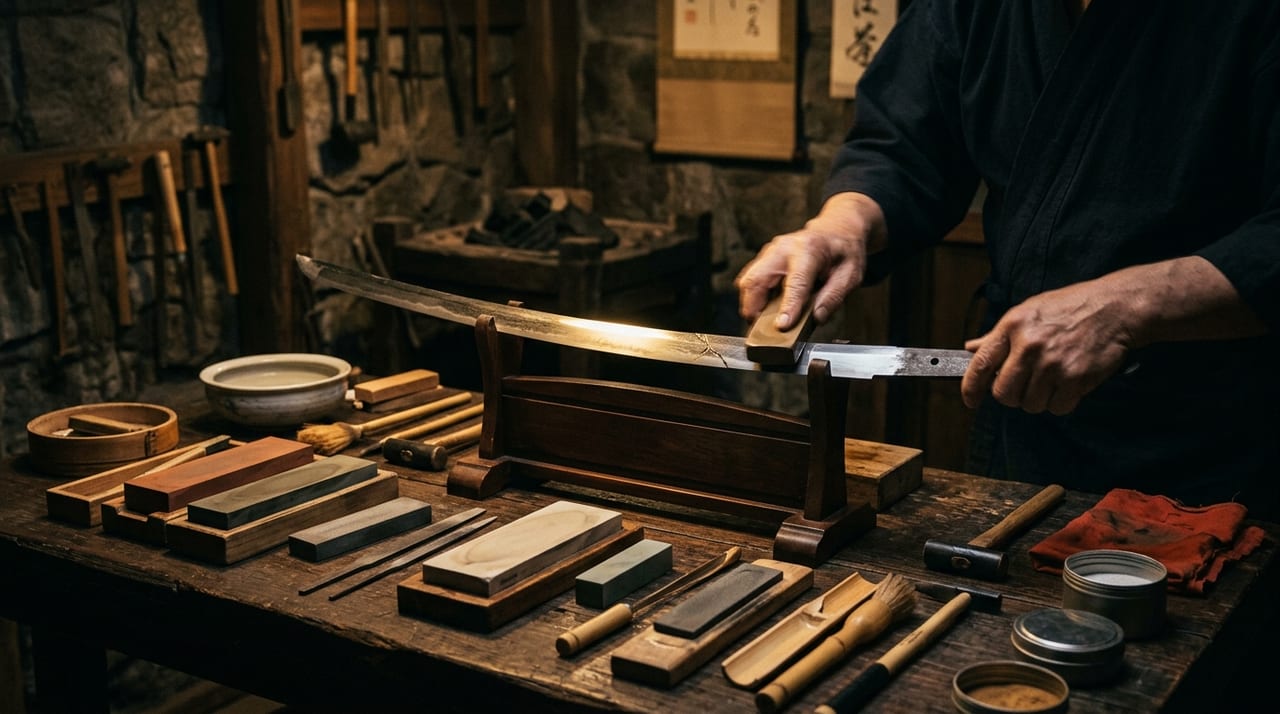 * Image is for illustrative purposes only.
Table of Contents
Broken Swords — Restore or Leave As Is?
A nihontō may break due to disaster, accident, improper storage, or combat (evidence of past use). When faced with a "broken masterpiece sword," the sword owner confronts a difficult choice: "Should it be restored, or preserved in its broken state as evidence?"
This article examines the reality of restoration techniques for broken swords and the criteria for deciding whether to restore them.
Causes of Nihontō Breaking
Technical Causes of Breakage
The main technical causes of a nihontō breaking:
- Failed yaki-ire (quenching) (historical swords): Where the bond between kawagane (jacket steel) and shingane (core steel) is insufficient, stress concentration occurs and the sword becomes prone to breaking
- Metal degradation from rust: Deep rust destroys the steel's crystal grain structure, causing embrittlement
- Age fatigue: Swords repeatedly used in combat become prone to breaking through metal fatigue
- Thermal shock (fire, etc.): Rapid heating and cooling alters and embrittles the blade
- Improper external force: Lateral impact or falling subjects the sword to forces outside its design parameters, causing breakage
Breaking in Combat — As Historical Evidence
Swords used in battle or duels may retain "traces of breakage (kasane-tsugi, re-forging, etc.)." These are important as historical evidence, making the decision of whether to erase them through restoration extremely significant.
Types and Limits of Restoration Techniques
Joint Restoration (Kasane-tsugi)
"Kasane-tsugi," the joining of fragments of a broken blade, is theoretically possible but in practice extremely difficult.
Technical problems:
- If the metal at the fracture surface has degraded, welding or forge welding is difficult
- The joint is highly likely to have lower strength than the original steel
- If yaki-ire (heat treatment) is reapplied, the hamon at the joint changes significantly
- "Traces of restoration (seams)" remain
In practice: "Kasane-tsugi" on a broken sword is technically highly demanding, and even if successful, the value and strength as the original sword are not fully recovered. Many togishi and tōkō "recommend shaped polishing over joint restoration."
Examining the cross-section at the break is an important factor in the restoration decision. If the cross-section is darkened and coarse-grained, this suggests insufficient forging or metal degradation from rust, and the success rate of joint restoration is low. If, on the other hand, the cross-section is silvery-white and fine-grained, the steel quality is good, and there is room to attempt "tsugi-tatae" — a process in which the fracture surfaces are forge-welded at high heat, the structure is homogenized by hammering, and yaki-ire is applied again. However, it should be noted that reapplying yaki-ire significantly transforms the hamon at the joint, inevitably lowering the assessment of the sword as a work of art.
Shaped Polishing (Shortened Finish)
This method "cuts away" the broken portion and shapes and polishes the remaining blade to finish it as a "shorter sword."
Specific process:
- Confirm the broken fragments
- Shape a "new kissaki (point)" at an appropriate length from the base of the break
- Shape and finish the kissaki form (ko-kissaki, chu-kissaki, etc.)
- Polish the whole blade to bring out the hamon
- Adjust the length of the nakago (tang) and address the mei (signature)
Result: The sword becomes shorter than the original nagasa (blade length) but is restored to a functional state. There are cases where "a uchigatana becomes a wakizashi" or "a wakizashi becomes a tantō."
Impact on value: Since the nagasa changes, the alignment with the original appraised value and registration certificate must be confirmed and updated.
Restoration of Chips (Ha-kobore)
Ha-kobore (chipping of the edge) is a less severe form of damage than a break and has a high potential for restoration:
Small chips (approximately 1–3 mm): Can be shaped and removed by polishing. The nagasa is slightly reduced but the visual impact is minor.
Large chips (5 mm or more): Shaping by polishing involves a significant reduction in nagasa. Depending on the depth and location of the chip, it may also be rational to choose to preserve the sword with the chip remaining.
"The Aesthetics of a Broken Sword" — Resonance with Kintsugi
The Philosophy of Kintsugi
Kintsugi, the Japanese ceramic restoration technique, joins the fragments of broken pottery with gold and silver, making the cracks stand out as beautiful rather than concealing them. Its core philosophy is that "the history of breakage is also part of the beauty."
Application to Nihontō — "Preserving the Evidence of Breakage"
Applying the kintsugi philosophy to nihontō gives rise to the idea of "preserving and displaying the fragments of a broken sword as they are, so that the sword bears witness to its own historical trace."
In practice, there are cases in museums and art galleries both in Japan and abroad where fragments of broken blades are displayed as "evidence of a famous sword broken in battle." The perspective is that the broken state itself, rather than restoring the sword to a "complete form," constitutes historical testimony.
Which to Choose — Decision Criteria
Criteria for deciding restoration vs. preservation in the broken state:
| Factor | When choosing restoration | When choosing preservation |
|---|---|---|
| Sword value | Restoration cost is justified by the value | Restoration cost exceeds the appraised value |
| Historical evidence | Cause of breakage unknown; low preservation value | Connection to battle or famous incident is proven |
| Purpose of use | Actual use in iai or martial arts desired | Appreciation or collection only |
| Sentimental value | Keepsake from the deceased; "want to preserve in complete form" | Acceptable in broken state |
Estimated Restoration Costs
Estimated costs for restoring a broken sword (approximate):
| Type of restoration | Estimated cost |
|---|---|
| Chip shaping (small; polishing only) | 50,000–150,000 yen |
| Chip shaping (large; new kissaki forged) | 200,000–500,000 yen |
| Break (cutoff + shaped polishing) | 300,000–800,000 yen or more |
| Joint restoration (kasane-tsugi) | 500,000–1,500,000 yen or more (no guarantee of success) |
It is strongly recommended to obtain estimates and assessments from multiple togishi and tōkō before restoration.
After restoration, it is strongly recommended to apply for re-appraisal with NBTHK (Society for the Preservation of Japanese Art Swords) or the Nihon Tōken Hozonkai. The kanteisho (appraisal certificate) issued before restoration loses its validity because measurements such as nagasa, motohaba, and kasane have changed; the new kanteisho will state that the sword has been restored and list the post-restoration specifications. Proceeding in parallel with updating the alignment with the registration certificate allows the documents to function as supporting materials at the time of sale, inheritance, or insurance valuation.
Conclusion — What a Broken Sword Teaches
A broken nihontō is not a "failed work." It is evidence that the sword actually received some kind of force and functioned as part of history.
Whether restoring it or preserving it broken, "facing a broken sword" makes one feel anew the depth of sword culture. The Japanese aesthetic sense of "the beauty of broken things" — it lives in the world of nihontō just as it does in kintsugi.