Quality Comparison Between Showa-Era Military Swords and Traditional Japanese Swords: How to Distinguish Machine-Made from Hand-Forged
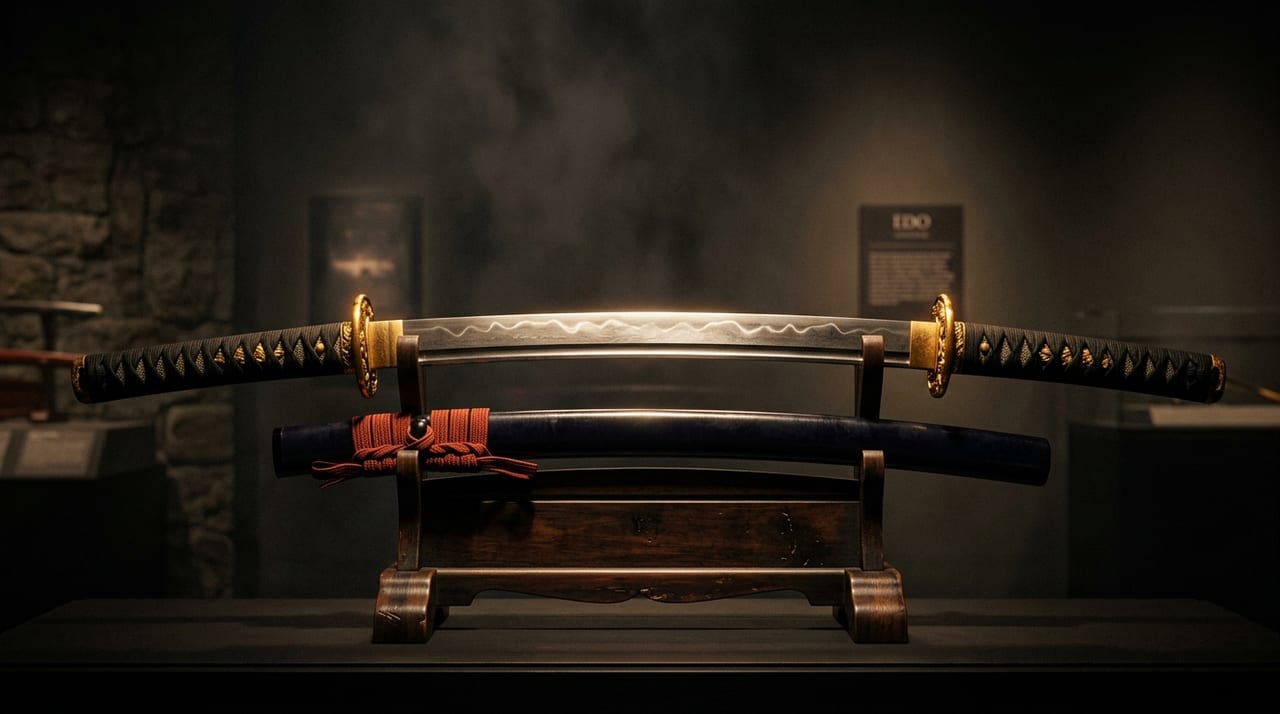 * Image is for illustrative purposes only.
Table of Contents
Showa Military Swords: The "Mass-Produced Swords" Born from War
During Showa's wartime period (1930–1945), the Japanese military issued swords in large quantities to officers and non-commissioned officers. These "military swords (guntō)" could not meet the enormous demand through traditional hand-forging methods alone, so an industrial mass-production system was rapidly established.
This created a situation in the Showa era where two types of "swords" coexisted:
- "Showa swords (shōwa-tō)" (machine-forged, mass-produced): Military swords produced by factory machinery. Quality was uniform, but both manufacturing methods and materials differed significantly from traditional swords.
- "Jūmei swords (jūmei-tō)" and some officer's swords (traditionally hand-forged): Swords forged using traditional methods by army-approved "jūmei sword smiths."
This article explains the manufacturing method differences between the two and provides concrete ways to distinguish them when examining actual examples.
Representative examples of military sword types include the Type 98 Military Sword (adopted in 1938) and the Type 3 Military Sword (adopted in 1943). After the outbreak of the Second Sino-Japanese War (1937), demand surged, creating supply pressure for tens of thousands of swords per month that traditional hand-forging alone could never meet. This supply-demand gap decisively accelerated the shift toward industrial production systems.
Manufacturing Methods and Characteristics of Showa Swords (Machine-Forged)
Manufacturing Process
Showa sword production mainly followed these steps:
- Industrial sourcing of steel: Used industrial steel materials (such as electric furnace steel) rather than tamahagane.
- Machine forging: Formed the blade shape using industrial presses and hammers.
- Mass heat-treating: Uniform heating in electric furnaces followed by water quenching.
- Machine polishing: Finishing using grinding machines.
Optimized for maximum productivity, this process allowed production of thousands of swords per month.
Visual Characteristics of Showa Swords
Blade pattern too uniform: As a result of mechanically uniform heat-treating, blade patterns tend to show regular patterns such as "evenly-spaced gunome." The natural variations and irregularities seen in traditional swords are almost entirely absent.
Dark steel with no figuration: Because industrial steel was used, the steel surface lacks decorative patterns known as "chikei and kinsuji." It presents a dark, flat appearance, and the difference from the traditional sword's "lively steel" is obvious to the naked eye.
No traces of folding and forging: In traditional swords, repeated folding and forging produces a wood-grain pattern called "hada" on the steel surface. Showa swords made from industrial steel lack this, and the surface appears uniformly gray.
Mechanically uniform ridge line: The ridge line produced by machine polishing has an artificial straightness, lacking the natural flow felt in hand-forged swords.
Characteristics of Hand-Forged Military Swords—Comparison with Traditional Swords
Some officers commissioned "jūmei sword smiths," who were army-approved, to custom-forge hand-forged military swords using traditional methods. Such swords conformed to traditional swords in both materials and process.
Use of tamahagane: Most jūmei sword smiths used tamahagane or equivalent high-quality steel.
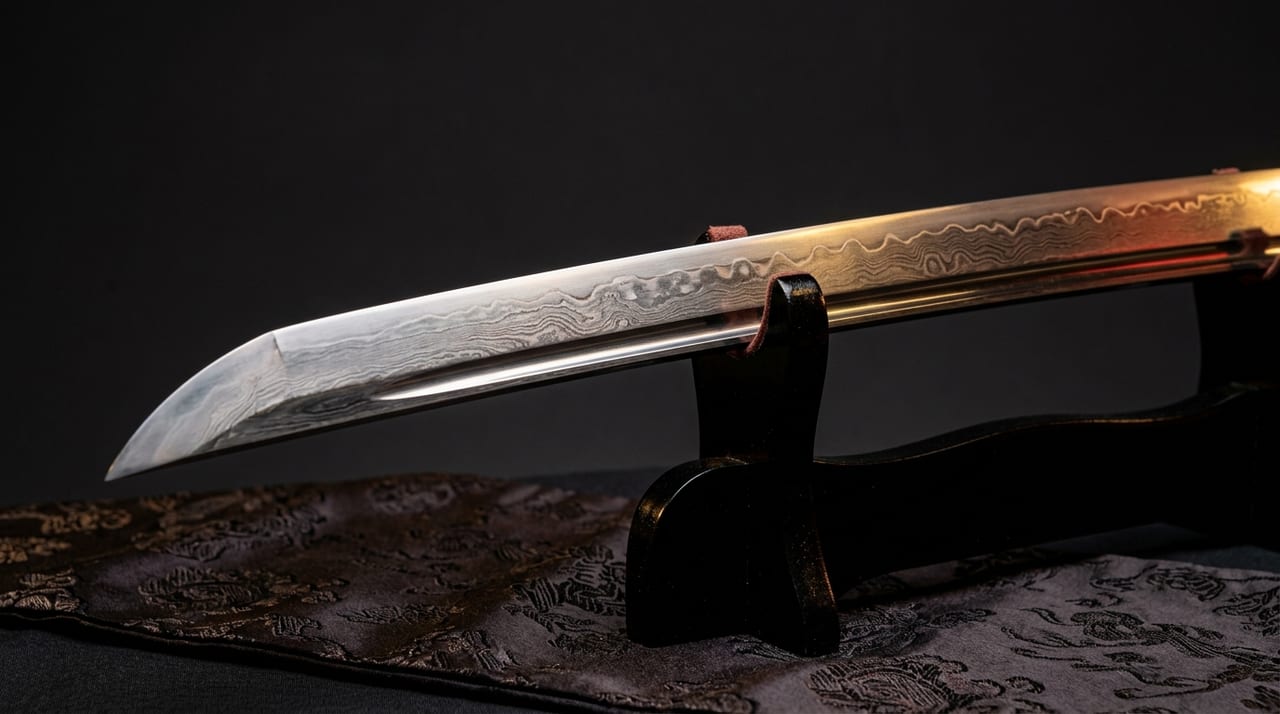
Traces of folding and forging: "Hada" patterns such as itame and masame clearly appear on the steel surface.
Natural variation in blade patterns: Blade patterns created by traditional clay application and heat-treating have a "living expression" unrelated to mechanical uniformity.
Bright steel: The combination of repeated folding and high-quality steel makes the surface shine brightly, where decorative patterns such as chikei and kinsuji are observable.
It should be noted that sword smiths such as Gassan Sadakazu II, Miyairi Yukihira, and Sumitani Masamine are known as representative figures who maintained traditional manufacturing methods even during this wartime period. Their work is still evaluated today as the pinnacle of modern sword-making, demonstrating how the jūmei sword smith system supported the continuity of traditional techniques.
Concrete Identification Methods—Practical Checklist
Here are the identification points to consider when examining actual swords.
Check 1: Steel Surface Figuration
Traditional swords and hand-forged military swords: Wood-grain patterns (hada) such as itame and masame are visible. When light is applied, decorative patterns flow, creating an impression of being "alive."
Showa swords (machine-made): The steel surface is uniformly dark. There are no wood-grain patterns, and no changes appear on the surface even when light is applied.
Check 2: "Naturalness" of Blade Pattern
Traditional swords and hand-forged military swords: The blade pattern has variation and individuality. Even within the same blade pattern, subtle differences exist in different sections, creating a sense of vitality.
Showa swords (machine-made): The blade pattern is mechanically uniform. Evenly-spaced gunome patterns and simple straight blades are common, with little variation.
Check 3: "Flow" of Ridge Line
Traditional swords and hand-forged military swords: The ridge line naturally curves from hilt to point. Rather than a perfect straight line, it has an organic flow.
Showa swords (machine-made): The artificial straightness from machine polishing is prominent.
Check 4: Bōshi (Blade Pattern at the Point)
Traditional swords and hand-forged military swords: The bōshi is beautifully formed, with the return properly finished.
Showa swords (machine-made): The bōshi often appears overly simple or is roughly finished.
Check 5: Tang Inscription and Finish
Traditional swords and hand-forged military swords: Hand-carved inscriptions show the smith's individuality. Rust develops naturally, suggesting age.
Showa swords (machine-made): Inscriptions are mechanical or stamp-like. When stamps such as "Army Jūmei" or "Navy" are present, they serve as important clues suggesting hand-forging.
Historical Value and Market Evaluation of Showa Swords
While Showa swords have low value as traditional art objects, they possess unique value as "historical artifacts of the Pacific War." Demand from American and European military history collectors remains strong, and certain pieces—those with specific unit marks, signatures of famous officers, or special designs—sometimes command premium prices.
Market Price Guide:
- General Showa swords: ¥30,000–¥100,000
- Owned by specific famous officers or special designs: ¥150,000–¥500,000
- Hand-forged jūmei swords (good condition): ¥300,000–¥1,200,000
Prices fluctuate depending on supply and demand and the sword's condition, so please treat these as rough guidelines only.
For practical authentication and quality assessment, a certification from the Society for the Preservation of Japanese Art Swords (NBTHK) is an important indicator. Established in 1948, the association issues four-tier certificates: "Exceptionally Important Sword," "Important Sword," "Specially Preserved Sword," and "Preserved Sword." As a rule, Showa swords fall outside the scope of evaluation for "Preserved Sword" and higher categories. It is important to understand that the presence or absence of a certificate significantly affects an item's value as an art object.
Conclusion—Evaluating Showa Swords Correctly
Showa swords are often discussed alongside traditional Japanese swords, but they are fundamentally different categories in terms of manufacturing methods, purpose, and evaluation criteria.
The assessment that "Showa swords have no value because they are Showa swords" is too one-sided. As historical evidence of war and as a record of Japan's modern industrialization, Showa swords have their own unique significance. On the other hand, one should avoid confusing "Showa swords = traditional Japanese swords" and paying high prices as art objects.
The first step toward proper evaluation is to clarify what one is seeking—art objects, historical artifacts, or collector's items—and to position Showa swords accordingly.