Anatomy of Shinogi-zukuri: What the Balance of Shinogi-ji, Shinogi-suji, and Kissaki Tells Us About Aesthetic Sensibility Across the Ages
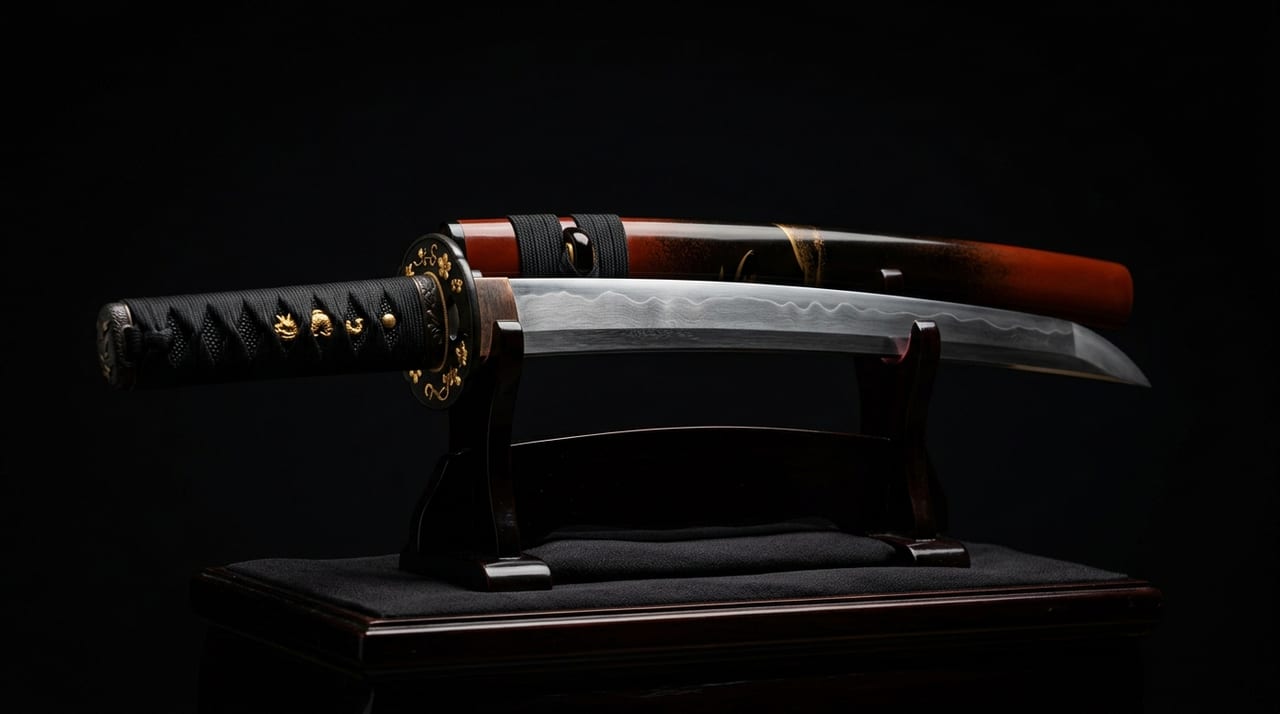
 * Image is for illustrative purposes only.
Table of Contents
What Is Shinogi-zukuri — The "Standard" of the Japanese Sword
There are multiple cross-sectional shapes (construction styles) for Japanese swords, but the most widespread "standard" among them is shinogi-zukuri. The vast majority of Japanese swords (uchigatana, tachi, wakizashi) that have been handed down to the present day employ shinogi-zukuri, and when people speak of "the cross-section of a Japanese sword," this shape is most commonly what they mean.
The defining feature of shinogi-zukuri is the ridge line known as the shinogi-suji. This ridge line divides the blade's cross-section into the "ji side" and the "shinogi-ji side," enabling the blade to function simultaneously as a cutting instrument and as an object of artistic expression. The position, angle, and smoothness of the shinogi-suji govern the overall impression of the entire sword and serve as an important basis for judgement in appraisal.
The Cross-Sectional Structure of Shinogi-zukuri — Names and Roles of Each Part
The cross-section of a shinogi-zukuri sword has the following parts:
Mune (Back of the Blade)
The part corresponding to the back of the sword. There are multiple shapes, including iori-mune (ridged back), maru-mune (rounded back), kaku-mune (squared back), and mitsu-mune. The shape of the mune reflects the character of the period and school and serves as a supplementary clue in appraisal.
Shinogi-ji
The flat surface running from the mune to the shinogi-suji. It occupies the upper half of the sword's "width." Polished to a white sheen by the togishi, it is an important surface for appreciation on which the jigane's chikei and kinsuji can be observed.
Shinogi-suji
The highest ridge line in the blade's cross-section. It marks the boundary between the shinogi-ji and the ji. The position of this ridge line — closer to the mune or closer to the ha — greatly influences the aesthetic balance of the sword. It is ideal for the ridge line to describe a single smooth flow from the base to the kissaki; any distortion or step indicates a problem in forging or polishing.
Looking more closely at the three-dimensional characteristics of the shinogi-suji, there are two measurable indices: "shinogi-taka" (shinogi height) and "shinogi-haba" (shinogi width). Shinogi-taka refers to the height by which the ridge line projects above the blade surface (hira-ji), while shinogi-haba refers to the distance from the shinogi-suji to the mune — that is, the width of the shinogi-ji. The higher the shinogi-taka, the more pronounced the three-dimensional quality of the ridge line, giving the blade a powerful impression. The wider the shinogi-haba, the greater the surface area of the shinogi-ji, allowing for richer observation of the jigane's activity. Swords of the Yamato-den tend toward a "combat-oriented" style with high shinogi-taka and narrow width, while swords of the Yamashiro-den are said to exhibit a moderate shinogi-taka and an aristocratic elegance.
Ji
The gently sloping surface running from the shinogi-suji to the ha (cutting edge). It is the part where the jigane (steel of the blade surface) appears most beautifully, and appreciating the jihada (grain pattern of the steel) — whether itame, masame, mokume, or other patterns — is one of the great pleasures of studying Japanese swords. The "activities" (hataraki) of chikei and kinsuji are observed here.
Ha (Edge) and Hazakai (Edge Boundary)
The portion of the blade hardened by yaki-ire (quenching) and its boundary (hazakai, the place where the hamon is formed). Reading the texture of the hamon — the nie (visible martensite crystals), the nioi (fine martensite mist), and so on — requires a sufficient light source and a loupe.
Shinogi Position and Kasane — A Design Choice
The "position (height)" of the shinogi and the "kasane (blade thickness)" of the blade are closely related design parameters.
A sword where the shinogi is closer to the ha: The ji is wide. The hamon can develop more expansively. Decorative value is high. A sword where the shinogi is closer to the mune: The shinogi-ji is wide. The rigidity of the sword increases. More practical. Thick kasane: High strength. Heavier. Superior cutting power. Thin kasane: Light. Allows quick handling. Higher risk of chipping.
The tōkō designs these parameters comprehensively according to the intended use specified by the client (combat, ceremony, or appreciation). Even within the work of the same tōkō, the balance may differ depending on the patron's requirements.
Changes in Shinogi-zukuri by Period — Reading the Shifts in Aesthetic Sensibility
Late Heian to Kamakura Period (The Age of the Tachi)
Characteristics of swords (tachi) from this period:
- Shinogi positioned relatively close to the mune: A design suited to slashing from horseback
- Wide shinogi-ji: A powerful impression. The activity of the jigane is relatively simple
- Koshi-zori: The sori (curvature) is concentrated toward the base (koshi) of the sword
- Inokubi-kissaki: A small, compact kissaki. A robust impression
Points for appreciation: Tachi of the Kamakura period are characterized by a powerful form that conveys "resolute martial authority." The shinogi-ji is wide and the overall form of the sword is well-proportioned. Many tachi designated as kokuhō (National Treasure) or jūyō bunkazai (Important Cultural Property) date from this period; they are the "ideal Japanese sword" that served as a model for tōkō of later generations.
Nanbokuchō Period (The Age of the Ōdachi and Long Swords)
In response to intense combat demands:
- The rise of the ōdachi and nodachi: The nagasa (blade length) expanded, and the forms became imposing, with the balance of shinogi-zukuri disrupted
- Wide ha width: The ji surface was made expansive, allowing large-scale chōji-midare hamon to develop
- Shallow sori: The sori became shallower in response to foot combat
- Ō-kissaki: A grand form with a large, elongated kissaki
Muromachi and Sengoku Periods (The Transition to the Uchigatana)
A transition occurred from the tachi to the uchigatana (worn edge-upward at the waist):
- Change in sori: Saki-zori or naka-zori became mainstream
- A tendency for the shinogi-suji to shift closer to the ha: The ji was made wide to secure more surface area for the development of the hamon
- Kissaki became medium-sized: The inokubi-kissaki gave way to the naka-kissaki as standard
The Sengoku period also saw demand for mass production, and it was a time when the precision of shinogi-zukuri varied. On the other hand, masterworks by skilled smiths maintained a consistently high standard.
Edo Period (The Refinement of Shintō and Shinshintō)
As combat opportunities decreased and swords came to be valued as works of art and symbols of status:
Shintō period (Keichō to Jōkyō):
- Shallow sori ("shintō with shallow sori")
- Extended kissaki (the fashion for ō-kissaki)
- A bold style with wide ha width
Shinshintō period (Tenmei to Bakumatsu):
- Many swords were copies (utsushi) of kotō (Kamakura and Nanbokuchō)
- Revival of koshi-zori and ko-kissaki in imitation of Kamakura tachi
- The width of the shinogi-ji was designed with greater precision
Gendaitō (Shōwa to Reiwa)
Tōkō designated as Living National Treasures or Holders of Important Intangible Cultural Properties study and carry on the styles of each period:
- Kotō utsushi: Faithfully reproducing the shinogi position and kasane of specific masterworks as models
- Personal interpretation: Swords with a "contemporary style" in which modern tōkō design the balance of the shinogi according to their own aesthetic sensibility
Gendaitō are evaluated at new sword exhibitions (shinsaku meitō-ten) and similar events, where the precision of shinogi-zukuri is also a subject of assessment.
The Shape of the Kissaki and Its Historical Changes
The kissaki is a crucial element that can be called the "face" of a shinogi-zukuri sword. The approximate period of production can be estimated from the shape of the kissaki alone.
| Type of Kissaki | Characteristics | Principal Period |
|---|---|---|
| Inokubi-kissaki | Small and compact. Robust | Mid-Kamakura period |
| Naka-kissaki | Standard size | Muromachi to present (most common) |
| Ō-kissaki (Enbun style) | Large and elongated | Nanbokuchō, Edo Shintō |
| Ko-kissaki | Slender and refined | Heian, early Kamakura, Shinshintō utsushi |
Practical Appreciation — Points for a Deep Reading of Shinogi-zukuri
Specific checkpoints when appreciating a shinogi-zukuri sword:
- Flow of the shinogi-suji: Does it flow as a single smooth line from the base to the kissaki? Any distortion or step indicates a problem in forging
- Polishing of the shinogi-ji: The shinogi-ji, polished to a white sheen, is an important surface that reveals the activity of the jigane. Are there any scratches or uneven polishing?
- Jigane of the ji surface: Does a beautiful jihada — itame, masame, or similar patterns — appear on the "ji" surface running from the shinogi-suji to the hamon?
- Proportion of the kissaki: Is the kissaki balanced with the overall blade? Too large or too small produces an unbalanced impression
- Naturalness of the sori: Does the sori describe a natural arc from the base toward the kissaki? Are there any signs of unnatural correction?
6. Position of the hi (groove): Grooves such as bō-hi, niju-hi, goma-hi, koshi-hi, and soe-hi are invariably placed on the shinogi-ji. This is because the shinogi-ji is the only surface on the blade where carving can be applied without compromising strength. The finishing of the groove ends (kaki-nagashi, kaki-tōshi) is also a point of appreciation, and the careful work of the togishi is evaluated in unity with the beauty of the ridge line.
The Go-den and the Individuality of the Shinogi — Differing Ridge Lines by School
The Go-ka-den (the five traditions of Yamashiro, Bizen, Yamato, Sōshū, and Mino) each possess their own distinctive shinogi character. The Yamashiro-den is characterized by a slender form, moderate shinogi-taka, and aristocratic elegance; the Bizen-den is known for a gentle, stable ridge line, with the clear shinogi-suji of the Osafune school being particularly celebrated. The Yamato-den features a combat-oriented construction with high shinogi-taka and narrow width, while the Sōshū-den — exemplified by Masamune — is distinguished by a powerful and dynamic, bold construction. The Mino Tradition has a moderate shinogi-taka, balancing practicality and beauty in response to the mass production demands of the Sengoku period. By keeping these school-by-school differences in mind, it becomes possible to make a rough estimate of the tradition from the shinogi-suji alone.
Conclusion — Shinogi-zukuri Is the "Grammar" of the Japanese Sword
Shinogi-zukuri is the most fundamental "grammar" in the crafting of the Japanese sword. The seemingly small variables — the position of the shinogi-suji, the width of the shinogi-ji, and the size of the kissaki — determine the overall impression and period character of the sword.
By understanding this "grammar," one cultivates the "eye for appreciation" that allows one to read from a single sword its period of production, region of origin, and the technical skill of the tōkō. Understanding shinogi-zukuri is both the gateway to and the heart of appreciating Japanese swords. Tracing the changes in shinogi-zukuri through the ages is also to follow the history of Japan's warrior culture and aesthetic sensibility.