Balance and Center of Gravity of the Nihontō: Grip and Its Effects on the Body in Iai and Battōjutsu
 * Image is for illustrative purposes only.
Table of Contents
What Is the Balance of a Nihontō?
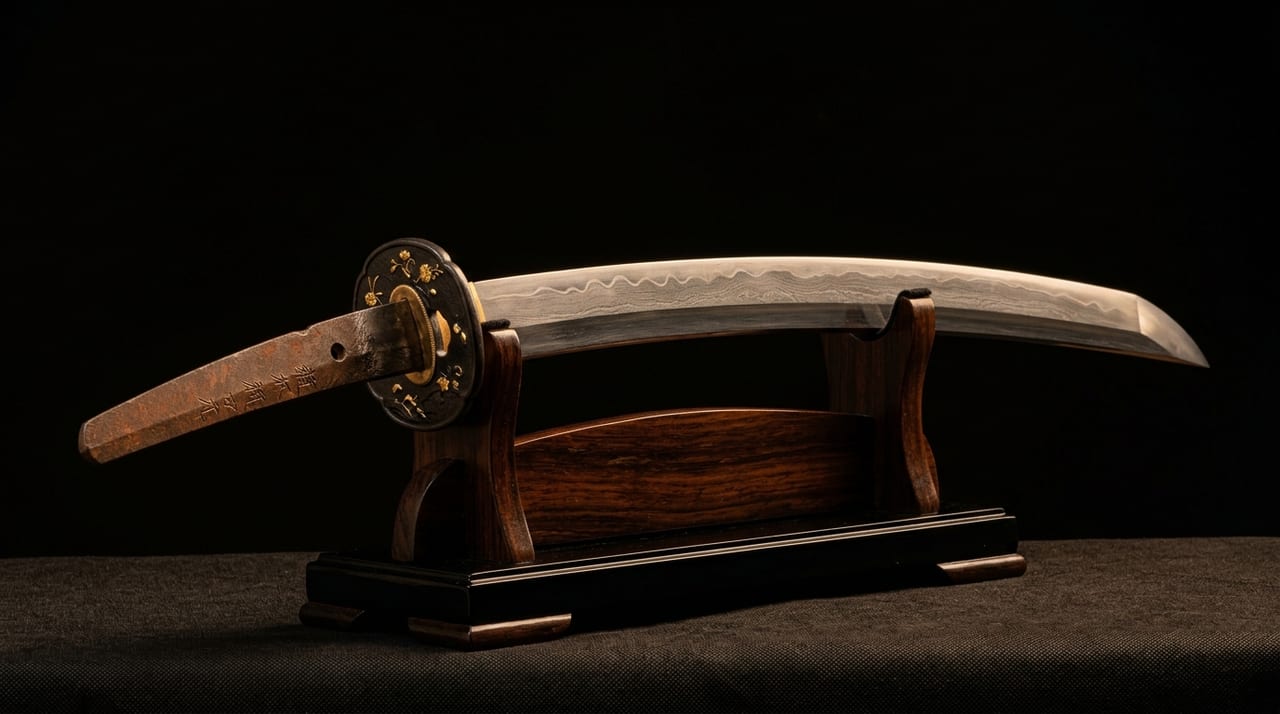
The nihontō has its own inherent "center of gravity," and how far that point lies from the tsuka (hilt) greatly affects the feel, speed, and accumulation of fatigue when swinging it. Most swords have their center of gravity at a point roughly 10 to 20 centimeters along the blade from the tsuba (hand guard), and this position governs how cleanly the hasuji tracks and how much natural acceleration is felt on the downswing.
Those learning iai or battōjutsu tend to focus solely on weight when selecting a sword, but in practice it is said that the position of the center of gravity has a greater impact on how manageable the sword is. Even among swords of the same 900 grams, the handling feels entirely different depending on whether the center of gravity is close to the tsuba or toward the kissaki (tip). This is the result of a comprehensive design that encompasses the construction of the blade, the sori (curvature), the difference between the motohaba and sakihaba, and even the position of the mekugi hole and the weight distribution of the nakago (tang) — an expression of the refined craftsmanship of nihontō making.
Sword Weight and Center of Gravity: Reading Usability from the Numbers
The approximate weight varies by type of sword.
| Type of Sword | Approximate Weight |
|---|---|
| Uchigatana | 600–900 grams |
| Iaito (practice sword) | 500–700 grams is the mainstream range (some practitioners choose 750 grams or more in order to train with a feel closer to a live blade) |
| Edo-period combat sword | Around 800–1,000 grams |
Edo-period combat swords were generally heavier than modern iai practice swords.
The feel of handling also changes greatly depending on the position of the center of gravity.
| Center of Gravity Position | Characteristics | Suited Training | Notes |
|---|---|---|---|
| Toward the tsuba (hand-side) | Feels light when held, suited to quick manipulation | Combination techniques, fast draw, precise hasuji manipulation | The "drop" sensation on the downswing is lacking, and for large cutting motions one may feel something is missing |
| Toward the kissaki (tip-side) | Natural acceleration is generated on the downswing, and the full weight of the sword can be firmly felt | Kata practice and single-strike kata training | The burden on the arms and shoulders increases, so fatigue sets in easily during prolonged training sessions |
Note that even swords of the same blade length will have different center of gravity positions depending on the depth of the sori (curvature). A sword with deep sori tends to have a thinner kasane (blade thickness) at the tip, while a sword with shallow sori or a construction close to a straight blade tends to have its center of gravity closer to the hand. Keeping the relationship between these blade shapes in mind when selecting a sword leads to more accurate judgment.
The Basics of Grip: The Meaning of Tightening the Pinky and Ring Fingers
The way of gripping a nihontō is unique even among martial arts. The foundation lies in a graduated application of force.
- Pinky and ring fingers: tighten
- Middle finger: moderate force
- Index finger and thumb: merely rest against
This is not merely a matter of school-to-school variation; it is based on a rational reason rooted in the structure of the body.
The reason for gripping primarily with the pinky and ring fingers is that the muscle groups close to the forearm's rotational muscles (pronation and supination) come into play, enabling force to be transmitted without disturbing the hasuji. When force enters the index finger and thumb, the wrist locks up, and the hasuji is said to become prone to deviation. Especially at the moment of drawing, smoothly executing sayabashiri requires not "gripping" the tsuka but rather a sense of "resting against" it — and the ability to alternate between this relaxation and tightening is one of the cores of iai technique.
The positional relationship of both hands is also indispensable.
- Right hand (front hand): placed at the upper portion of the tsuka, one fist's width from the tsuba
- Left hand (rear hand): placed near the kashira (pommel)
Maintaining an appropriate spacing between both hands makes each of the movements — drawing, swinging, and sheathing — smooth. If the spacing is too narrow, maneuverability suffers; conversely, if it is too wide, force becomes dispersed and the hasuji cannot be maintained. Adjustment in line with the length of the tsuka and one's own physique and arm length is essential.
Strain on the Arms, Shoulders, and Lower Back: Knowledge for Preventing Injury
Incorrect grip, posture, and sword selection can lead to chronic strain on the shoulders, elbows, and wrists over the long term. Iai and battōjutsu may appear to involve relaxed movement at first glance, but because repeated drawing motions continuously concentrate load on specific muscles and joints, appropriate care and an understanding of the body are indispensable.
- Wrists (risk of tenosynovitis and carpal tunnel syndrome): The main causes are a tense grip and repetitive motion in a state where the hasuji is not maintained. Develop the habit of keeping the wrists supple and checking the hasuji using a mirror or feedback from an instructor.
- Elbows (symptoms similar to tennis elbow and golfer's elbow): Continuing to use a heavy sword for long periods can cause inflammation on the inner and outer sides of the elbow. Increasing training volume incrementally and starting with a lighter sword serves as prevention. Beginners in particular who start using a heavy live blade at an early stage are prone to elbow and wrist problems, so a gradual transition is recommended.
- Shoulders (shoulder joint fatigue and rotator cuff inflammation): Continued unnatural loading on the shoulder through the sequence of drawing, swinging, and sheathing motions makes inflammation likely. It is important not to neglect warm-up and cool-down, and to continue improving form.
- Lower back and core: Because instability in the lower back and core concentrates excess load in the upper body, in iai's "seated techniques" the stability of the lower body is the key to enhancing whole-body coordination, and it is worth considering core strengthening as part of long-term care.
Balance Check Methods When Selecting a Sword
Here are practical methods for checking a sword's balance before purchase. Keep the following points in mind in order to make the most of opportunities to handle swords at a dealer or dojo.
- One-finger balance test: Place the index finger against the blade at a point about 10 centimeters from the tsuba and try to keep the sword horizontal. If it is nearly level at that position, the center of gravity is close to that point; if it tilts toward the hand, it is tsuba-side; if it tilts toward the tip, it is kissaki-side. Use this as a reference alongside the training content of your school and your own physique.
- Checking the feel through suburi: If possible, actually perform suburi (practice swings) and confirm the sense of acceleration and resistance on both the downswing and the upswing. If something feels off, it is important to determine whether that is something one adapts to through accumulated training or something that is incompatible with one's physical structure. Ideally, have an instructor or experienced practitioner present to provide objective feedback.
- Checking the tsuka thickness and length: A tsuka that does not fit the size of one's hands becomes a cause of fatigue. Generally, a length such that the kashira is contained within the palm is ideal. The grip feel also varies with the thickness and material of the tsukamaki (hilt wrapping) (genuine silk or synthetic), and non-slip performance when the hand is sweaty is also an important point to verify.
Pursuing Unity Between Sword and Body
Iai and battōjutsu are martial arts that pursue a sense of unity with the sword. Only when center of gravity, grip, posture, and breathing are aligned does the sensation of wielding the sword naturally arise for the first time.
To that end, it is first important to know the characteristics of one's own body. The strength of one's dominant hand, shoulder flexibility, palm size, habitual posture — all of these affect sword selection and training methods. This is why the same sword is not necessarily optimal for people of different physiques and experience levels, even if they practice the same school.
"Building a body that does not tire easily" is also an important element in continuing to practice over the long term. By not merely understanding the balance of the sword but also approaching it comprehensively — including core training, maintaining flexibility, and proper rest and nutritional management — one can continue to handle a sword safely even as one ages.
Knowing the sword also leads to knowing one's own body. We hope you will deepen your awareness of balance and center of gravity through daily training and connect it to the pursuit of deeper technique.