From tatara Smelting to tamahagane: A Detailed Guide to the Smelting Process — Sand Iron, Charcoal, and Three Days and Three Nights
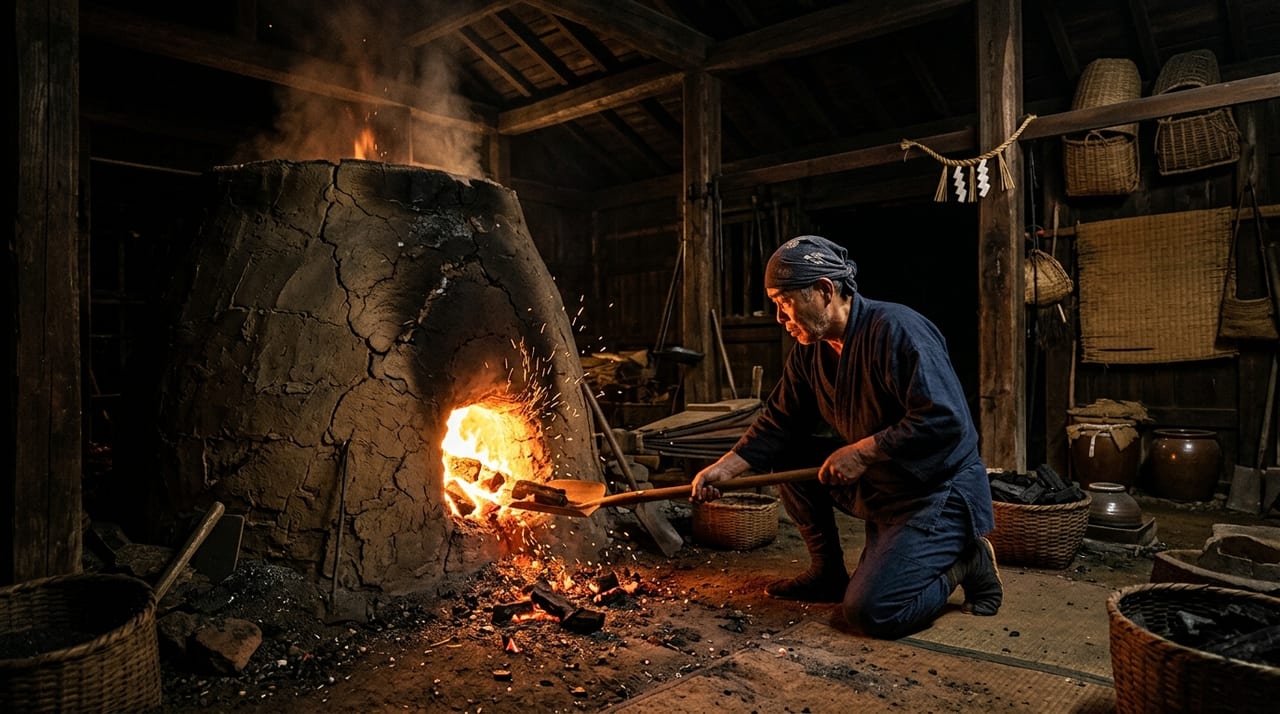 * Image is for illustrative purposes only.
Table of Contents
What Is tamahagane — The Soul Material of the Japanese Sword
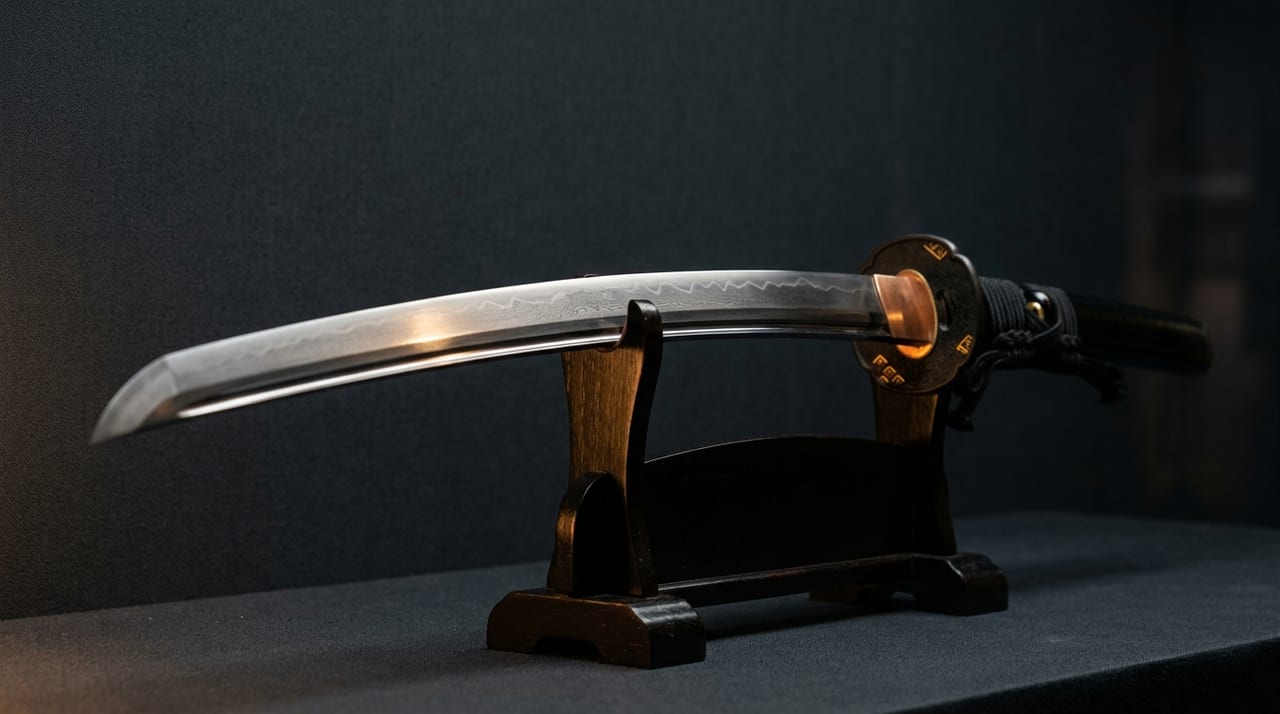
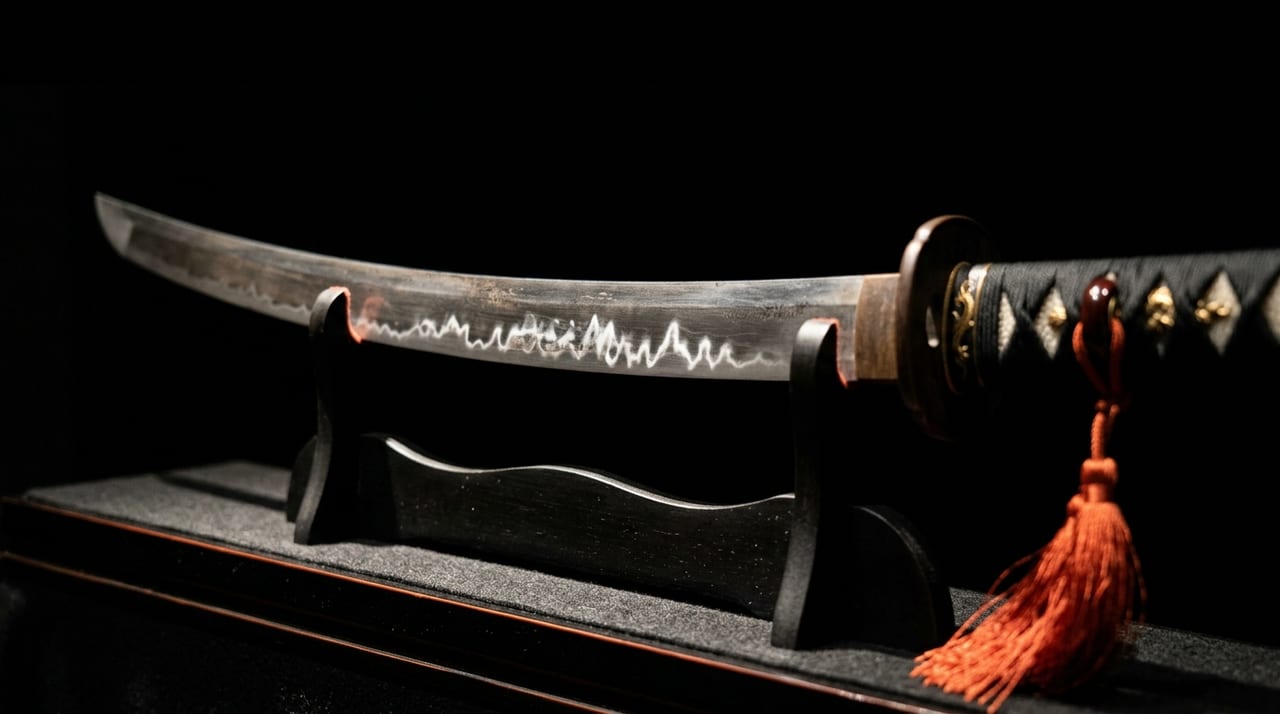
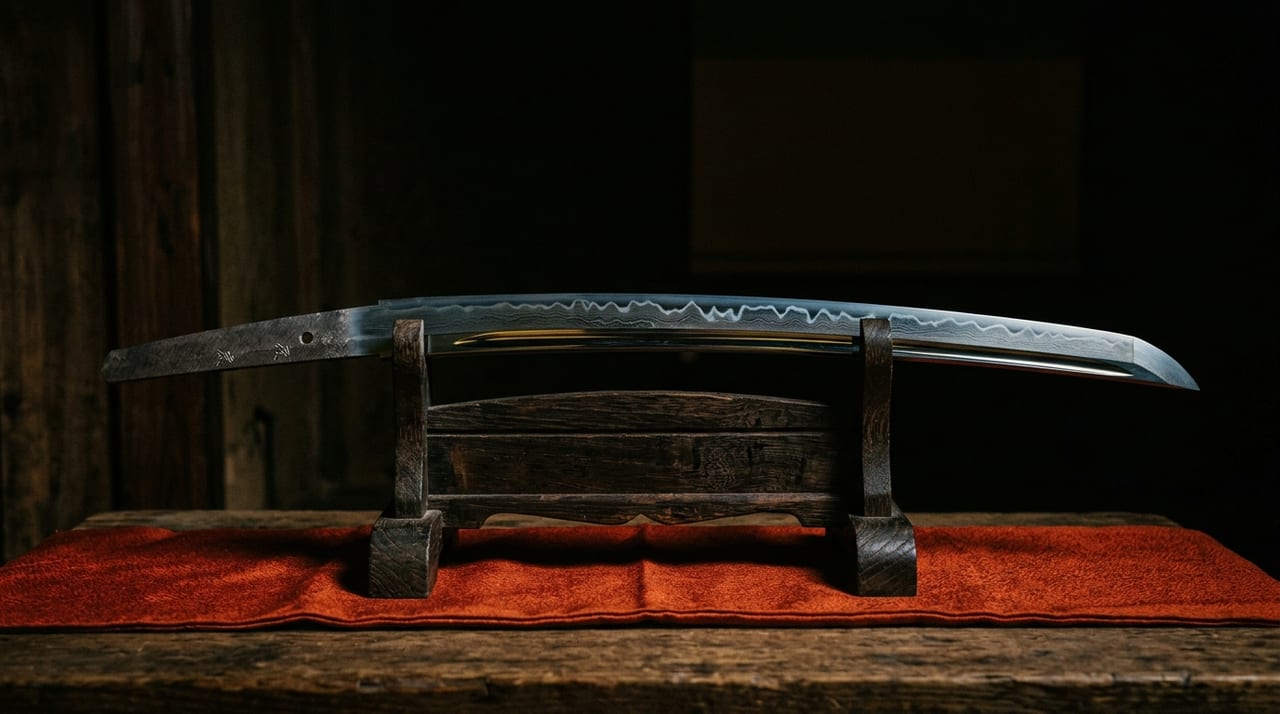
"Tamahagane" is an indispensable special steel used to make the blade of a Japanese sword. Its name derives from "steel (hagane) that has become round like a jewel (tama)," and in English too, "tamahagane" has become an established technical term used as-is.
Whereas modern steel production uses mass-production technology with a blast furnace, tamahagane is made by tatara (traditional smelting), a uniquely Japanese manufacturing method passed down from ancient times. This method is still practiced today in the Okuizumo region of Shimane Prefecture, and "Nittoho Tatara," operated by NBTHK, is virtually the sole source of tamahagane distributed to registered tōkō.
What Is tatara Smelting — A Uniquely Japanese Technology
The origins of tatara smelting are said to trace back to the Kofun period (5th–6th centuries). The etymology of "tatara" has several theories, but it became established as a term referring either to the action of treading a bellows (fuigo) to force air in, or to the smelting furnace itself.
Differences from Other Countries' Ironmaking Technologies
While Europe developed blast furnace ironmaking using coal and coke, Japan independently evolved low-temperature, long-duration reduction smelting using charcoal as fuel. This was the result of optimization for Japan's topographical and resource environment (abundant forests and high-quality sand iron deposits), and should be understood not as mere technological backwardness but as a rational choice adapted to the environment.
Charcoal-based ironmaking is difficult to control in terms of temperature, but it allows carbon content to be built up gradually, and in a non-uniform state that varies from part to part. This very "non-uniformity" is the key to producing the Japanese sword's distinctive quality of being "hard yet resilient" through sorting and combination in later processes.
Raw Materials (1) — Types and Selection of Sand Iron
The first raw material of tatara smelting is "satetsu" (sand iron). Sand iron consists of particles of magnetite or sandstone iron deposited on riverbeds, coastlines, and mountainous areas, and has the property of being attracted to a magnet.
Main Types of Sand Iron
Masa satetsu: Sand iron born from weathered granite. The grains are fine and it is suited to producing "soft steel (nankō)" with low carbon content, and is often used as the raw material for shingane (core steel).
Akome satetsu: Sand iron born primarily from igneous rock parent rock such as andesite. It tends to contain more impurities (such as titanium) than masa satetsu, but depending on conditions can yield hard steel, and is sometimes chosen as the raw material for kawagane (jacket steel).
The Okuizumo region (around Nita District and Unnan City, Shimane Prefecture) is known as a producer of high-quality sand iron, and sand iron flowing from the granite zone of the Chugoku Mountains has accumulated over many years in the valleys of Okuizumo.
Methods of Sand Iron Extraction
"Kannagashi," which was once the mainstream method, is a traditional extraction technique in which mountain slopes are cut away, the sandy soil is channeled into waterways, and the heavy sand iron settles and is collected in sedimentation basins. Through this process mountains were excavated on a large scale, and even today Okuizumo retains characteristic terrace-like landforms as "kannagashi remnants" (at the present-day Nittoho Tatara, historical extraction-site sand iron stocks and modern ore-dressing methods are also used in combination).
Raw Materials (2) — The Role and Selection of Charcoal
The second raw material of tatara smelting is "charcoal" (mokutan). Charcoal plays a dual role as both a heat source and a reducing agent that supplies carbon to the iron.
Best Wood Species for Charcoal
Pine charcoal (matsuzumi): Hard and capable of reaching high temperatures, but tends to supply a large amount of carbon during combustion. Used in process stages where raising the carbon content is desired. Oak charcoal (kashizumi): Has relatively stable combustion characteristics and is easy to manage in terms of temperature control. Binchotan: Suitable for high-temperature, long-duration combustion, but is expensive; in tatara smelting, the more common pine charcoal and oak charcoal are the mainstays.
Charcoal that has been fully dried to remove all moisture is used. If there is too much moisture, the temperature inside the furnace becomes unstable, causing unevenness in the reduction reaction of the sand iron and adversely affecting quality.
Structure of the tatara Furnace — The Stage for Ironmaking
The tatara furnace of "Nittoho Tatara," which is still in operation today, consists of the following elements.
Furnace bed (roshō): The bottom of the furnace, made from a special material mixing clay and sand. It receives the sand iron and charcoal and allows the molten iron (kera) to accumulate. Furnace walls (roheki): Clay walls approximately 1 to 1.5 m in height, which are broken down at the end of the operation to extract the kera inside. Tenbinfuigo (balance bellows): A blowing device that forces air in. At the modern Nittoho Tatara, both sessions using an electric blower and sessions that recreate the traditional tread bellows have been recorded. Sub-floor equipment (yukashita setsubi): Wood is placed under the furnace bed and moisture is removed over several weeks to prevent accidents caused by humidity.
The Three-Day-Three-Night Smelting Process — The Reality of tatara Operations
A full tatara smelting operation spans approximately 70 hours (three days and three nights). The following is an outline of the operational schedule of the modern "Nittoho Tatara."
Day 1 (Preparation and Ignition)
- Charcoal is added first to warm the furnace interior, and sand iron input begins
- Air is pumped in by the bellows, gradually raising the temperature inside the furnace
- The furnace temperature at this stage is approximately 800 to 1,000°C
Day 2 (Full Operation — Peak)
- The furnace temperature reaches approximately 1,300 to 1,500°C, and the reduction reaction of the sand iron progresses
- The "murage," the overall director of ironmaking, constantly observes the color and sound of the furnace flames and the way the sand iron falls, adjusting input quantities and airflow
- Sand iron and charcoal are continuously fed alternately at fixed intervals
- At this stage the iron mass (kera) begins to accumulate at the furnace bottom
Day 3 (Finishing and Breakdown)
- The input quantities are adjusted to maximize the kera inside the furnace
- After the operation ends, the furnace walls are broken down to extract the "kera"
- The weight of kera produced in a single operation is said to be approximately 2 to 3 tons
Splitting the Kera and Sorting the tamahagane
The extracted kera is a lump of non-uniform composition. Portions with high carbon content, low carbon content, and portions with many impurities are all mixed together, and the process of splitting and sorting this to obtain tamahagane is crucial.
Kera-wari (kera splitting): The kera is split with a large hammer, and the cross-sectional composition is examined and classified.
- tamahagane: High-quality steel with a carbon content of roughly around 1%. Used in the blades of Japanese swords
- Zuku (pig iron): Portions with excessively high carbon content. Used for casting and similar purposes
- Hōchōtetsu: Low-carbon soft iron. Used for purposes such as shingane (core steel)
tamahagane's appearance and sorting criteria:
- The cross-section shines with a silver-white luster (a characteristic of high-carbon steel)
- A fine pattern is visible in the cross-section (considered a guide to uniform structure)
- The sound when struck is clear
- The volume is appropriate for the weight (high density)
The tamahagane obtained from a single tatara operation is said to amount to several hundred kilograms in scale, and the tamahagane produced is managed by NBTHK and distributed to registered tōkō.
The Rarity of tamahagane and Its Modern Significance
The annual number of Nittoho Tatara operations is limited to a few times per year, and the annual production volume of tamahagane is far from abundant relative to the demand from tōkō and sword craftsmen around the world. When the number of newly made swords produced today is compared against the required amount of material, tamahagane is said to be in a state of chronically tight supply, which is one of the factors driving up the cost of raw materials for Japanese swords.
NBTHK has developed "Sugaya Tatara Sannai" in Shimane Prefecture as a preservation and public facility, conducting demonstrations and tours of tatara smelting. The cultural landscape related to tatara smelting in the Okuizumo region was certified in 2016 by the Agency for Cultural Affairs as Japan Heritage, under the narrative of "tatara smelting," and its cultural value is once again attracting attention both domestically and internationally.
The tamahagane born from tatara smelting then undergoes many further processes, including yaki-ire (quenching), to be transformed into a Japanese sword. Tameshi-yaki (test quenching), done as preparation just before yaki-ire to gauge the material's reaction, is also an indispensable process precisely because of the individual variation inherent in this tamahagane material.
Conclusion — tamahagane as the Essence of Japanese Technology
Only after the long journey from sand iron → tatara → kera → tamahagane does the material for a Japanese sword come into being. The tension-filled operation of three days and three nights, the murage's fine adjustments based on accumulated experience, the consumption of enormous quantities of sand iron and charcoal — this seemingly inefficient process produces the unique properties of tamahagane that cannot be replicated elsewhere.
This is why it is said that "to know the Japanese sword is to know tatara smelting." The production of tamahagane is not mere metal production — it is a crystallization of Japan's natural environment, technical culture, and aesthetic sensibility.