Pursuing the Path of a Tōshō in Japan as a Foreigner — Verifying the Requirements for Sword-Manufacturing Approval and Residence Status in the Statutes
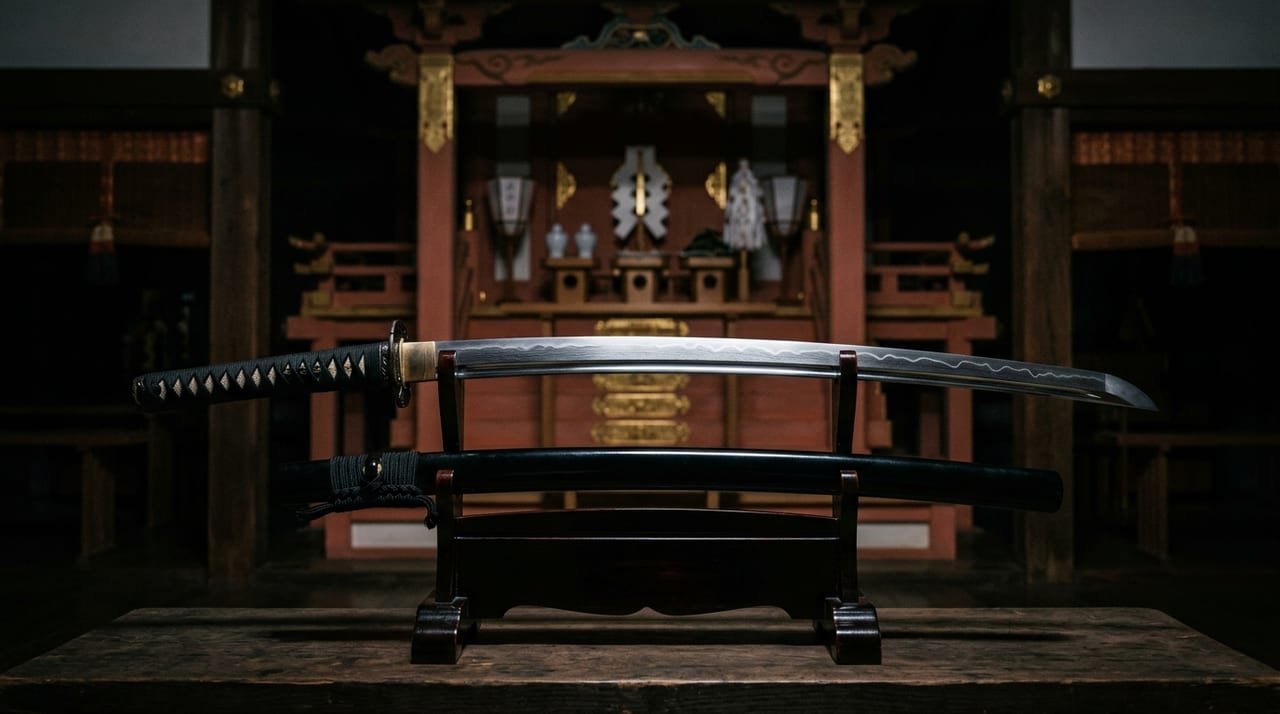 * Image is for illustrative purposes only.
Table of Contents
Manufacturing Approval — A Procedure Required for Each Sword
To make a nihontō as a work of art in Japan, one must obtain manufacturing approval for each individual sword to be made. Article 18-2 of the Act for Controlling the Possession of Firearms or Swords and Other Such Weapons (Jūtōhō) stipulates that any person intending to manufacture swords of artistic value must obtain approval for each sword they intend to manufacture from the Board of Education of the prefecture where they reside (or, in cases prescribed by cabinet order, from the Commissioner of the Agency for Cultural Affairs) (Act for Controlling the Possession of Firearms or Swords and Other Such Weapons (e-Gov Legal Search)).
The details of approval are stipulated by the Rules on Approval for the Manufacture of Art Swords. Swords made by a tōshō seeking approval for the first time are approved by the Commissioner of the Agency for Cultural Affairs (Article 2, Paragraph 1), while swords made by a tōshō who has previously received approval are approved by the prefectural Board of Education (Article 2, Paragraph 2) (Rules on Approval for the Manufacture of Art Swords (e-Gov Legal Search)). Approval is not granted to a person like a qualification or license; it is obtained for each individual sword. The system as a whole is also covered in The Structure of the Tōshō System.
No Nationality Requirement in the Approval Criteria
The first concern for a person of foreign origin aiming to become a tōshō in Japan is likely "Can a non-Japanese national obtain approval?" Neither Article 18-2 of the Jūtōhō nor the Rules on Approval for the Manufacture of Art Swords contains any provision making nationality a requirement (Rules on Approval for the Manufacture of Art Swords (e-Gov Legal Search)). The provisions in the Jūtōhō that specifically name foreigners concern matters such as the special exception for possession permits for foreigners entering the country to participate in international competitions held domestically (Article 6), and are not provisions governing manufacturing approval (Act for Controlling the Possession of Firearms or Swords and Other Such Weapons (e-Gov Legal Search)).
The items to be entered on the approval application form as stipulated in Article 1 of the approval rules also include no field for nationality.
- The name (or title) and address of the approval applicant
- If the applicant and the person in charge of manufacturing are different, the name and address of the person in charge of manufacturing
- The date of birth and tōkō career history of the person in charge of manufacturing
- The name (or title) and address of the person who commissioned the manufacture
- The type and number of swords intended to be manufactured (including the number of kageuchi)
- The purpose of manufacture, the place of manufacture, and the scheduled dates for commencement and completion of manufacture
On the other hand, the requirements for first-time approval are the same regardless of nationality, and they are not light. The requirements under Article 2, Paragraph 1 are organized as follows (Rules on Approval for the Manufacture of Art Swords (e-Gov Legal Search)).
| Requirement | Content of the Rules |
|---|---|
| Artistic value of the sword | The swords intended to be manufactured must be of artistic value |
| Training | Having devoted oneself exclusively to the refinement of techniques for at least five consecutive years under a tōshō who has previously received approval, and having acquired sufficient technical skill as a person in charge of manufacturing |
| Certification and endorsement | The master tōshō having certified this, and two or more registration examination committee members having endorsed it |
| Training course | Having received training related to the manufacture of swords conducted by the Commissioner of the Agency for Cultural Affairs |
The Zen Nihon Tōshōkai, the professional association of tōshō, also states in its guidance for those considering apprenticeship that it is not institutionally impossible for a foreigner to become a kaji. However, the association also notes that it is not an exaggeration to say there are virtually no kaji who will accept a foreigner as an apprentice, and that due to language and visa issues, it is extremely difficult (Zen Nihon Tōshōkai, "For Those Who Want to Become a Kaji").
The absence of a nationality requirement means that the path is open for non-Japanese nationals, but it does not mean there is a shortcut. The central requirement is training for at least five consecutive years under an approved tōshō and having that tōshō provide the certification. Furthermore, the application window for approval is designated as the Board of Education of the prefecture "where the applicant resides," which presupposes that the applicant has an address within Japan.
Residence Status During Training — What Can Be Verified from the Official List
To continue training in Japan for five or more years, one needs a residence status for that period. The Table of Residence Statuses published by the Immigration Services Agency of Japan does not list tōshō or tōkō as applicable examples. Among the definitions in the table, those that appear to be relevant to training and sword-making are as follows.
| Residence Status | "Activities Permitted in Japan" from the Table (excerpt) | Applicable Examples |
|---|---|---|
| Cultural Activities (non-working status) | Activities involving academic or artistic pursuits not accompanied by income, or activities involving specialized research into, or learning under the guidance of an expert in, culture or arts unique to Japan | Researchers of Japanese culture, etc. |
| Artistic Activities (working status) | Activities in music, fine arts, literature, or other artistic pursuits accompanied by income | Composers, painters, authors, etc. |
| Permanent Resident, Spouse or Child of Japanese National, etc. | Residence status based on status or position held in Japan, not activities (Appended Table II of the Immigration Control Act) | Those who have received permanent residency permission, spouses and children of Japanese nationals, etc. |
Regarding the case of "learning culture or arts unique to Japan under the guidance of an expert," the Immigration Services Agency of Japan's page on the "Cultural Activities" residence status lists examples of culture and arts unique to Japan including ikebana, chado, judo, Japanese architecture, Japanese painting, Japanese dance, Japanese cuisine, and hogaku, and states that Zen and karate are also included. Since the tanren of nihontō is not named among the examples, whether apprenticeship under a tōshō falls under this category will be determined by the examination of each individual application.
According to the same page, applications in this case require documents clarifying the content and duration of activities in Japan, documents certifying the ability to cover expenses during the stay in Japan, and materials clarifying the career and accomplishments of the supervising expert (any one of the following: copies of licenses, papers or portfolios of works, or a curriculum vitae). Documents created in a foreign language must be accompanied by a Japanese translation. Since the permitted stay for Cultural Activities is one of the following: three years, one year, six months, or three months, applying for renewal of the permitted stay period will be necessary in order to continue training for five or more years (Immigration Services Agency of Japan, "Table of Residence Statuses").
Cultural Activities, as its definition states, is a status for activities "not accompanied by income." Receiving a salary during training or earning income by selling swords one has made falls outside this definition. It is advisable to confirm in advance, before applying, what is permitted under each residence status by consulting resources such as the Immigration Services Agency of Japan's Immigration Information Center for Foreign Nationals.
After Receiving Approval — Registration and Export Abroad
Swords made after receiving approval are registered by the owner applying to the Board of Education of the prefecture where they reside, based on the appraisal of registration examination committee members (Jūtōhō, Article 14, Act for Controlling the Possession of Firearms or Swords and Other Such Weapons (e-Gov Legal Search)). The appraisal criteria are whether the sword is "a nihontō" with recognized beauty in its form, steel quality, hamon, engravings, and so on, or whether its mei has value as a historical document; the nationality of the maker is not among the criteria (Rules on the Registration of Firearms and Swords (e-Gov Legal Search), Article 4, Paragraph 2).
When completing training and returning to one's home country, or when sending a sword to a buyer abroad, the procedure for export from Japan applies. When a registered sword is exported and the owner no longer possesses it, the registration certificate must be returned to the Board of Education that handled the registration (Jūtōhō, Article 16, Paragraph 1, Item 2). For export, one must apply to the Agency for Cultural Affairs for the Export Inspection Certificate for Antique Art Objects, which certifies that the sword has not been designated as a kokuhō (National Treasure) or jūyō bunkazai (Important Cultural Property) and does not qualify as a recognized jūyō bijutsuhin (Important Art Object), and submit the original certificate to customs at the time of clearance (a dedicated attached inventory form is available for registered firearms and swords). The procedure is covered in Export Procedures for Nihontō, and the receiving country's regulations are covered in Sword Export Regulations by Destination Country (English-speaking Countries) and Regulations in Europe and Asia.
When continuing to make swords in one's home country, the rules governing sword manufacture and possession are determined by that country's laws and regulations. Japan's manufacturing approval is a procedure based on Japanese law.
What to Verify Before Beginning Apprenticeship
Working back from the statutes and official pages, the following are points that a person of foreign origin aiming to become a tōshō in Japan will want to verify before beginning apprenticeship.
- Whether the master tōshō is one who makes swords under manufacturing approval (the requirement is training "under a tōshō who has previously received approval")
- Whether there is a prospect of maintaining residence status throughout at least five consecutive years of training (including renewal of the permitted stay period)
- How to cover living expenses during training (Cultural Activities is a status for activities not accompanied by income, and the application requires documentation of the ability to cover expenses)
- Whether, at the time of completing training, it will be possible to follow the steps of: certification by the master, endorsement by two or more registration examination committee members, and training conducted by the Commissioner of the Agency for Cultural Affairs
- Whether one understands the procedures for registration, sale, and export abroad of swords one has made
The approval requirements themselves are the same as for a Japanese-national apprentice. The path from apprenticeship to approval is covered in detail in Becoming a Tōkō, and the system for training sword craftsmen is covered in Successor Training in the Sword Craftsman Industry.