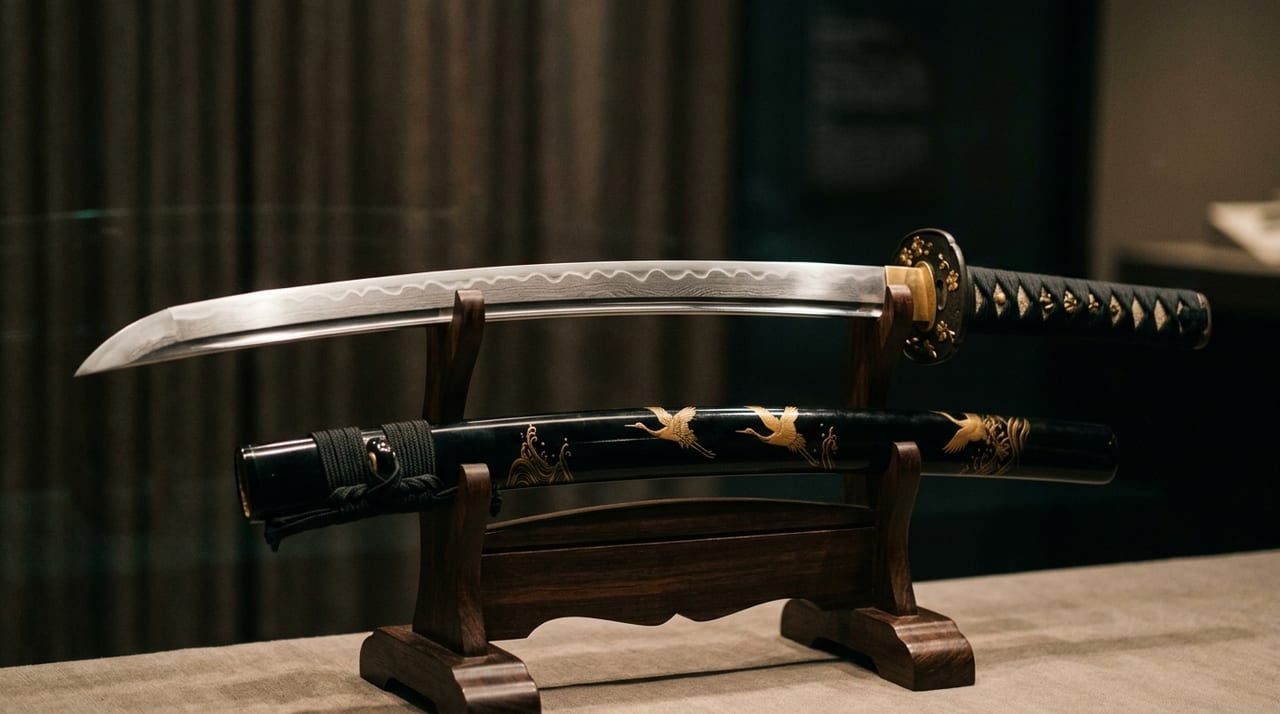
 * Image is for illustrative purposes only.
Muramasa
村正
Also known as: The Cursed Blades of Muramasa
Description
Overview
Known by the nickname "yōtō" (cursed blade), Muramasa is the most widely recognized sword signature in the history of Japanese swords. The name refers collectively to blades forged by the Sengo Muramasa school of smiths, based in Kuwana, Ise Province (present-day Kuwana, Mie Prefecture). The Muramasa name was carried on by several generations under the same signature, and dated works are found from the 1st year of Bunki (1501) through the Keichō era (1596–1615). Above all, the style is defined by a sharp cutting edge built for actual combat.
Craftsmanship and Characteristics
The jigane (base steel) is a refined forging of itame grain mixed with masame, with ji-nie (fine particles) visible. The most distinctive feature is the hamon (temper line), a gunome-midare (alternating, wave-like) pattern that matches on both sides of the blade. The hamon on the front and back are almost symmetrical, which required very advanced hardening technique. This matched hamon, also called "Sengo-ba," is a hallmark of the Muramasa school and the most important basis for authenticating Muramasa blades. The bōshi (blade tip) takes a distinctive form called Jizō-bōshi, and the nakago (tang) is often in the tanago-bara form. When that form is strongly pronounced, it is called a Muramasa tang.
The reason Muramasa came to be called "yōtō" lies in its ill-omened association with the family of Tokugawa Ieyasu. Ieyasu's grandfather, Matsudaira Kiyoyasu, was assassinated in the 4th year of Tenbun (1535) during the Moriyama Kuzure incident by his retainer Abe Masatoyo, who wielded a Muramasa sword. His father, Matsudaira Hirotada, was reportedly stabbed by a retainer with a Muramasa wakizashi (short sword), though he did not die; accounts vary. Ieyasu himself was injured as a child when he cut his hand on a Muramasa tantō (dagger). It is also said that the kaishaku-tō (sword used to behead in ritual suicide) used when Ieyasu's eldest son, Matsudaira Nobuyasu, performed seppuku was a Muramasa blade. Because these unfortunate coincidences piled up, Muramasa came to be shunned within the Tokugawa household as a "cursed blade that brought ruin to the Tokugawa."
From a historical standpoint, however, Muramasa blades were simply widespread among Mikawa samurai because the smiths were from Kuwana, which is close to Mikawa, the Tokugawa family's home base. Accidents are bound to be more common where a weapon is used more often, so the legend of Muramasa as a "cursed blade" can be seen as a kind of urban legend born from a run of coincidences. Even so, the ominous ring of the Muramasa name has continued to stir people's imaginations, and the legend of the "cursed blade" remains one of the most widely known stories in Japanese sword culture to this day.
Legends & Stories
Legends and Anecdotes
Tokugawa Ieyasu's grandfather Matsudaira Kiyoyasu was assassinated by a retainer wielding a Muramasa blade (the Moriyama Incident), and his father Hirotada was reportedly stabbed with a Muramasa wakizashi by a retainer, Iwamatsu Yahachi, though Hirotada did not die; the reliability of the sources for this incident is debated. Ieyasu himself was wounded by a Muramasa tantō as a child, and even his eldest son Nobuyasu's ritual suicide was assisted by a Muramasa blade. These tragic coincidences led the Tokugawa household to shun Muramasa as a 'cursed sword that brings ruin upon the Tokugawa.' In the Edo period, once the cursed-blade legend had spread, owning a Muramasa openly became taboo, and many owners ground off or altered the signature. Yet during the Bakumatsu era, anti-shōgunate loyalists deliberately sought out Muramasa blades as symbols of defiance against Tokugawa rule. The 'cursed blade' legend was a source of dread — and of romantic heroism.