 * Image is for illustrative purposes only.
Matsura Historical Museum
松浦史料博物館
Overview
The Matsura Historical Museum stands on the grounds where the Matsura family, lords of the Hirado domain, maintained their residence throughout the Edo period. In 1955, after the Second World War, the then head of the family, Matsura Noboru, donated the buildings and grounds to a foundation, and the museum opened that October following renovation. Its central exhibition hall, Chitose-kaku, was built in 1893 by Matsura Akira as an audience and reception hall; the former Matsura residence grounds are designated a Tangible Cultural Property of Nagasaki Prefecture.
The Hirado Matsura Family and Its Collection
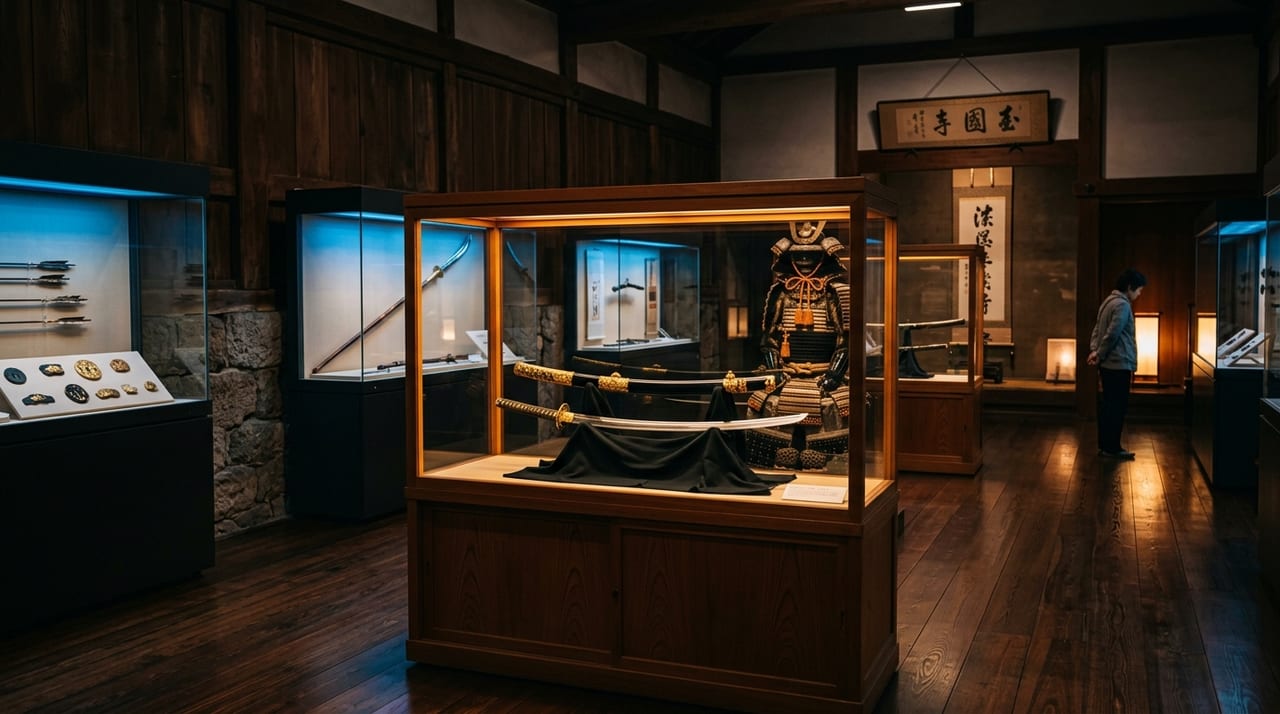
The Hirado domain was governed throughout the Edo period by the Matsura family, descendants of the medieval Matsura clan, and Hirado served as a key gateway for trade with Portugal and later the Dutch. The museum preserves portraits of successive lords, a picture scroll depicting Nagasaki's trade with the Dutch, and a document of Toyotomi Hideyoshi's edict banning Christianity — materials reflecting Hirado's position at the front line of Japan's foreign relations. Among its arms and armor, the Important Cultural Property cuirass known as Kon'itoodoshi Katashiro Akadōmaru stands out as a fine example of late Muromachi-period armor. Including swords and armor, the family's holdings total roughly 30,000 items.
The Legacy of Matsura Seizan, the Scholar-Lord
The 34th head of the family, Matsura Seizan, active in the late Edo period and known as the author of the essay collection Kasshi Yawa, was celebrated as a "scholar-daimyo." He assembled a substantial body of globes, celestial spheres, world maps, and Western books — a record of how information about the wider world was received in early modern Japan, closely tied to Hirado's character as a trading port.
Chinshin-ryū Tea and Living Tradition
Successive heads of the Matsura family have served as grand masters of the Chinshin-ryū school of tea ceremony, and experiential tea classes are still held today in the museum's tea room, Kan'untei. The combination of a diplomatic history and a living tea tradition, experienced within the family's own former residence, is a defining feature of the museum.
Access and Hours
12 Kagamikawa-chō, Hirado, Nagasaki. Open 8:30–17:30 (confirm current schedule and any closures with the museum).
Highlights
- Built on the former residence grounds of the Matsura family, lords of Hirado; opened in 1955 after head-of-family Matsura Noboru donated the property; the Chitose-kaku hall dates to 1893 and is a Nagasaki Prefecture Tangible Cultural Property
- Holds roughly 30,000 items handed down in the Matsura family, rich in materials documenting Hirado's role as a gateway for Portuguese and Dutch trade
- Holds the Important Cultural Property cuirass Kon'itoodoshi Katashiro Akadōmaru, a fine example of late Muromachi-period armor
- Preserves globes, celestial spheres, and world maps assembled by the 34th head, Matsura Seizan, the "scholar-daimyo" and author of Kasshi Yawa
- The Matsura family still heads the Chinshin-ryū school of tea; experiential classes are held in the museum's tea room, Kan'untei
* Opening hours and exhibitions are subject to change. Please check the official website before visiting.