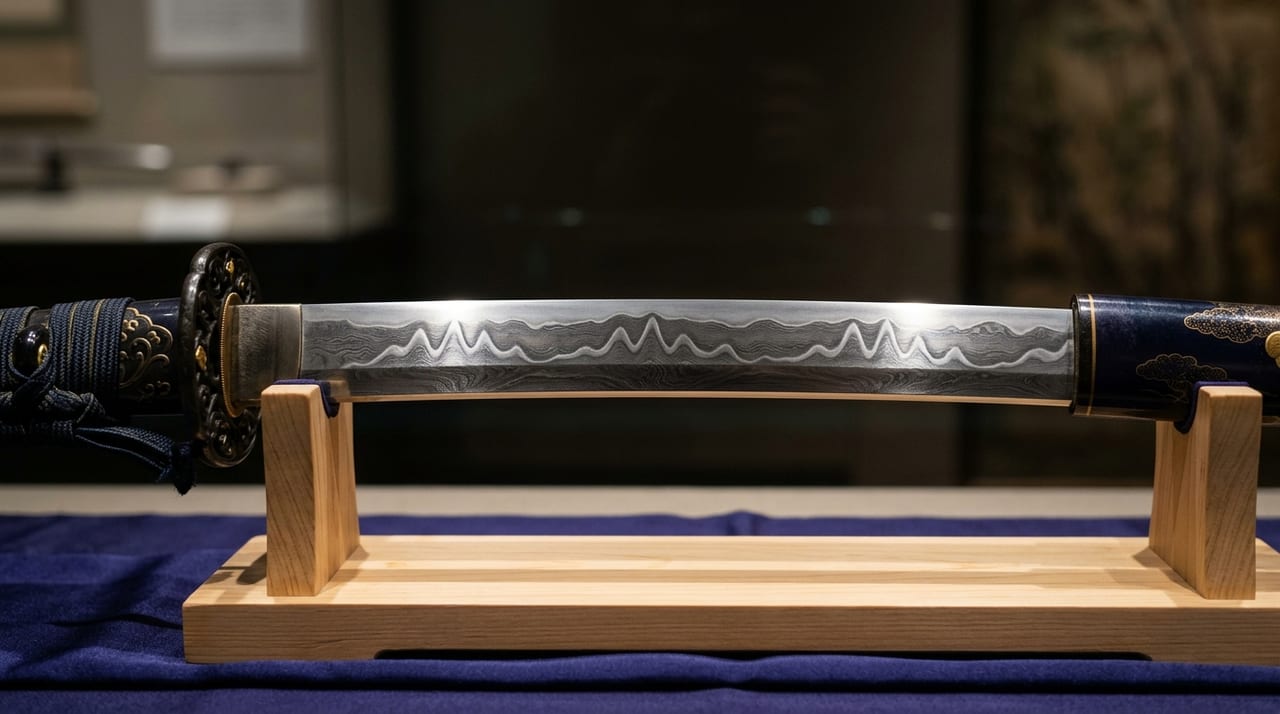
 * Image is for illustrative purposes only.
Katana by Seki Magoroku Kanemoto
関孫六兼元の刀
Also known as: Magoroku Kanemoto
Description
Seki Magoroku Kanemoto is the defining figure of the Seki school of Mino Province (present-day Gifu Prefecture), and it is the second-generation Kanemoto—known simply as 'Magoroku Kanemoto'—who stands at the pinnacle of his lineage. Magoroku Kanemoto's swords are celebrated above all for their distinctive hamon known as 'Sanbon-sugi' (Three Cryptomeria Trees), in which the gunome-midare crests group in triads that repeat regularly along the full length of the blade—a pattern uniquely his own among all Japanese swordsmiths. This katana, approximately 69 centimeters in length, displays a superb example of the Sanbon-sugi hamon, with abundant nie and a lively interior to the tempered zone. The jigane shows the prominent nagare-hada (flowing grain) characteristic of Mino smiths, interspersed with areas of mokume, presenting a beautiful overall texture. The smith is said to have had close dealings with the Sengoku warlord Saitō Dōsan during the latter's rule of Mino. Kanemoto's blades were also celebrated for their cutting performance—praised in cutting-test records as virtually unbeatable. Now held by the Gifu Prefectural Museum, the sword is a source of local pride as the apex of Mino swordsmanship.
Legends & Stories
The origin of Magoroku Kanemoto's signature 'Sanbon-sugi' hamon is explained by a legend in which Kanemoto received divine inspiration one night while gazing at a grove of cryptomeria trees. In a dream, a deity appeared and commanded, 'Imbue your blades with the power held within three cryptomeria,' and the masterworks he forged in response to this divine revelation became known for the distinctive triple-crest hamon. Saitō Dōsan is said to have exclaimed 'This is a divine sword' upon testing a Magoroku Kanemoto blade on the battlefield, after which possessing one became the supreme status symbol among the warlords of Mino. Cutting-test records also contain accounts of 'a hundred-man cut' attributed to these blades, and tales of their extraordinary sharpness have been handed down across the centuries.