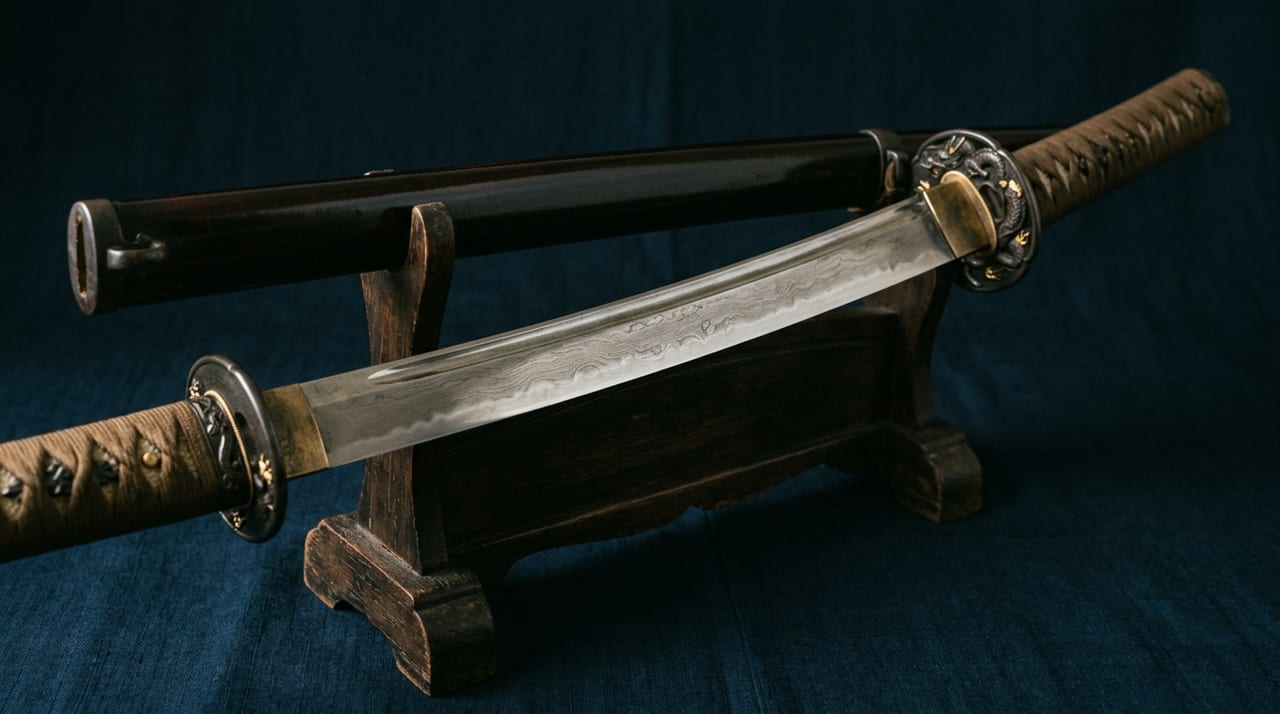
 * Image is for illustrative purposes only.
Sasanuki
笹貫
Also known as: Sasanuki: Legendary Sword of Satsuma, The Masterwork of Namihira Yukiyasu That Pierced Bamboo
Description
Overview
Sasanuki is a tachi attributed to Naminohira Yukiyasu, a Satsuma swordsmith of the Kamakura period (13th century). It is a signed work bearing the inscription "Naminohira Yukiyasu" and is celebrated as one of the few surviving examples by the early Yukiyasu. Handed down in Satsuma since ancient times under the name "Sasanuki," it is today an Important Cultural Property held by the Kyoto National Museum, highly regarded as a representative blade of the Satsuma Naminohira school to which Yukiyasu belonged. The lineage of the Naminohira school and the wider culture of Satsuma swords are treated in the accompanying article; here the focus is on the form and provenance of Sasanuki as an individual blade.
Form and Workmanship
The blade is about 72.5 cm long with a curvature of roughly 2.3 cm, deeply curved throughout. The tip takes the short, compressed ikubi-kissaki ("boar's-neck point"), showing the robust tachi form of the Kamakura period. The jigane is forged in itame mixed with masame, evenly covered with fine ji-nie. The hamon is a suguha with a tight nioiguchi; both ji and ha are sound and of high quality. This serene, upright suguha attests to the Naminohira school's descent from the Yamato tradition. The nakago retains the "Naminohira Yukiyasu" signature. Its subdued, unshowy workmanship has long been spoken of alongside the sturdy simplicity of the Satsuma temperament.
Provenance
Sasanuki is known as a tachi handed down in the Kabayama family, senior retainers of the Shimazu clan of Satsuma. According to tradition, the blade was once presented to the main Shimazu house, but when strange occurrences persisted in the household it was returned to the Kabayama. Thereafter it was preserved as a Kabayama family treasure together with a black-lacquered tachi mounting (kuro-urushi tachi koshirae) of the early Muromachi period; the fittings are said to bear the Shimazu crest of a cross within a circle. In the modern era it was designated a national Important Cultural Property in 1972 (Showa 47), and it is now held and preserved by the Kyoto National Museum. A koto blade born in Satsuma and guarded by Satsuma's warrior families is now exhibited and studied in Kyoto as a masterpiece that conveys the history of the Japanese sword.
Naminohira Yukiyasu, Maker of Sasanuki: What Kind of Swordsmith Was He?
Naminohira Yukiyasu (波平行安), the creator of Sasanuki, is regarded as a master craftsman and the de facto founder of the Naminohira school (波平派), a sword-making community in Satsuma Province (present-day Kagoshima Prefecture). The Naminohira school is said to have originated when a swordsmith from Yamato Province migrated to Satsuma in the late Heian period, and thereafter continued blade forging in the same region for approximately seven hundred years until the early Meiji period. It is known as the longest-lived lineage among Japanese sword-making schools. The name "Yukiyasu" (行安) was passed down through successive generations of the main line, so it does not refer to a single individual; however, the first-generation Yukiyasu (known as ko-Namihira), who forged Sasanuki, is regarded as the standard-bearer of the Naminohira school's characteristic style. The value of Yukiyasu lies in his achievement of creating a distinctive straight-edge (suguha) working style within Satsuma's natural environment, while maintaining the lineage of the Yamato tradition among the Five Traditions (Gokaden).
Where Is Sasanuki Today?
Sasanuki is currently housed and preserved by the Kyoto National Museum (Kyoto, Higashiyama Ward). It was designated as a National Important Cultural Property on May 30, 1972 (Showa 47). This ancient blade, born in Satsuma and handed down through the samurai families of that region, is now displayed in Kyoto as a masterwork that speaks to the history of Japanese swords and is actively studied and presented to the public. Since it is not on permanent display, it is shown to visitors during special exhibitions focused on swords and blades. Those wishing to view the original sword should consult the museum's exhibition information.
The Origin of the Name "Sasanuki"
The name "Sasanuki" derives from a legend surrounding the swordsmith Naminohira Yukiyasu. When Yukiyasu forged this blade with all his skill, he mistakenly believed it was a failure and threw it into a bamboo thicket. That night, the sword began to emit an eerie light, and when people retrieved it, they discovered that its point had pierced countless leaves of bamboo grass (sasa) that had fallen to the ground—and from this anecdote, the blade came to be called "Sasanuki" (grass-piercer). This paradoxical expression—the sharpness to pierce thin, soft bamboo leaves—symbolizes the cutting power and spiritual force of this tachi. There is also a tradition that when the sword was later passed down to the Kabayama family, senior retainers of the Shimazu clan of Satsuma, and subsequently presented to the main house, strange occurrences ensued and it was returned; this account further testifies to the mysterious power said to reside in this blade.
Legends & Stories
The Legend Behind the Name "Sasanuki"
The origin of the name "Sasanuki" lies in a legend about its smith, Naminohira Yukiyasu. Setting out to forge a supreme blade, Yukiyasu strictly forbade his wife to look into the smithy, but she broke the prohibition and peered inside. Believing his concentration ruined and the blade a failure, Yukiyasu cast the sword away into a bamboo thicket. Thereafter a strange light shone from the thicket night after night, and when people pulled the sword out, its tip was found to have pierced countless fallen leaves of bamboo grass (sasa) that had drifted down upon it. From this tale of a blade that had pierced the sasa leaves, the name "Sasanuki" (sasa-piercing) is said to derive. The paradoxical image of a sharpness able to pierce thin, soft sasa leaves symbolizes both the cutting power of this tachi and the numinous power attributed to it.
A Spiritual Blade Guarded by Satsuma's Kabayama Family
The warriors of Satsuma held a special spiritual reverence for swords. Sasanuki was carefully preserved as a celebrated blade handed down in the Kabayama family, senior retainers of the Shimazu clan, and it came to symbolize the Satsuma reverence for supreme masterpieces. The tradition that strange events occurred when it was presented to the main Shimazu house — leading to its return — likewise conveys the mysterious power said to reside in the blade. Under Satsuma's distinctive sword culture, epitomized by the Jigen-ryu school, Sasanuki was revered by the sturdy, plainspoken warriors of Satsuma as a spiritual blade embodying their ideal. It is now held as an Important Cultural Property by the Kyoto National Museum, conveying the koto tradition of southern Kyushu to the present day.