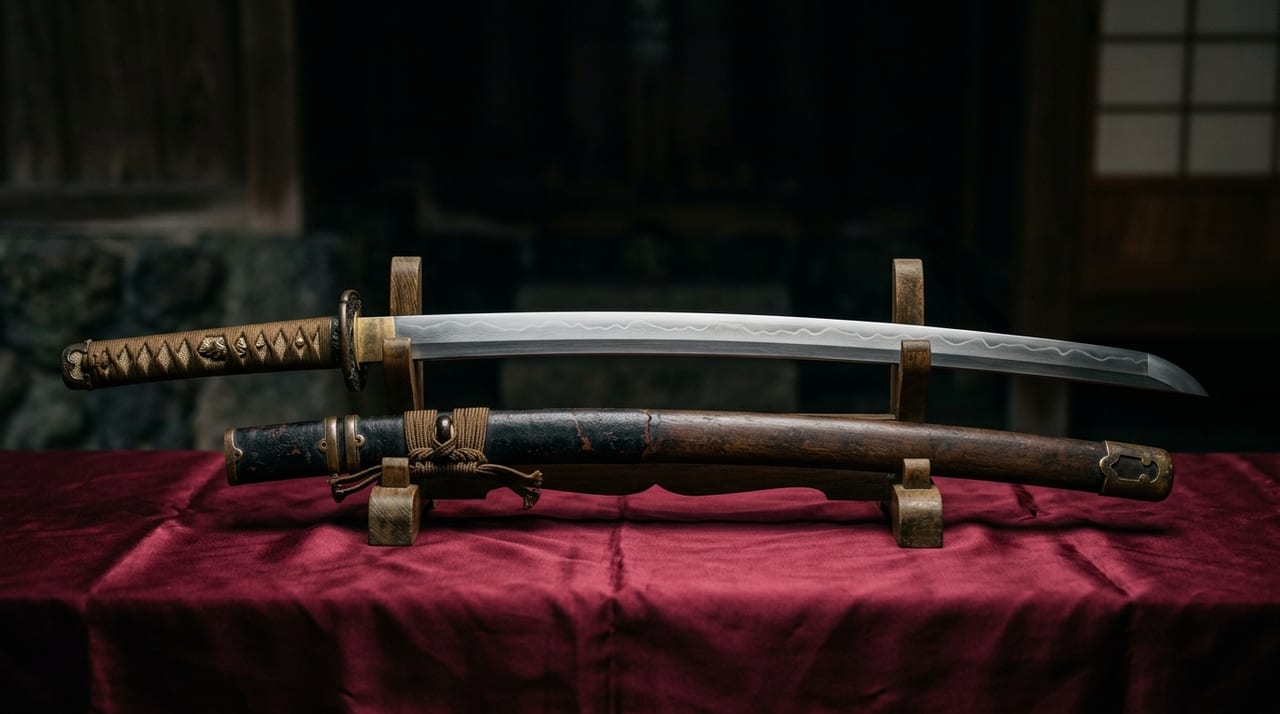
 * Image is for illustrative purposes only.
Kokaji Munechika
小鍛冶宗近
Also known as: Kokaji Tachi
Description
"Kokaji" ('the little swordsmith') is the legendary appellatory name for a tachi said to have been forged by Munechika under the divine protection of Inari Daimyōjin, and represents the most mythologically imbued single blade in Japanese sword history, becoming the subject matter of the Noh play "Kokaji." It is said to have been forged by Munechika at the imperial command of Emperor Ichijō (r. 980–1011), and from the legend that Inari Daimyōjin appeared in the form of a white fox to assist in the forging, there is also a tradition that the inscription "Kogitsune" (Little Fox) was engraved upon the tang. The blade measures approximately 72 centimeters in length, possessing the graceful koshi-zori curvature characteristic of mid-Heian period tachi form; the hamon is the gentle ko-midare befitting the Heian aesthetic, with fine, quiet nie pervading the tempered zone. The jigane displays compactly refined ko-itame grain with beautiful texture, and Munechika's distinctive white, pellucid jigane-gloss is prominently evident. This sword is traditionally said to have been kept secret by court nobles of the Kujo family from antiquity, but its whereabouts are now said to be unknown. Imbued with the character of a divinely protected blade—a sacred treasure—it is handed down not merely as a work of sword history but as a special entity deeply woven into Japanese mythology and folk tradition.
Legends & Stories
Receiving the imperial commission from Emperor Ichijō, Munechika lamented that he had no skilled smith to serve as his hammer-partner, and performed seven days and nights of prayer at the Inari shrine. A white fox then appeared, took up the hammer, and the two—one man, one deity—forged a tachi together, inscribing 'Kogitsune' (Little Fox) on the tang. When the forging was complete, the fox vanished, and Munechika is said to have declared, 'Without the help of the gods, this sword could not have come into this world.' The legend lives on today as the Noh play 'Kokaji,' performed to this day, embodying the spirit of 'creation as collaboration between gods and humans' in Japanese craft culture—a story that has outlived the sword world to become a foundational myth of Japanese culture at large.