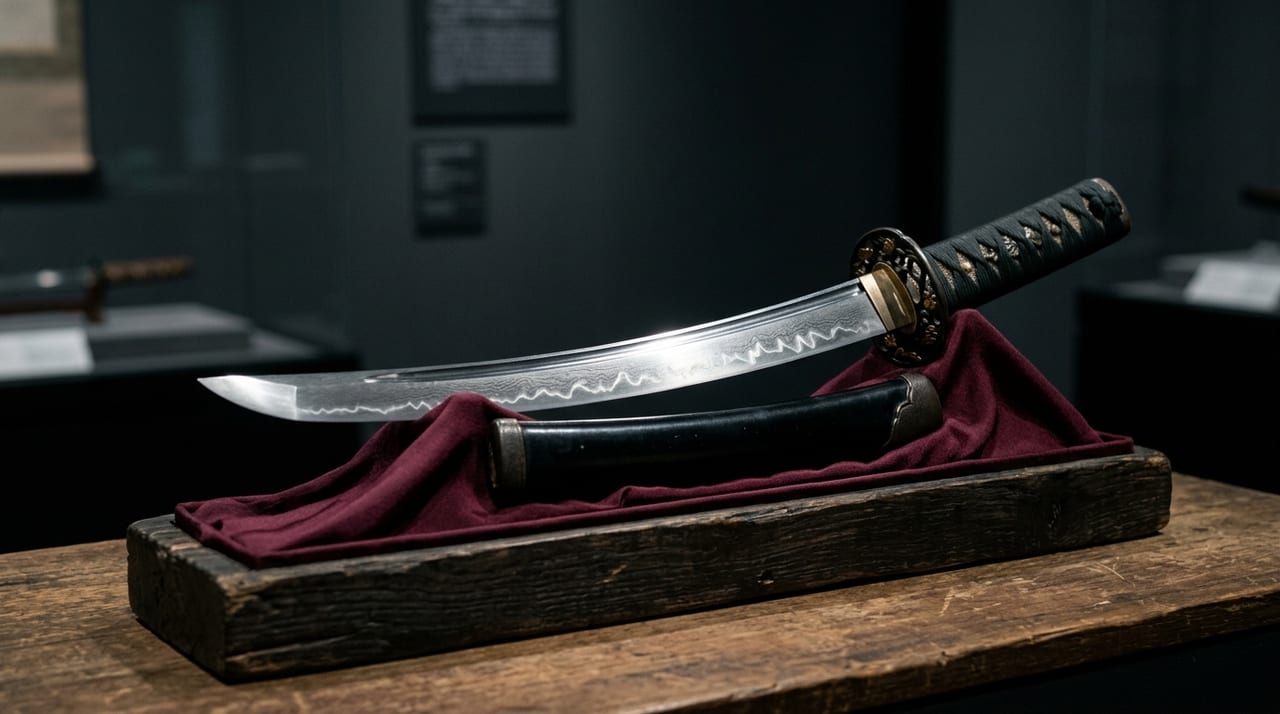
 * Image is for illustrative purposes only.
Namazuo Tōshirō
鯰尾藤四郎
Also known as: Namazuo Tōshirō, Namazuo-shaped tanto, a masterwork of the Toyotomi clan
Description
Overview of the Blade
Namazuo Tōshirō is a naginata-naoashi tanto forged by Awataguchi Yoshimitsu, and is a masterwork of distinctive character, named "Namazuo Tōshirō" because its tapered blade resembles the tail of a catfish (namazu). Naginata-naoashi refers to a form in which part of a naginata blade was remade into a tanto, and because the original naginata's curve remains, it produces a deeper curve than a typical tanto and unique curved beauty. With a blade length of 1 shaku 2 sun 7 bu (approximately 38.5 cm), which is somewhat long for a tanto, combined with an elegant curved form that tapers at the point like a catfish tail, it stands out as having a distinctive character completely different from other Yoshimitsu tantos. This naginata-naoashi form is rare among Yoshimitsu's works, and is particularly noted as a work that demonstrates the breadth of Yoshimitsu's creative range, showing formal diversity in each blade.
The Significance of the Naginata-naoashi Form
Naginata-naoashi is a form that became widespread from the late Kamakura period through the Nanboku-cho period as weapons demand changed, and by remaking long-hafted naginata into tantos, it achieved both portability and practical close-quarters combat functionality. Because the original naginata's curve remains in the blade, a unique curvature not found in ordinary hira-zukuri tantos is created, and its flowing curved beauty is aptly expressed by the metaphor "catfish tail." The catfish is a spiritual being rooted in Japanese folk belief as a water deity and earthquake god, and the name "catfish tail" imparts a mystical atmosphere to this blade as if imbuing it with the spiritual power of nature. Whether Yoshimitsu's choice of the naginata-naoashi form was intentional design or a response to a patron's special request is debated, but in either case it is certain that this single blade serves as evidence of the breadth of Yoshimitsu's artistic range.
Blade Details: The Essence of Yoshimitsu Embodied in the Naginata-naoashi
The jigane (base metal) of Namazuo Tōshirō displays Yoshimitsu's characteristic ko-itame surface, with fine jifu creating a fine-grained, lustrous iron color. When light strikes it, the clear brilliance that causes a faint white glow to drift across the entire jigane is the greatest characteristic of Yoshimitsu's jigane and represents the essence of Awataguchi work that cannot be imitated by other schools. The hamon displays a bright, keen appearance with a straight blade pattern as its basis and fine nie. The hamon flowing along the naginata-naoashi's curve creates an elegant curved movement along the edge in harmony with the blade's curved form. The kissaki (point) has an elegant form that curves back in a small round, with beautiful finishing to the very tip. The nakago (tang) is reportedly polished (suriage), and while there are various theories about the condition of the signature, the workmanship of the jigane and hamon provides unwavering authentication as a Yoshimitsu work.
Provenance: Fire Damage in the Siege of Osaka Summer Campaign and Reworking
The provenance of Namazuo Tōshirō is said to have begun with Oda Nobutaka's ownership, and it later came into the possession of Toyotomi Hideyoshi, where it was treasured as a masterwork of the Toyotomi clan. This blade, which passed to Toyotomi Hideyori, is said to have become fire-scarred when Osaka Castle fell to fire during the Siege of Osaka Summer Campaign in Keicho 20 (1615). The fire-damaged blade was reworked (yakinarashi) by Echizen Yasuitsugi and refurbished to its present form. Afterwards, it came into the hands of Tokugawa Ieyasu, passed through the Owari Tokugawa house, and is now preserved in the Tokugawa Art Museum. Though this naginata-naoashi tanto has not received cultural property designation because of the reworking, it is highly evaluated as one of the most important works demonstrating Yoshimitsu's multifaceted talent.
Current Position and Cultural Impact
Namazuo Tōshirō is preserved in the Tokugawa Art Museum alongside Atsushi Tōshirō, and is regularly displayed as a representative masterwork of Yoshimitsu's tanto collection. Its unique naginata-naoashi form delivers a powerful visual impact to visitors unfamiliar with anything beyond hira-zukuri tantos, providing an excellent example that intuitively demonstrates the formal diversity of Japanese swords. Appearing as "Namazuo Tōshirō" in the game Touken Ranbu, with its elegant and distinctive curved beauty reflected in the character, it has become widely known to younger generations.
The Aesthetics of the Naginata-naoashi Form
The fact that Namazuo Tōshirō possesses the naginata-naoashi form gives this tanto a unique aesthetic character distinct from typical tantos. The naginata is a close-quarters weapon with a curved blade mounted on a long haft and was one of the warrior's important weapons in the Heian and Kamakura periods. Naginata-naoashi refers to the modification (refitting) of such a naginata blade into a tanto. During the modification, the original naginata's curve remains to some degree, creating a deeper curve and unique curved beauty than in typical tantos. The blade length of 1 shaku 2 sun 7 bu (approximately 38.5 cm) is longer than typical tantos (which are usually 8-9 sun), and evokes the original naginata's heritage. Namazuo Tōshirō's elegant tapered curve, like a "catfish tail," is deeply related to its origins as a naginata-naoashi. Whether Yoshimitsu modified a blade forged as a naginata into a tanto or designed it as a naginata-naoashi from the beginning remains unclear, but in any case the current Namazuo Tōshirō represents a rare work in which the elegance of the naginata and the precision of the tanto have fused. It is currently preserved in the Tokugawa Art Museum and has not received cultural property designation due to the reworking.
Namazuo Tōshirō in the Houses of Tokugawa and Toyotomi
The provenance of Namazuo Tōshirō reflects the shift in power from the Sengoku to the Edo period. This tanto is said to have been one of the important holdings of the Toyotomi clan, and after the collapse of the Toyotomi regime (1615, Siege of Osaka Summer Campaign), it came into the possession of the Tokugawa clan. Managed as a treasured sword (okoshimono) of the Tokugawa shogunal house, Namazuo Tōshirō was prized as a meibotsu (named masterwork) recorded in the Kyoho Meibotsu-cho. When recorded as "Namazuo Tōshirō" at the time of the meibotsu-cho's compilation, this name was officially established, and it has been consistently called by this name in subsequent historical documents and sword catalogs. Subsequently, it was passed to the Owari Tokugawa house and is now preserved in the Tokugawa Art Museum. Through preservation and research at the museum, detailed information about this blade's appearance and provenance has been transmitted to the present day, and it is recognized as having high academic value as a rare example of a Yoshimitsu naginata-naoashi tanto.
Legends & Stories
The Catfish as Symbol: Water Deity, Earthquake God, and the Blade's Name
The catfish (namazu) is a spiritual being that occupies a special position in Japanese folk belief. In Japan, it has long been believed that great earthquakes occur because a giant catfish dwelling underground thrashes about, and the catfish has been regarded with awe and respect as the "embodiment of the earthquake-causing deity." In the Edo period, "namazu-e" (catfish prints)—satirical pictures featuring earthquakes and social upheaval—were widely enjoyed by common people, and the catfish became deeply embedded in Japanese imagination as a cultural and spiritual entity transcending a mere river fish. The connection of Namazuo Tōshirō's name to this aquatic creature is based purely on formal similarity—the visual resemblance between the tapered, arcing blade and the catfish's tail—but it is certain that the cultural associations of the catfish as embodying the power of earth, the spirituality of water, and the force of transformation impart to this blade a mystical atmosphere distinct from other Yoshimitsu tantos.
The Honno-ji Incident and the Fate of Famed Blades
In the early morning of June 2, Tensho 10 (1582), when Akechi Mitsuhide's thirteen thousand troops surrounded Honno-ji in Kyoto, many famed swords had gathered in Oda Nobunaga's possession. Nobunaga is known as one of Japan's greatest sword collectors, and is said to have kept numerous masterworks gathered from throughout the land, including the Yoshimoto Samonji. As Honno-ji burned, Nobunaga fought valiantly and fell in battle, but many of these famed swords were lost in the flames. The Namazuo Tōshirō was not fire-damaged in the Honno-ji Incident, but rather when Osaka Castle fell during the Siege of Osaka Summer Campaign in Keicho 20 (1615). The first owner recorded in historical documents is Oda Nobuo, Oda Nobunaga's second son, who gave it to his retainer Hijikata Masahisa around the time of the Battle of Komaki-Nagakute in Tensho 12 (1584), and it was subsequently presented to Toyotomi Hideyoshi. After Hideyoshi's death, it became a wakizashi of Toyotomi Hideyori, but was fire-damaged during the Siege of Osaka Summer Campaign and was reworked by Echizen Yasuitsugi on the orders of Tokugawa Ieyasu. The very fact that it was reworked speaks of the extremely high regard in which this blade was held. Hideyoshi is said to have held this naginata-naoshi form and Yoshimitsu's outstanding technique in high regard, and to have treasured it especially.
The World of Yoshimitsu Tantos: The Diversity of the Yoshimitsu Family
The naginata-naoshi form that Namazuo Tōshirō possesses makes it stand out as the most formally distinctive and individual among Yoshimitsu's collection of tantos. Yagen Tōshirō with its thin construction, Atsushi Tōshirō with its thick construction, Midaretojiro with its irregular hamon, and Hirano Tōshirō with its flat construction—each of Yoshimitsu's tantos possesses a completely different character, yet all bear the spiritual imprint of Yoshimitsu through their clear jigane and keen hamon that are common to all. This remarkable diversity demonstrates that Yoshimitsu was a truly brilliant smith who was not bound by a single style and could freely choose the optimal form according to a patron's demands and the blade's intended use. Namazuo Tōshirō, as the most formally adventurous among that diversity, is the work that most vividly embodies the breadth of Yoshimitsu's creative range.
Touken Ranbu and the Modern Namazuo Tōshirō
In the sword-cultivation simulation game "Touken Ranbu" (commonly called "touranbu"), produced by DMM and Nitroplus and released in 2015, the character of Namazuo Tōshirō is expressed with a "light and delicate, yet strong-spirited" personality, reflecting the slender and supple naginata-naoshi form, and is deeply beloved by many fans. This characterization is a brilliant interpretation that elevates the blade's physical characteristics into the character's personality, and is highly regarded as an example of historical sword lore and modern creative work meeting harmoniously. When the actual blade is on display, young visitors surge in numbers, and the fact that Yoshimitsu's work from over seven hundred years ago continues to move the hearts of modern youth clearly demonstrates that Japanese sword culture is not a dead museum artifact but a living culture that continues to function.
The Catfish and Japanese Folk Belief: Spiritual Power Dwelling in a Famed Blade
By bearing the name "catfish tail," this blade is naturally connected to the image of the catfish in Japanese folk belief. In Japan, the catfish has been both feared and revered as a messenger of the earthquake and water deities. The belief that earthquakes occur when the catfish thrashes imparted to this blade the image of "a sword possessing power mighty enough to shake the earth." In fact, the generals and rulers who possessed Namazuo Tōshirō are said to have believed that this blade brought their master mysterious good fortune and protection. Looking at its provenance as a treasured possession of the Toyotomi house and a treasured sword of the Tokugawa house, we can see that people of the time recognized special spiritual value in Namazuo Tōshirō. Through the convergence of the supreme swordsmith Yoshimitsu's technique and the symbolic spirituality of the catfish, this tanto has been accorded the position of a "spirit sword" transcending mere artwork. In the present day, Namazuo Tōshirō remains one of the most captivating famed blades for many sword enthusiasts.