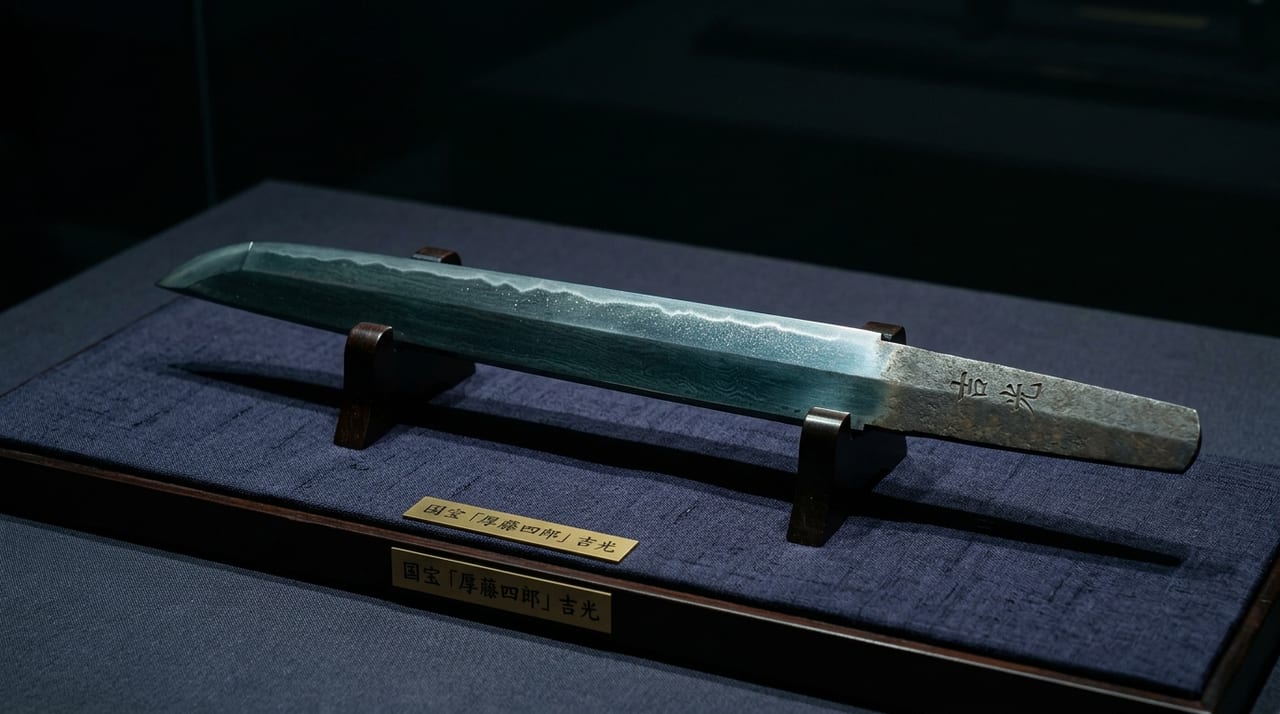
 * Image is for illustrative purposes only.
Atsushi Tōshirō
厚藤四郎
Also known as: The Thick Tōshirō
Description
Overview of the Sword
Atsushi Tōshirō is a National Treasure masterpiece that stands out as a particularly “thick-built” example among the tantō forged by the master smith Awataguchi Yoshimitsu of the mid-Kamakura period. “Tōshirō” was Yoshimitsu's common name. Because his tantō were generally called “[name] Tōshirō” by custom, this tantō, true to its name with its notably thick, stocky, and powerful build, is called “Atsushi Tōshirō.” Although it is a small tantō with a blade length of approximately 21.8 cm (7 sun 2 bu), its thickness (kasane) stands out even when compared with the other Yoshimitsu tantō, and this unusual thickness became the source of its name. Among all of Yoshimitsu's works, which established the pinnacle of tantō culture in the Kamakura period, it has drawn special attention from sword researchers and enthusiasts as the most distinctive piece.
Awataguchi Yoshimitsu—Master of Tantō
Awataguchi Yoshimitsu was a swordsmith who lived in Awataguchi, Yamashiro Province, in the mid-Kamakura period (late 13th century), and is one of the most eminent master smiths in the history of swords, producing one masterpiece of the Awataguchi school after another. Yoshimitsu's tantō, affectionately known by the common name “Tōshirō,” have been acclaimed for over seven hundred years as among the highest-standard works in the history of Japanese swords, and many of the extant works with secure signatures have been designated National Treasures or Important Cultural Properties. The most defining feature of Yoshimitsu's tantō is, above all, the precision of their jigane (ground steel). Their beautiful steel color, with well-packed ko-itame hada, fine jinie, and both lustre and transparency, is a distinctly Awataguchi-school achievement that no other school has been able to match. The hamon is based on sugu-ba with ko-nie, and the nioguchi is bright and clear, showing a finish that is pure, limpid, and dignified. The name Awataguchi Yoshimitsu continues to shine today, seven hundred years later, as a symbol of the summit of Japanese sword culture.
Blade Details of Atsushi Tōshirō
Atsushi Tōshirō is a tantō of hira-zukuri construction, and its greatest feature is, as its name suggests, its exceptionally thick kasane (blade thickness). Whereas ordinary Yoshimitsu tantō give an impression of refinement and delicacy, Atsushi Tōshirō has a bold and powerful presence. The jigane has well-packed itame with jinie and chikei, presenting the clear steel color characteristic of Yoshimitsu, and the hamon is in a sugu-ba style with ko-nie, showing a refined finish with a bright, clear nioguchi. The bōshi shows a graceful form, returning in a plump ko-maru, and the nakago is ubu, with the two-character signature “Yoshimitsu” carefully cut with fine chisel work. This thick kasane may also be interpreted as a functional design intended to achieve maximum effect as a practical tantō for thrusting through gaps in armor. If Yoshimitsu consciously chose this construction as a “fighting tantō” that resists breaking and excels in thrusting power, then Atsushi Tōshirō stands out anew in value as a masterpiece in which beauty and function are fused at a high level.
Provenance—From the Muromachi Shogunate to the Tokugawa
Atsushi Tōshirō was originally owned by the Ashikaga shogunal family, and it is said to have been used as the sword worn by the ninth shogun, Ashikaga Yoshihisa. The Ashikaga shogunal family was especially devoted to collecting and appraising swords, and many of Yoshimitsu's tantō were gathered as okoshimono (the shogun's personal swords). After the fall of the Muromachi shogunate, it passed out of the shogunal family and went through the hands of Hon'ami Yūtoku, then Hitotsuyanagi Naosue, Kuroda Yoshitaka, Toyotomi Hidetsugu, and Hideyoshi, and was transmitted to Mōri Hidemoto. In Kanbun 4 (1664), it was presented by Mōri Tsunamoto to the fourth shogun, Tokugawa Ietsuna, and from then on it was handed down within the Tokugawa shogunal house. It is currently held by the Tokyo National Museum, and it was designated a National Treasure in Shōwa 31 (1956).
Form and Characteristics of the Blade
The greatest feature of Atsushi Tōshirō lies in its “thickness of the kasane (the thickness on the mune side),” as its name indicates. Yoshimitsu's tantō as a group generally have a finely crafted and refined construction, but Atsushi Tōshirō stands out among them for its notably thick kasane, giving a stocky and powerful impression in cross-section. It is an extremely small tantō with a blade length of seven sun two bu (approximately 21.8 cm), but it received this name because its moto-kasane (thickness at the base) of about 11 millimeters clearly differs from the others. The jigane has well-packed itame with jinie and chikei, and the lustre of its refined steel with a bluish tinge is superb. The hamon is sugu-ba (straight temper), with a medium yaki-haba, a deep nioguchi, and vigorous activity within the hamon, such as ashi, yō, and kinsuji. The bōshi returns in a ko-maru, the ha-machi (edge-side shoulder) and mune-machi (back-side shoulder) are clearly defined, and the finishing of the nakago is also careful. The nakago is ubu, and the two-character signature “Yoshimitsu” is neatly cut. It is currently held by the Tokyo National Museum and has been designated a National Treasure. It is preserved in especially fine condition among Yoshimitsu's works and conveys the essence of forging technique to the present day.
The Tokugawa Shogunate and the Provenance of Atsushi Tōshirō
Particularly important in the provenance of Atsushi Tōshirō is the fact that it was kept for a long period as a okoshimono of the Tokugawa shogunal family. In the Edo period, the Tokugawa shogunal family widely collected famous swords called “famous treasures of the realm,” and kept them under strict custody in the okoshimono storehouse managed by a dedicated office, the Okoshimono-kata. Atsushi Tōshirō was registered as a okoshimono from an early date, was also recorded in the Kyōhō Meibutsuchō compiled at the command of the eighth shogun, Tokugawa Yoshimune, and is placed at the beginning in one line of its manuscript copies (Category 1). Several of Yoshimitsu's tantō were transmitted to the shogunal family, but Atsushi Tōshirō held a special position even among them. From the Meiji period onward, it was passed down within the Tayasu Tokugawa family, and in Shōwa 13 (1938) it was delivered by Tokugawa Satotaka, head of the Tayasu Tokugawa family, to the Imperial Household Museum (now the Tokyo National Museum), where it has remained to the present. Managed under strict conditions as a National Treasure, this sword is exhibited at exhibitions so that many people can see it in person, and it continues to be valued today as the pinnacle of Japanese sword art.
Legends & Stories
Yoshimitsu's Tantō and the Origin of the Name “Tōshirō”
The fact that Awataguchi Yoshimitsu's tantō are called by the affectionate name “Tōshirō” derives from the fact that Yoshimitsu's common name was “Tōshirō.” In the world of Japanese swords, there is a custom of incorporating the name of a renowned smith into the name of a sword, and the naming “○○ Tōshirō” was widely applied to Yoshimitsu's tantō. Yagen Tōshirō, Honebami Tōshirō, Hōchō Tōshirō, Midare Tōshirō, Hirano Tōshirō, and Namazuo Tōshirō are all distinctive names given to Yoshimitsu's works, each embodying in its name the individual characteristics and provenance of the blade. Among them, Atsushi Tōshirō takes as its name “thickness,” the simplest and most direct of characteristics, a naming that lets anyone who sees it grasp its individuality at once. Yoshimitsu is known in the history of Japanese swords as a master of tantō, and by bringing the aesthetics peculiar to tantō, distinct from tachi and katana, to their utmost height, his tantō continue to receive the highest acclaim even now, more than seven hundred years later.
Thickness as Character—The Technical Depth of Yoshimitsu
The “thickness” of Atsushi Tōshirō, going beyond a mere feature of shape, testifies to the range of Yoshimitsu's technical skill and to his deliberate design as a smith. Whereas ordinary Yoshimitsu tantō are characterized by delicate and refined thin construction, Atsushi Tōshirō has a bold and powerful build at the opposite extreme. Showing a difference so great that it is hard to believe it is by the same smith, yet still bearing Yoshimitsu's fine jigane and clear hamon, this fact shows both the technical breadth of Yoshimitsu and his earnest attention to each individual blade. It is not clear why Yoshimitsu chose a special thick construction for this blade. On the battlefield, the tantō was important as a close-combat weapon for thrusting through gaps in armor or in the menpō, and a blade with thick kasane resists breaking and excels in penetrating power. As a high-level fusion of beauty and function, Atsushi Tōshirō is an indispensable piece within the world of Yoshimitsu's works.
The Kyōhō Meibutsuchō and Edo-Period Appraisal
The Kyōhō Meibutsuchō, a catalogue of famous swords compiled by the Hon'ami family at the command of the eighth shogun, Tokugawa Yoshimune, is an official record covering the swords renowned throughout the realm at that time, and being recorded in this book meant receiving shogunate-endorsed recognition as a “famous treasure of the realm.” Atsushi Tōshirō is recorded in the Kyōhō Meibutsuchō, which proves that it was prized as a famous treasure of the realm even in the Edo period. Swords treated as okoshimono of the shogunal family were symbols of the shogun's authority, and were also spiritual guardians of the Tokugawa house. The fact that many works of the Awataguchi school, the highest of pedigrees, among Yoshimitsu's tantō gathered in the shogunal family was also one proof that the Tokugawa house was a ruler with the highest connoisseurship of swords.
Modern Yoshimitsu Fever and Atsushi Tōshirō
In recent years, Awataguchi Yoshimitsu's tantō have been depicted as individually characterful figures in the sword-personification game Touken Ranbu. Atsushi Tōshirō also appears as a character and is loved by many fans. The sharp increase in fans visiting the Tokyo National Museum to see the actual swords, and the fact that the work of a medieval master smith continues to move young people today, shows the astonishing vitality of Japanese sword culture. Across seven hundred years, the sound of Yoshimitsu's hammer still resonates in people's hearts through this sword.
The End of Toyotomi Hidetsugu and Atsushi Tōshirō
In Bunroku 4 (1595), Toyotomi Hidetsugu, who was suspected by Toyotomi Hideyoshi of plotting rebellion and forced to take his own life at Mount Kōya, is said to have given Atsushi Tōshirō to his attendant Yamada Sanjūrō just before his death, and Sanjūrō also performed seppuku with this tantō and followed his lord in death. Afterward, it is thought that Atsushi Tōshirō was confiscated by Hideyoshi, and after Hideyoshi's death, Mōri Hidemoto received it as a keepsake distribution.
Upheaval of the Bakumatsu and Meiji Periods and the Fate of Swords
The turbulent period from the late Edo era through the Meiji era was a time of trial for many famous swords. The enforcement of the Haitōrei (Sword Abolition Edict) in Meiji 9 (1876), the decline of the former samurai class, and the wave of Westernization brought by Bunmei Kaika (Civilization and Enlightenment) greatly shook the social standing of Japanese swords, which had long been the spiritual and material symbol of the samurai. Atsushi Tōshirō continued to be passed down within the Tayasu Tokugawa family after the Meiji period, and in Shōwa 13 (1938) it was delivered by Tokugawa Satotaka to the Imperial Household Museum (now the Tokyo National Museum). It was designated an Important Cultural Property in Shōwa 30 (1955), and a National Treasure the following year, Shōwa 31 (1956), and it is still held by the Tokyo National Museum today.