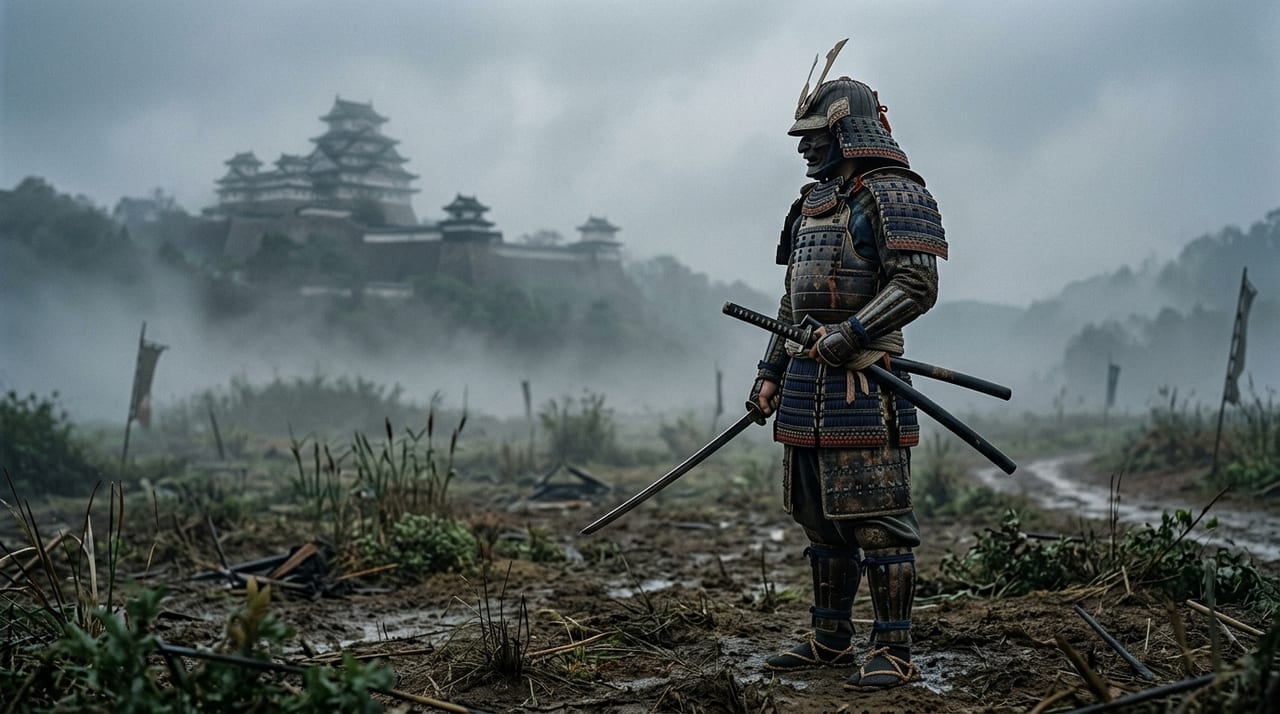
 * Image is for illustrative purposes only.
Miyamoto Musashi
宮本武蔵
Sword Saint
Description
The Birth of a Sword Saint
Miyamoto Musashi (Shinmen Musashi-no-Kami Fujiwara no Genshin), said to have been born in Harima or Mimasaka Province in Tenshō 12 (1584), boasted of being undefeated in more than sixty duels with live blades. Together with the title "Sword Saint," he is known to all as the most iconic swordsman in the history of the Japanese sword. As founder of the Niten Ichi-ryū, he perfected the two-sword style, and the Gorin no Sho (The Book of Five Rings), which he wrote in his later years, is still read around the world as a landmark of military strategy.
Early Duels
Musashi's swordsmanship career began with his first duel at the age of thirteen. After winning his first duel against Arima Kihei of the Shintō-ryū, Musashi traveled through the provinces, defeating one famous swordsman after another. His series of battles against the Yoshioka school shook the sword world of Kyoto. At the Battle of Ichijōji Sagarimatsu, he is said to have fought alone against several dozen members of the Yoshioka school and destroyed them.
The Duel at Ganryūjima
The most famous duel of Musashi's life was his battle with Sasaki Kojirō on Ganryūjima in Keichō 17 (1612). Musashi arrived late at the small island in the Kanmon Strait, carrying a wooden sword he had carved from a boat's oar. Against Kojirō's long sword, known as "Monohoshizao," Musashi used a longer wooden sword to gain the advantage in distance and defeated Kojirō with a single blow. That Musashi chose a wooden sword rather than a live blade for this decisive battle has given rise to much debate and interpretation in later generations. For Musashi, what mattered was not the fame of the sword but the skill and state of mind to wield any weapon freely.
The Pinnacle of Martial Skill
Musashi's Niten Ichi-ryū is a school of strategy that uses two swords, a long sword in the right hand and a short sword in the left. In the Gorin no Sho, Musashi logically explains the advantages of using two swords. He held that one who has mastered the skill of wielding the long sword with one hand could fight freely on horseback, among crowds, or in confined spaces, and he placed importance on adaptability to every situation. For Musashi, the essence of strategy was not to cling to particular forms or schools, but to comprehend the principles of all things and reach a state of freedom.
Teachings of the Gorin no Sho
The Gorin no Sho consists of five scrolls, Earth, Water, Fire, Wind, and Void. It is Musashi's life's work and comprehensively discusses everything from swordsmanship techniques to life philosophy. "Use a thousand days of practice as forging, and ten thousand days of practice as tempering." "Having a stance yet no stance" (uko muko). These teachings go beyond swordsmanship as universal life lessons, and they are widely quoted in today's business world.
Philosophy on Swords
Musashi warned against becoming attached to any particular famous blade. In the Gorin no Sho, he criticizes other schools that favor long swords, short swords, or heavy swinging cuts, and he argues that one should choose the most suitable weapon for the situation. A sword said to have been used by Musashi is the "Izumi-no-Kami Kaneshige," but in light of Musashi's philosophy, this sword too would have been merely one of the many weapons he used. The wooden sword of Ganryūjima was, for Musashi, a "weapon" equal to a live blade.
Later Years and Legacy
Musashi was not only a master swordsman but also an artist skilled in calligraphy and painting. His ink paintings "Uzu-zu" (Cormorant) and "Koboku Meikakuzu" (Shrike on a Withered Branch) have been designated Important Cultural Properties. Their piercing brushwork, like his sword, shows a state of mind that captures a single moment of inspiration. He is also said to have been versed in woodworking and metalworking and to have been involved in making sword guards (tsuba). For Musashi, the sword and art were equally expressions of "the Way."
In Kan'ei 17 (1640), Musashi was invited by Hosokawa Tadatoshi, lord of the Kumamoto Domain, to serve as a guest retainer. From Kan'ei 20 (1643), he is said to have shut himself away in the Reigandō cave in Kumamoto and begun work on the Gorin no Sho. In Shōhō 2 (1645), Musashi died in Kumamoto at the age of sixty-two. His life began with the sword and ended with the sword, and it was a grand spiritual quest that elevated the sword from a mere weapon into an embodiment of "the Way."
Notable Swords
- Izumi-no-Kami Kaneshige (traditionally said to have been used by Musashi; Kaneshige was a swordsmith active in Edo who is said to have served Tōdō Takatora)
- Musashi's bokutō (used in the duel on Ganryūjima; said to have been carved from a boat oar, it gave him a reach exceeding Kojirō's 'Monohoshizao')