New Arrivals — Browse our catalog for the latest authentic Japanese sword arrivals. Browse →
c. 1604 (Keichō 9), per tradition (based on the "Kokura Hibun," "Niten-ki," and other sources compiled after Musashi's death)
Ichijōji Sagarimatsu, on the outskirts of Kyoto (present-day Ichijōji, Sakyō Ward, Kyoto City)
Forces
Miyamoto Musashi (alone)
The Yoshioka school
About 15 min read
The duel at Ichijōji Sagarimatsu is told as the final clash in a series of duels between the celebrated swordsman Miyamoto Musashi and the prestigious Yoshioka school of swordsmanship in Kyoto. However, accounts of this duel are almost entirely absent from Edo-period local gazetteers, and the story rests primarily on commemorative sources compiled long after Musashi's death: the "Kokura Hibun" inscription, said to have been erected by his adopted son Miyamoto Iori; the later-compiled "Niten-ki"; and the "Bukōden," said to have been passed down through Musashi's disciples. The "Niten-ki" in particular was compiled in the mid-Edo period, more than a century after Musashi's death, with a strong intent to celebrate him as a hero, and is widely considered likely to contain embellishment and exaggeration. What follows should be understood with this reliance on later tradition in mind.
Musashi's own martial treatise, the "Gorin no Sho," written during his lifetime, mentions the duels with the Yoshioka school only briefly and contains no specific description of a large-scale group battle at Ichijōji Sagarimatsu. For this reason, while many researchers consider the duel's basic occurrence to reflect historical fact to some degree, the specific course of events, scale, and outcome are thought to be heavily colored by embellishment from later commemorative sources.
According to tradition, in 1604 (Keichō 9), the 21-year-old Miyamoto Musashi challenged the prestigious Yoshioka dojo — hereditary swordsmanship instructors to the Ashikaga shogunal house — to a match. Musashi is said to have defeated the dojo's head, Yoshioka Seijūrō, in single combat, and subsequently defeated Seijūrō's younger brother, Yoshioka Denshichirō, in a rematch. Having lost face through these successive defeats, the Yoshioka school reportedly sought a third and final reckoning with Musashi to restore its honor. For a school that had served for generations as hereditary swordsmanship instructors to the Ashikaga shogunal house, losing first to an unknown young swordsman and then to his brother in succession is said to have been a crisis serious enough to threaten the dojo's very survival. Prior to this feud with the Yoshioka school, Musashi is said to have traveled the provinces engaging in numerous matches with other swordsmen, and the duel at Ichijōji Sagarimatsu is positioned as the culmination of this period of martial pilgrimage (musha shugyō).
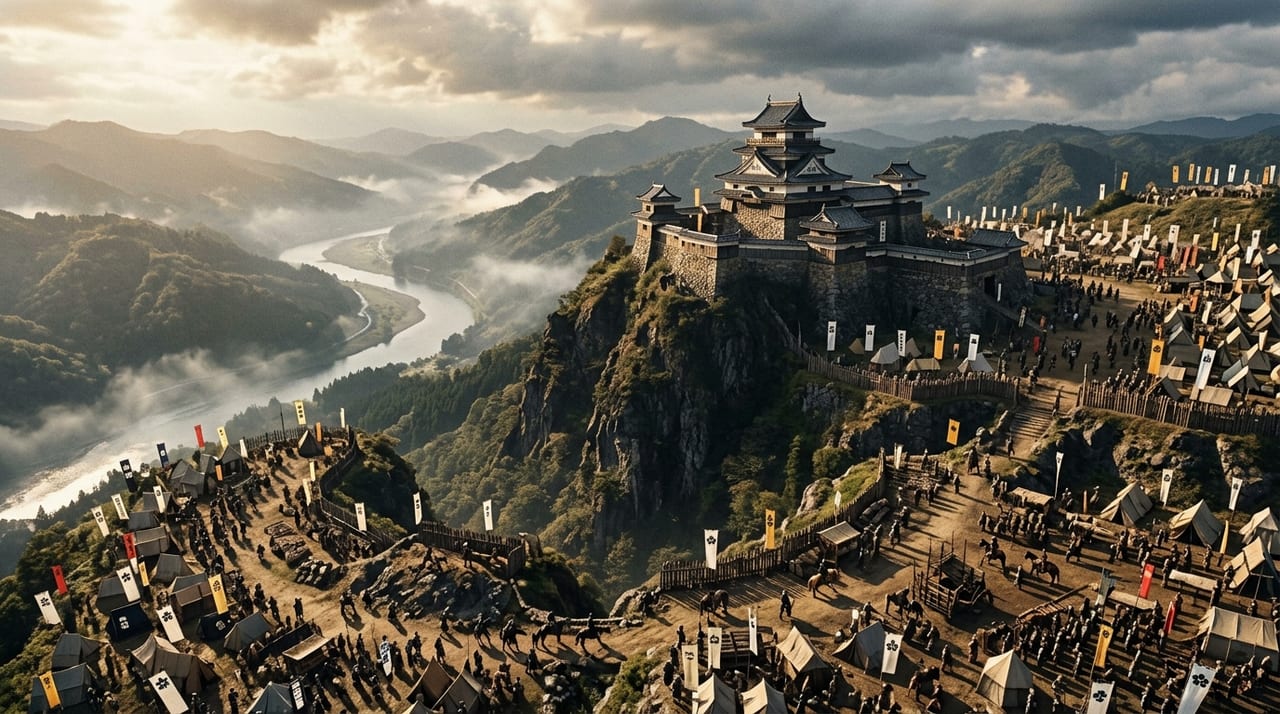
According to the "Kokura Hibun," the Yoshioka school placed Seijūrō's young son, Matashichirō, at its nominal head and, with several hundred disciples reportedly armed even with bows and firearms, lay in wait for Musashi at Ichijōji Sagarimatsu on the outskirts of Kyoto (present-day Ichijōji, Sakyō Ward, Kyoto City, near Shisen-dō). Musashi, sensing the ambush, is said to have rushed down a mountain path from behind the site, cut down the young nominal head Matashichirō first, and cut his way through the confused ranks of disciples to escape the crisis. This account of Musashi single-handedly fighting his way out against overwhelming numbers has been widely passed down as an emblematic legend of his prowess as a master swordsman. The site of the duel lay along a road leading from central Kyoto toward Mount Hiei, an area then lined with pine trees on the city's outskirts. Musashi's tactic of rushing down from the mountainside to launch a surprise attack has, in some readings, been seen as a practical application of using terrain against a numerically superior opponent — an approach consistent with the combat philosophy later expressed in the "Gorin no Sho."
However, this series of duels with the Yoshioka school shows major discrepancies between sources, raising serious doubts about its historicity. For instance, the "Yoshioka-den," compiled in 1684 (Jōkyō 1), records that the duel between Musashi and the Yoshioka side ended in a draw, with Musashi only wounded on the forehead — a version starkly at odds with the decisive victory described in the "Kokura Hibun." It has also been noted as a contradiction that while Musashi is said to have spoken often in his later years about the Yoshioka duels, he reportedly said almost nothing about his later duel with Sasaki Kojirō at Ganryūjima. The number of disciples actually involved in the fighting is also reported inconsistently across sources, ranging from several dozen to several hundred, and the very premise of one man single-handedly prevailing against a force of several hundred is widely regarded as implausible. Many researchers conclude that this episode was likely gradually embellished and expanded after Musashi's death as part of commemorative efforts led by his adopted son, Miyamoto Iori, among others. Iori rose to become a senior retainer (karō) of Akashi domain in Harima Province, and it has been suggested that the erection of the "Kokura Hibun" honoring his adoptive father's achievements may also have served to legitimize Iori's own lineage and status. The "Kokura Hibun" was erected in 1646 (Shōhō 3), two years after Musashi's death, at Tamukeyama in Kokura; while it is treated as one of the oldest surviving sources on Musashi's life, its character as a memorial stele commissioned by an adopted son means its objectivity requires a degree of caution.
The Yoshioka dojo was a hereditary line of swordsmanship instructors who had served the Ashikaga shogunal house since the Muromachi period, known for the Yoshioka-ryū style descended from the Kyō-hachi-ryū tradition. Miyamoto Musashi, for his part, is known as the founder of the Niten Ichi-ryū (two-sword) style he established in his later years, but some views hold that at the time of the Ichijōji Sagarimatsu duel he had not yet developed his distinctive two-sword fighting style, and traditions differ as to exactly what weapons and techniques he used. It was only in his later years that Musashi himself, in the "Gorin no Sho," described having established the martial philosophy of the Niten Ichi-ryū; at the time of the supposed 1604 duel, he is thought to have still been a young swordsman in the midst of his provincial training pilgrimage. No reliable source records which sword Musashi carried at the time; the blades that later tradition celebrates as "Musashi's beloved swords" are all based on accounts spanning his entire life, and no confirmed record ties a specific sword to this particular duel at Ichijōji Sagarimatsu. In recent sword scholarship and Musashi studies, the Ichijōji Sagarimatsu episode is increasingly treated less as a reflection of the historical Musashi than as one facet of the "sword saint" image constructed in later generations, with a growing tendency to separate the verification of historical fact from the analysis of legend.
Although barely recorded in Edo-period gazetteers, this episode became widely known after novelist Yoshikawa Eiji gave it prominent treatment in his Shōwa-era novel "Miyamoto Musashi." It has since been repeatedly depicted in films, television dramas, and manga, becoming established as one of the defining episodes shaping the popular image of Musashi as a master swordsman. Today, Ichijōji in Sakyō Ward, Kyoto, preserves a stone monument inscribed "Site of Miyamoto Musashi's Duel," along with a pine tree said to mark the site of the battle (the original tree has since died, and a successor has been planted in its place). The nearby Hachidai Shrine also houses a statue of Musashi commemorating an anecdote — echoing themes from the "Gorin no Sho" — in which Musashi, on his way to the duel, checked his impulse to pray for the gods' protection and instead disciplined himself with the resolve "I revere the gods and buddhas, but do not rely on them," passing by the shrine without stopping. Apart from the doubts about its historicity, the site remains cherished today as a local tourist attraction and cultural memory. Each year, Hachidai Shrine holds rites and commemorative events related to Musashi, drawing kendo practitioners and admirers from across Japan. Beyond the scholarly debate over fact versus legend, the duel at Ichijōji Sagarimatsu continues to hold an important place in the history of Japanese swordsmanship and sword culture today, as a symbolic story that, through the figure of Miyamoto Musashi, carries forward Japan's tradition of swordsmanship and the spirit of bushidō.