New Arrivals — Browse our catalog for the latest authentic Japanese sword arrivals. Browse →
August 15–16, 1863 (Bunkyū 3, 7th month, 2nd–3rd day)
Kinko Bay (coastal area of Kagoshima City) and the Kagoshima Castle town
Forces
Satsuma Domain
British East India Squadron
About 18 min read
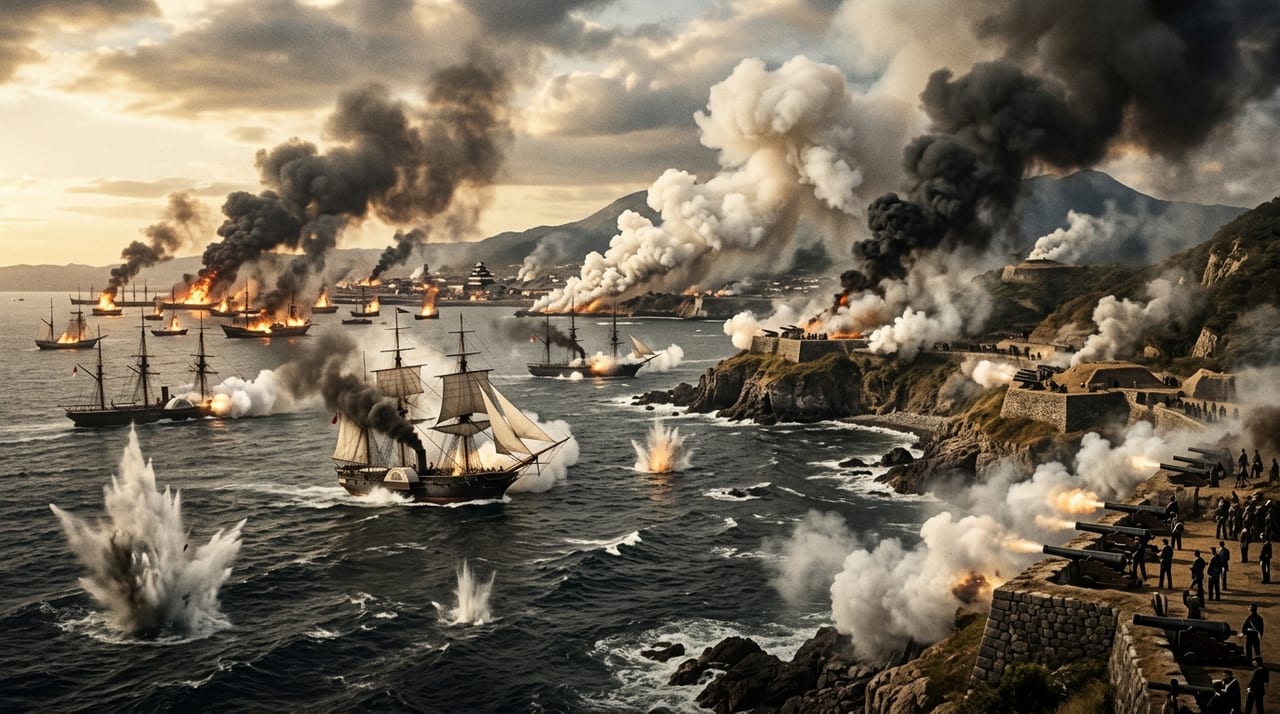
On August 15–16, 1863 (Bunkyū 3/7/2–3), the Satsuma-British War was fought in Kagoshima Bay, where the Satsuma domain and the British squadron of the East Indies and China Station clashed. It was one of the most dramatic events of the late Tokugawa period, a head-on collision between the jōi (expel-the-barbarians) movement and the modern military power of the Western powers. The direct trigger for the war was the Namamugi Incident of the eighth month of Bunkyū 2 (1862), the year before.
On September 14, 1862 (Bunkyū 2/8/21), the procession of Shimazu Hisamitsu, guardian of the Satsuma daimyō, passed along the Tōkaidō through Namamugi village (today's Tsurumi Ward, Yokohama). The British merchant Charles Richardson tried to cross the procession while still mounted, and he was cut down and killed by Satsuma retainers. Two other Britons were wounded. This incident became one of the grave cases in which the jōi movement took the lives of foreigners. The British government demanded from the bakufu and the Satsuma domain a large indemnity (100,000 pounds from the bakufu and 25,000 pounds from the Satsuma domain) and the punishment of the perpetrators. The bakufu agreed to pay, but the Satsuma domain continued to refuse payment stubbornly.
On August 11, 1863 (Bunkyū 3/6/27), Rear-Admiral Augustus Kuper arrived in Kagoshima Bay at the head of the seven-ship British squadron of the East Indies and China Station and presented the Satsuma domain with an ultimatum. There were two demands: (1) payment of the indemnity, and (2) punishment of the murderers of Richardson. The Satsuma domain rejected these demands, and the negotiations broke down. On August 15, 1863 (Bunkyū 3/7/2), the British squadron made a surprise seizure of three Satsuma steamers: the Ten'yū Maru, the Seiyō Maru, and the Hakuhō Maru. In response to this provocation, the Satsuma batteries immediately opened fire, and the war began.
The Satsuma batteries along the shore of Kagoshima Bay were armed with more than 80 cannon, many of them Western-style cast guns. The British squadron met resistance far fiercer than it had expected. The violent fire of the Satsuma batteries heavily damaged the British flagship HMS Euryalus. Captain Josling, the ship's captain, and Commander Wilmot, her executive officer, were killed by direct cannon hits, a shocking development. In total, 13 men in the British squadron were killed and about 50 were wounded. In retaliation, the British bombarded the city of Kagoshima, burning Satsuma warehouses, factories, and the Shūseikan (the Shimazu family's complex of modern factories), among other sites. The three Satsuma steamers that had been captured were also burned. On the Satsuma side, 5 were killed, many were wounded, and parts of the city were destroyed by fire.
The Shūseikan, destroyed by the British bombardment, was a complex of modern industrial facilities built in the late Tokugawa period by Shimazu Nariakira, lord of the Satsuma domain. It included Japan's first Western-style factories, ironworks, and glassworks, making it an advanced installation. The Shūseikan was a symbol of Japan's independent search for modernization, and the fact that Western warships destroyed it deeply shocked the sonnō-jōi faction in Satsuma. Ironically, however, this destruction became the greatest lesson that taught Satsuma the impossibility of jōi. The Shūseikan was rebuilt after the war (today's Shōko Shūseikan Museum), and Satsuma shifted its course toward a more full-scale introduction of Western technology and modernization.
As a result of the Satsuma-British War, the Satsuma domain paid the indemnity on the surface (25,000 pounds), though in practice it diverted money borrowed from the bakufu to do so, and Anglo-Satsuma relations improved rapidly. From 1864 onward, Satsuma purchased the latest steam warships and weapons from Britain. The Satsuma leaders drew from the fact that a squadron of only seven British ships had inflicted such damage the conclusion that "jōi is impossible, and unless Japan adopts foreign technology and achieves a wealthy country with a strong military, it cannot escape the fate of ruin." This understanding led to Satsuma's active involvement in the later Satsuma–Chōshū Alliance (1866), the Taisei Hōkan (return of power to the emperor, 1867), and the Meiji Restoration (1868).
The fighting of Satsuma samurai in the Satsuma-British War also clearly showed the limits of the Japanese sword as a weapon of its era. In the artillery duel in Kagoshima Bay, the tachi and katana of the Satsuma samurai were of no use at all. The protagonists of the battle were the cannon, the steam warships, and Western military technology. However, this recognition did not deny the value of the Japanese sword. Satsuma's samurai culture had nurtured a distinctive swordsmanship, the Jigen-ryū, and the force of its technique was so intense that other domains warned, "Do not take the first strike of Jigen-ryū." That intensity was the very spirit of the Satsuma warrior. Even after the Satsuma-British War, Satsuma samurai continued to wear swords and to train in Jigen-ryū.
Even in the modern military buildup that the Satsuma domain pursued after the Satsuma-British War, the sword remained the spiritual pillar of the shizoku (samurai class). The extraordinary strength in hand-to-hand combat shown by Jigen-ryū swordsmen in the Satsuma Rebellion (Seinan War, 1877) was the ultimate expression of this Satsuma sword culture. The Satsuma-British War should be positioned in the history of Japanese swords not as "the end of the age when the sword was the protagonist," but as "the turning point at which samurai who carried swords became the agents of Japan's modernization." Defeated by cannon and steam warships, the Satsuma warriors did not abandon their swords. Carrying their swords, they learned Western technology and took on the role of leading Japan's modernization.
Komatsu Tatewaki was a senior retainer who became the linchpin of the Anglo-Satsuma negotiations after the Satsuma-British War, and he handled diplomatic affairs while wearing a sword himself. Saigō Takamori, Ōkubo Toshimichi, Godai Tomoatsu, and other Satsuma men of purpose also pursued the policy of a wealthy country with a strong military, drawing directly on the experience of the Satsuma-British War. The swords they owned are still handed down today in museums and at donor institutions across Japan, preserving the sword culture of late Bakumatsu Satsuma.
Godai Tomoatsu (1836–1885) is known as a businessman who later contributed to the development of the Osaka business world, but during the Satsuma-British War he experienced being captured as a prisoner by a British ship. This captivity led him to study in Britain and to master modern economics, and it eventually drove him to devote himself to building the economic foundations of modern Japan, including the founding of what became the Osaka Chamber of Commerce and Industry. The ironic experience of being held prisoner aboard a British steam warship, peculiar to the late Tokugawa period, helped shape a figure of the modern era.
Satsuma had engaged in active trade with Portugal since the Sengoku period, and it is also known as the place where matchlock guns were first introduced to Japan at Tanegashima (Tenbun 12, 1543). At the same time, Satsuma's sword smiths also developed independently, and the swords of the smiths known as Satsuma shintō had a distinctive style that combined practicality with sharpness. The sword culture of Satsuma, nurtured together with the Jigen-ryū swordsmanship, continued vigorously until the Bakumatsu period. Many of the Satsuma samurai who fought in the Satsuma-British War took their positions in the batteries along the shore of Kagoshima Bay wearing swords made by these Satsuma smiths.
The Satsuma-British War ended as a brief armed clash, but its historical impact was enormous. First, the Satsuma domain's foreign policy fundamentally shifted from jōi to opening the country and overthrowing the bakufu. Second, the rapprochement between Satsuma and Britain became a remote cause of the formation of the Satsuma–Chōshū Alliance with the Chōshū domain. Third, Britain came to regard Satsuma as a powerful force that could oppose the bakufu, and it came to exert a certain influence on Japan's domestic politics.
Historic sites that preserve traces of the artillery duel of the Satsuma-British War still exist within Kagoshima city. The Shōko Shūseikan (the former Shūseikan site) was registered in 2015 as a constituent asset of the World Heritage site "Sites of Japan's Meiji Industrial Revolution." The shoreline where the British ships anchored still conveys the turbulence of the Bakumatsu period. Five years after the Satsuma-British War, in Meiji 1 (1868), the Tokugawa bakufu fell to the Boshin War led by the Satsuma domain, and the Meiji Restoration was achieved. The Satsuma-British War was one of the greatest turning points of the Bakumatsu period, standing at its starting point.
The Shūseikan Machine Factory (the surviving stone factory building), completed in Keiō 1 (1865), was a rebuilt and modernized version of the old Shūseikan, which had been burned in the Satsuma-British War bombardment. It is now used as the main building of the Shōko Shūseikan Museum. The Satsuma people rebuilt with Western technology what the gunfire of the Satsuma-British War had burned. This symbolic fact aptly illustrates the essence of the Meiji Restoration.