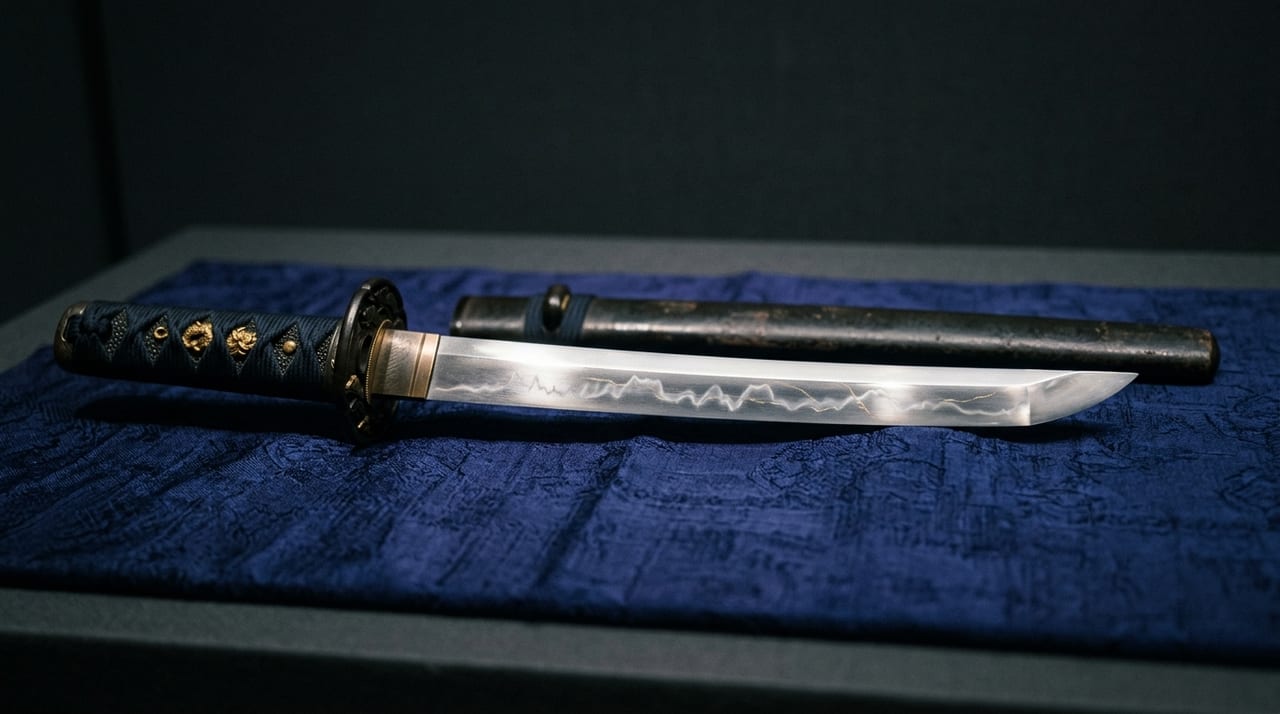
 * Image is for illustrative purposes only.
Beloved Sword of Miyamoto Musashi
宮本武蔵の愛刀
Also known as: Musashi's Sword (Blade of the Sword Saint, Founder of Niten Ichi-ryū)
Description
Miyamoto Musashi (1584–1645) was the sword saint of the early Edo period and the founder of the Niten Ichi-ryū (Two Heavens as One) school, the most celebrated swordsman in the history of Japanese martial arts. His more than sixty undefeated duels and the military philosophy treatise "The Book of Five Rings" (Go Rin no Sho), written in his final years, have had incalculable influence on posterity. His beloved sword occupies a special place in Japanese sword culture as a relic embodying his two-sword philosophy and his life as a sword saint. Born in Harima or Mimasaka Province, Musashi won his first real duel at age thirteen and traveled the country refining his skills. At twenty-nine, he defeated Sasaki Kojirō on Ganryū Island (present-day Yamaguchi Prefecture), earning his reputation as the greatest swordsman in the land. In his later years, invited by Hosokawa Tadatoshi, lord of Kumamoto domain, he took up residence in Higo and wrote "The Book of Five Rings" at Reigan Cave. His two-sword style used a longer uchigatana as the primary blade and a shorter wakizashi as the secondary. Several attributed pieces survive at Musashi Shrine in Mimasaka City (Okayama Prefecture) and at temples in Kumamoto associated with the Hosokawa family. Whether or not each piece can be confirmed as Musashi's own blade, swords bearing his name have been venerated as vessels of the sword saint's spiritual power, drawing martial artists on pilgrimage to this day. In Musashi's philosophy, the sword was not merely a weapon but the embodiment of heihō — the way of strategy — and his beloved blade remains a spiritual touchstone for martial artists in the twenty-first century.
Legends & Stories
Many legends surround Miyamoto Musashi's sword. At the duel on Ganryūjima, the wooden sword Musashi used is said by some accounts to have been whittled from the rudder of the small boat that brought him to the island — a story passed down as proof of his attainment beyond attachment to tools. A ghost-story tradition from Kumamoto holds that while Musashi was writing "The Book of Five Rings" in Reigan Cave in his later years, his beloved sword slid from its scabbard on its own in the night and emitted a pale blue glow when the tip touched the cave wall. It is also said that a swordsmith who copied the form of Musashi's blade gazed at the polished result in a mirror and saw Musashi's face appear — a story that perpetuates the belief that "the soul of the sword saint dwells in the blade." Among martial artists today, the saying survives that "one who holds Musashi's sword even once draws closer to the essence of the sword way," and his attributed blades remain pilgrimage sites for practitioners of the martial arts throughout Japan.