What Is the Kusarigama——Structure, Usage, and Schools; the Duel Legend with Miyamoto Musashi, and the Reality of Ninja Culture
 * Image is for illustrative purposes only.
Table of Contents
What Is the Kusarigama — A Composite Weapon Born from a Farm Tool
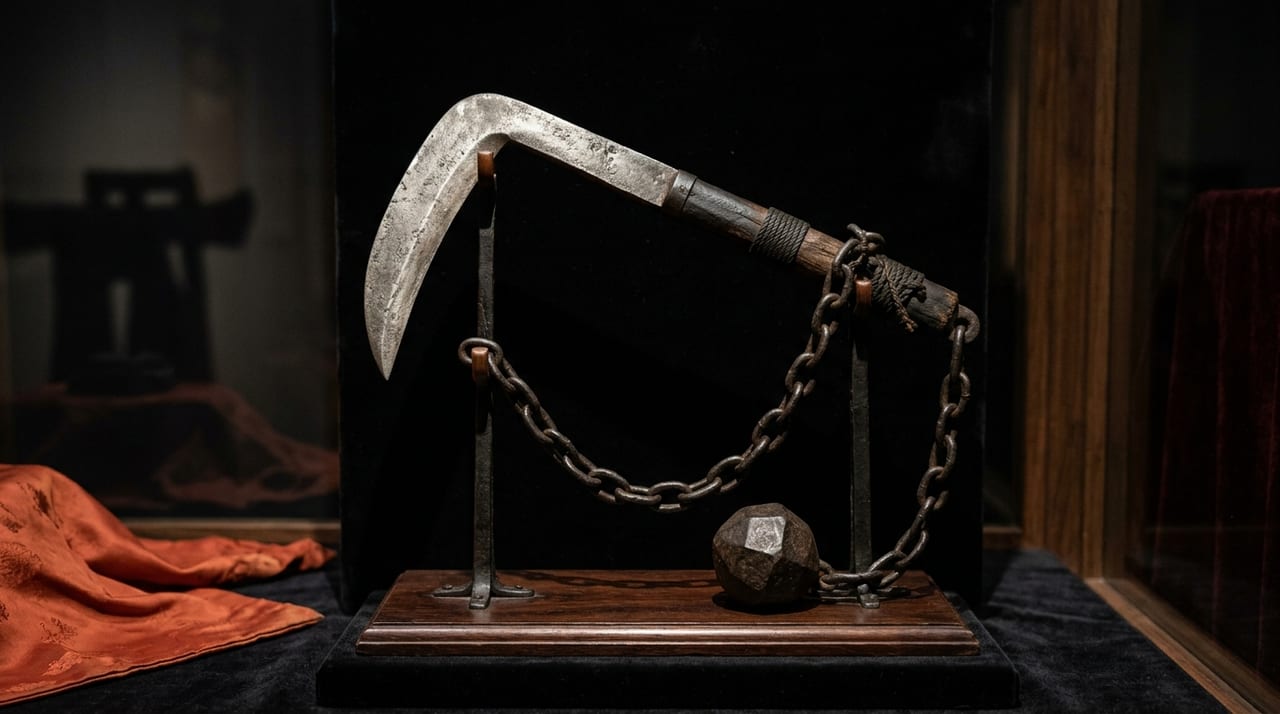
The kusarigama is a composite weapon in which a chain is attached to a kama and an iron weight called a fundo is tied to its end. It is a kama used for farm work that was modified into a weapon; although it belongs to an entirely different class of weapons from swords, it is frequently discussed in the context of "duels against the sword" in the history of Japanese martial arts.
The origins of the kusarigama are not clear, but it is said to have been systematized as a martial art from the late Muromachi period through the Sengoku period. The prevailing theory holds that the prototype was developed by farmers, rural samurai, and others who could not freely carry regulation swords, who repurposed and modified farm tools and everyday implements as weapons. Even today, kusarigama-jutsu is transmitted in various parts of Japan as a branch of kobudo.
Structure of the Kusarigama — The Kama, Chain, and Fundo
The kusarigama consists of three main components.
| Component | Role | Typical specifications |
|---|---|---|
| Kama | Cutting, hooking, finishing blow | Steel blade; single-edged with the cutting edge on the inner curve |
| Tsuka (hilt) | Gripping the kama; pivot for strikes | Mainly wooden. Length approximately 30–60 cm |
| Chain and fundo | Striking, entangling, feinting | Chain approximately 1–3 m; fundo is an iron weight |
The position where the chain is attached varies by school: some attach it to the near end of the tsuka (the tsuka-jiri, or butt), while others attach it to the spine side of the kama. The length of the chain and the weight of the fundo also differ by school; a shorter chain suits quick entangling, while a longer chain is suited for controlling the opponent from a greater distance. This "versatility of engagement range" is precisely what enabled the kusarigama to establish its unique position in confrontations against swords.
How to Use the Kusarigama — Fundamentals of Fundo Strikes and Entangling
The techniques of the kusarigama are broadly composed of the following three stages.
1. Swinging the Fundo and Feinting The fundo is swung overhead or at the side of the body to keep the opponent at bay from outside one's engagement range. The spinning fundo itself is a striking weapon; when driven into the head or hands, it delivers considerable striking force.
2. Entangling The chain is thrown to wrap around the opponent's blade, tsuka, arm, or leg, immobilizing their weapon or body. Once the chain coils around a sword, the opponent can neither slash nor withdraw it.
3. Drawing In and Striking with the Kama The entangled chain is pulled to break the opponent's posture, then the distance is closed to finish with the kama. The kama has a structure better suited to a hooking and drawing cut than to a direct slashing attack.
This sequence demands advanced technique. The skill to throw the chain with appropriate force and angle, the physical ability to close the distance the instant it entangles, and the judgment to aim precisely at a vital point with the kama are all required simultaneously; training in kusarigama-jutsu is said to take as many years as swordsmanship, if not more.
The Tactical Relationship Between the Kusarigama and the Sword — As a Counter-Sword Weapon
The primary reason the kusarigama occupies a special position in the history of Japanese martial arts is that it developed as a weapon designed to face the katana (nihontō). When confronting a sword directly, a kama of farm-tool origin would struggle even to enter the sword's engagement range. The tactic that was devised in response was to entangle the sword with the chain-and-fundo, neutralize the opponent's weapon, and then finish with the kama.
At the same time, the kusarigama has weaknesses. Because it requires space to swing the chain, it is difficult to use effectively indoors or in areas with many obstacles; and if the chain is thrown and misses, a major opening is created. The strength of "sealing the sword from outside its range" and the weakness of "a single missed throw proving fatal" were two sides of the same coin, making it an extremely high-risk, high-reward weapon.
Miyamoto Musashi and Shishido Baiken — The Reality Behind the "Kusarigama vs. Sword" Legend
The most celebrated "kusarigama versus sword" duel in history is the encounter between the sword master Miyamoto Musashi and a practitioner of the kusarigama. The biography of Musashi, Niten-ki (compiled in the mid-Edo period), records that Musashi dueled and defeated a master of the kusarigama by the name of Shishido-nanigashi in Iga Province. It was Yoshikawa Eiji's novel Miyamoto Musashi (written in the 1930s) that gave this "Shishido-nanigashi" the name "Shishido Baiken"; the character of "Baiken" is a fictional creation of the novel.
Niten-ki is a work compiled more than a hundred years after Musashi's death, and there is debate about the historical veracity of the duel itself. Nevertheless, the very fact that a "practitioner of the kusarigama" was specifically chosen as the opponent in a sword-master legend can itself be taken as circumstantial evidence that the kusarigama was genuinely regarded as a formidable counter-sword weapon.
Schools and Technical Systems — The Transmission of Kusarigama-jutsu
Kusarigama-jutsu has been transmitted not so much as an independent martial art but rather as a supplementary art alongside other disciplines such as kenjutsu and jōjutsu. Among surviving examples, "Isshin-ryū kusarigama-jutsu," transmitted alongside Shindō Musō-ryū jōjutsu, is well known. In addition, the art of the "kusari-fundō (manrikigusari)" — which uses only a chain and weight — is transmitted by schools such as Masaki-ryū, and the technical systems of chain weapons developed in close interrelation with the kusarigama.
The length of the chain, the weight of the fundo, and the shape of the kama differ by school, with each school's tactical philosophy reflected in the design of the weapon. A heavier fundo enables powerful blows using inertia but is less maneuverable; a lighter fundo can be handled nimbly but is inferior in striking power. These design differences gave rise to the distinct specialty techniques of each school.
Ninja and the Kusarigama — Between Reality and Exaggeration
In modern times, the kusarigama is strongly associated with the image of "ninja weapons" and appears frequently in films, anime, and games. However, from a historical perspective, firm evidence that the kusarigama was an exclusive weapon of the ninja is scarce. While it is certain that ninja (shinobi) used a variety of tools depending on the situation, it is not accurate to restrict the kusarigama to ninja.
Rather, the kusarigama is thought to have spread as a weapon used by people such as farmers, rural samurai, and martial artists — those who could not carry a sword at all times, or who sought a weapon other than a sword. The equation of "ninja = kusarigama" was reinforced after the postwar ninja boom (from the 1960s onward), and is the result of visual impact taking precedence over historical accuracy.
Does the Kusarigama Violate the Firearms and Swords Control Act (Jūtōhō)? — Its Legal Treatment Today
The kusarigama is not subject to the registration system (firearms and swords registration) under the Firearms and Swords Control Act (Jūtōhō). Registration is required for swords, blades, spears, naginata, and other such bladed weapons, and the kama is not included. Therefore, possessing an antique kusarigama in itself does not require a registration certificate.
This is not unrestricted, however. As the kama portion is a bladed weapon, carrying it without legitimate reason would violate Article 22 of the Firearms and Swords Control Act (Jūtōhō) (prohibition on carrying bladed weapons with a blade exceeding 6 cm) or Article 1, Item 2 of the Minor Offenses Act (Act for Controlling the Possession of Firearms or Swords and Other Such Weapons (Jūtōhō) (e-Gov Legal Database) · Minor Offenses Act (e-Gov Legal Database)). The kusari-fundō portion, if concealed and carried without legitimate reason, may also fall under the Minor Offenses Act or the nuisance prevention ordinances of individual prefectures. In kobudo practice, it is customary to transport the weapon in a tool bag when moving, and to use dull-bladed, wooden, or resin practice kusarigama for training.
Was the Kusarigama Actually Used in Real Combat?
There are almost no records of it being used as a primary weapon in battles; the leading weapons on the battlefield were spears, bows, firearms, and swords. The kusarigama was primarily a weapon for one-on-one martial arts and self-defense, and the picture closest to reality is that it was systematized as a school weapon during the Edo period.
Where Can One See an Authentic Kusarigama?
Authentic examples are sometimes displayed in the constabulary tools and antique weapons sections of local history museums and martial arts museums throughout the country; at kobudo demonstration events, one can also see live performances of Isshin-ryū kusarigama-jutsu and similar arts. Antique kusarigama occasionally appear in the antiques market as well, but assessing authenticity and condition — such as the age of the kama portion and whether the chain is a later replacement — is difficult, so it is advisable to seek expert advice before purchasing.
Conclusion — The Diversity Seen from the "Opposite Pole" of Sword Culture
While the nihontō embodies the pinnacle of refined beauty as "the soul of the samurai," the kusarigama — originating from a farm tool yet elevated to a sophisticated martial art — stands as an excellent example of the diversity and ingenuity of Japanese weapons culture. The confrontational structure of "kusarigama versus sword" provides an indispensable contrast for speaking about the richness of sword culture in the history of Japanese martial arts. Adding the backdrop of the weapons systems of that era to the appreciation of swords will deepen one's understanding of history all the more.