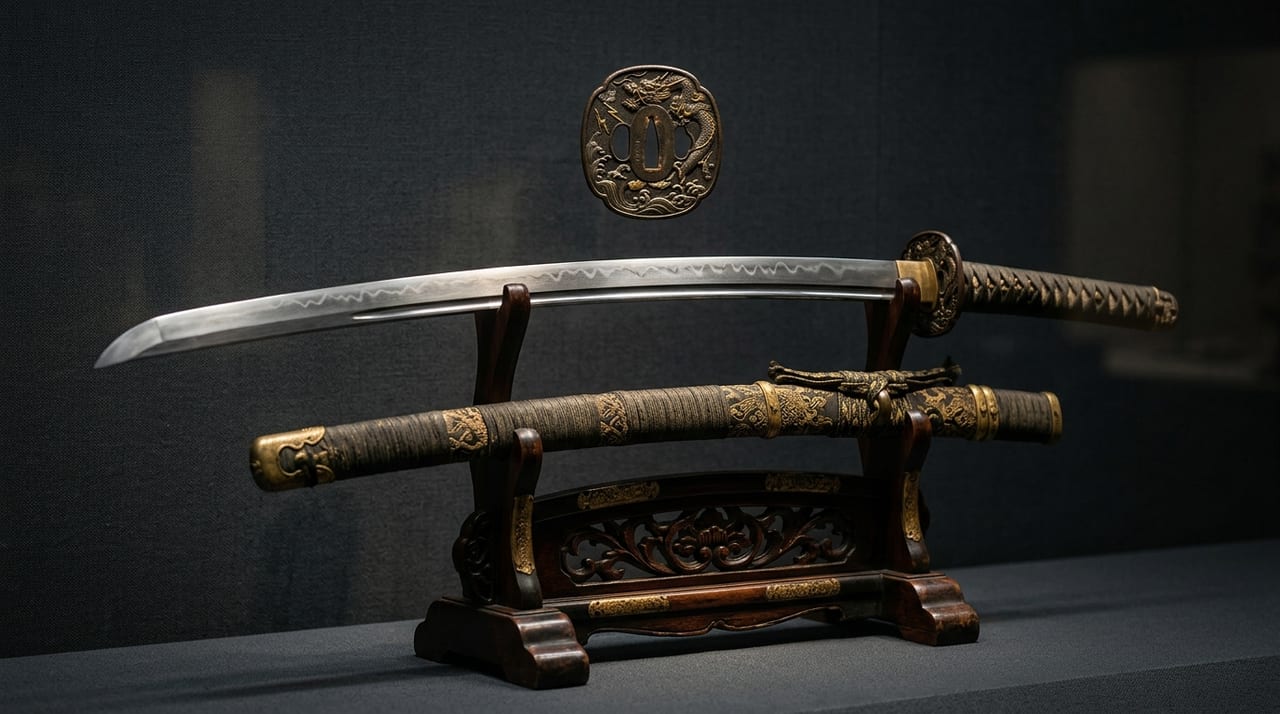
 * Image is for illustrative purposes only.
Futsunomitama-no-Tsurugi
布都御魂剣
Also known as: Futsunomitama; Divine Sword of Emperor Jinmu's Eastern Expedition
Description
Overview of Futsunomitama-no-Tsurugi—the Supreme Divine Sword of Isonokami Jingū
Futsunomitama-no-Tsurugi is the sacred body (shintai) of Isonokami Jingū, and is recorded in the Nihon Shoki as the divine sword granted to Emperor Jinmu by Takemikazuchi-no-Kami (Takemikazuchi-no-Mikoto) during the climactic moment of the mythological "Eastern Expedition of Emperor Jinmu." "Futsunomitama" means "the spiritual power that cuts sharply," and as the name itself indicates, it is a divine sword that deifies the fundamental power of the sword—the ability to cut. Isonokami Jingū is located on a mountain in Tenri, Nara Prefecture, and as one of the oldest shrines in Japan, has commanded national reverence since antiquity, with the ancient and powerful Mononobe clan overseeing its priestly rites. As the sacred body of this shrine, Futsunomitama-no-Tsurugi is inseparable from Isonokami Jingū itself and stands as "the oldest core of Japan's divine sword faith"; alongside the Seven-Pronged Sword and Ame-no-Habakiri, it is counted among the Three Great Divine Swords of Isonokami Jingū.
The Role of Futsunomitama-no-Tsurugi in the Eastern Expedition of Emperor Jinmu
According to the Nihon Shoki, when Emperor Jinmu's army fell into difficulty during its Eastern Expedition toward Yamato (present-day Nara Prefecture), incapacitated by poisonous miasma in Kumano (present-day Wakayama Prefecture) and brought to a standstill, Takemikazuchi-no-Kami (Takemikazuchi-no-Mikoto) appeared in Emperor Jinmu's dream and spoke: "From the High Heavenly Plain where I dwell, I send down a sword. The name of this sword is Futsunomitama. If you receive this sword, you will be able to subjugate the Emishi." Following the divine command of Takemikazuchi, Takakuraji—upon whose storehouse this sword descended—presented it to Emperor Jinmu. Upon receiving it, the imperial forces recovered, and Emperor Jinmu subdued the enemy forces of Yamato and ascended as Japan's first emperor. In this mythology, Futsunomitama-no-Tsurugi serves as the medium for the decisive moment of "the bestowal of power from the heavenly gods to the earthly emperor," and occupies a special position as the divine sword that most directly expresses the fundamental theme of Japanese mythology: "the divine sword grants the emperor legitimate authority to rule."
Isonokami Jingū and the Mononobe Clan—the Ancient Institution of Divine Sword Guardianship
The Mononobe clan, which oversaw the priestly rites of Isonokami Jingū, was one of the oldest clan-based warrior families of ancient Japan, undertaking warfare, iron-working, and ritual worship as an integrated whole. As the name "Mononobe" (the people of mono—"things") suggests, the Mononobe clan is understood as the clan charged with the manufacture and management of "things"—especially iron implements such as weapons and agricultural tools—and built their political and religious authority as guardians of Isonokami Jingū, this "sacred domain of the divine sword." The Futsunomitama-no-Tsurugi guarded by the Mononobe at Isonokami Jingū transcended mere religious symbolism and became "a symbol of the nation's martial power"; the structure by which "the Mononobe guard the sword (martial power)" religiously underpinned the Mononobe's political claim to be "the legitimate wielders of martial authority." The fall of the Mononobe clan in the Rebellion of Mononobe-no-Moriya in 587 CE marks one of the greatest turning points in Japanese religious and political history—the moment when this "religious legitimacy of martial power" was defeated by the "authority derived from Buddhist law" of the Soga clan and Prince Shōtoku.
Takemikazuchi-no-Kami—the God of Thunder and the Sword
Takemikazuchi-no-Kami (Takemikazuchi-no-Mikoto), the possessor of Futsunomitama-no-Tsurugi, was the divine messenger in the "Land-Yielding Myth" who conveyed to Ōkuninushi-no-Mikoto the will of Amaterasu Ōmikami—"yield the earthly realm to the heavenly grandchild"—and is a divine figure revered since antiquity as god of the sword, thunder, and warfare. Takemikazuchi is also the chief deity of Kashima Jingū, and is venerated to this day by martial artists throughout Japan as the god of martial ways. Futsunomitama-no-Tsurugi, as the sword granted by this Takemikazuchi to Emperor Jinmu, carries the position of "the authority-granting sword bestowed by the heavenly god of warfare upon the earthly emperor," embodying the most fundamental motif of Japanese mythology: the sword functions as "the medium through which authority transfers from heaven to earth." The combination of Takemikazuchi, the "god of thunder and sword," wielding Futsunomitama, the "divine sword of cutting," exemplifies the mythological logic that "the violent power of heaven (thunder) manifests upon earth as the sharpest cutting power (sword)," and is noted in scholarship as one of the oldest and purest expressions of Japan's "conception of the divine sword."
The Modern Significance of Futsunomitama-no-Tsurugi
Futsunomitama-no-Tsurugi remains today the sacred body of Isonokami Jingū, protected in a state of non-public display; it is virtually impossible for ordinary people, and even researchers, to see the actual object. Yet its existence lives on as "the oldest core of Japan's divine sword faith," continuing to dwell at the foundation of Japan's religious culture and sword culture. For those who worship at Isonokami Jingū, Futsunomitama-no-Tsurugi is "a tangible artifact of mythology still existing before our eyes" and "a place where spiritual power continuing from the age of the gods still dwells," most directly embodying the sanctity of the shrine itself. In the Japanese conception of the sacred—where "that which is unseen possesses the greatest power"—Futsunomitama-no-Tsurugi stands alongside Kusanagi as "Japan's supreme invisible divine sword," continuing to reside in the deepest reaches of the spiritual core of Japanese culture. When modern Japanese set foot into the grove of Isonokami Jingū and feel the "ancient spiritual presence" in its silence, that presence flows from the power of existence that Futsunomitama-no-Tsurugi, as a divine sword, has emanated across more than two thousand years.
The Position of Futsunomitama in the System of Swords in the Kiki Mythology
In the Kiki mythology of Japan, the sword appears in multiple mythological contexts, but Futsunomitama-no-Tsurugi is the divine sword that bears the most politically significant function: "the sword through which the heavenly god grants legitimacy to the earthly emperor." While Kusanagi is "the hero's sword" and Ame-no-Habakiri is "the sword that slew the great serpent," Futsunomitama-no-Tsurugi holds the position of "the sword that made possible the establishment of a nation," and functions as the oldest foundation for Japan's emergence as a nation-state and the legitimacy of imperial rule. This character as "the sword of national founding" places Futsunomitama-no-Tsurugi in the highest political and religious position among Japan's divine swords, and is one of the fundamental reasons that Isonokami Jingū continues to be revered today as "one of Japan's oldest and most sacred shrines."
Legends & Stories
The legend of Futsunomitama-no-Tsurugi is the legend of Japan's founding. When Emperor Jinmu's army lay helpless from poison — unable to advance, unable to retreat, facing death in the wilderness of Kumano — the thunder deity Takemikazuchi appeared in the emperor's dream: 'I possess a sword named Futsunomitama. I will send it down to you. Take it, and your enemies will fall.' The sword appeared in the camp; the army rose; the conquest of Yamato was completed. Japan's first emperor took his throne. This story encodes a theology that runs through all of Japanese history: legitimate power comes from the gods, transmitted through sacred objects. The sword that the god sends down from heaven is not merely a weapon — it is authorization, the physical presence of divine sanction for human rule. The Mononobe clan, who guarded this sword for centuries as Japan's 'people of weapons,' built their entire claim to be the nation's legitimate military power on their role as its custodians. Their defeat by the Buddhist faction in 587 was not just a political battle but a theological revolution — a change in the source of divine authorization from ancient sword-gods to the Buddha. Yet the sword survived in its shrine through all political changes, honored by every subsequent regime, as the embodiment of the principle that legitimate rule in Japan rests ultimately not on human force but on divine permission. Stone-surrounded, forest-wrapped, never shown to ordinary eyes — Futsunomitama is the divine principle of the sword itself, not a blade but an idea made holy by two thousand years of veneration.