Totsuka-no-Tsurugi: The System of Divine Swords in the Nihon Shoki and Kojiki, and Their Influence on Historical Japanese Swords
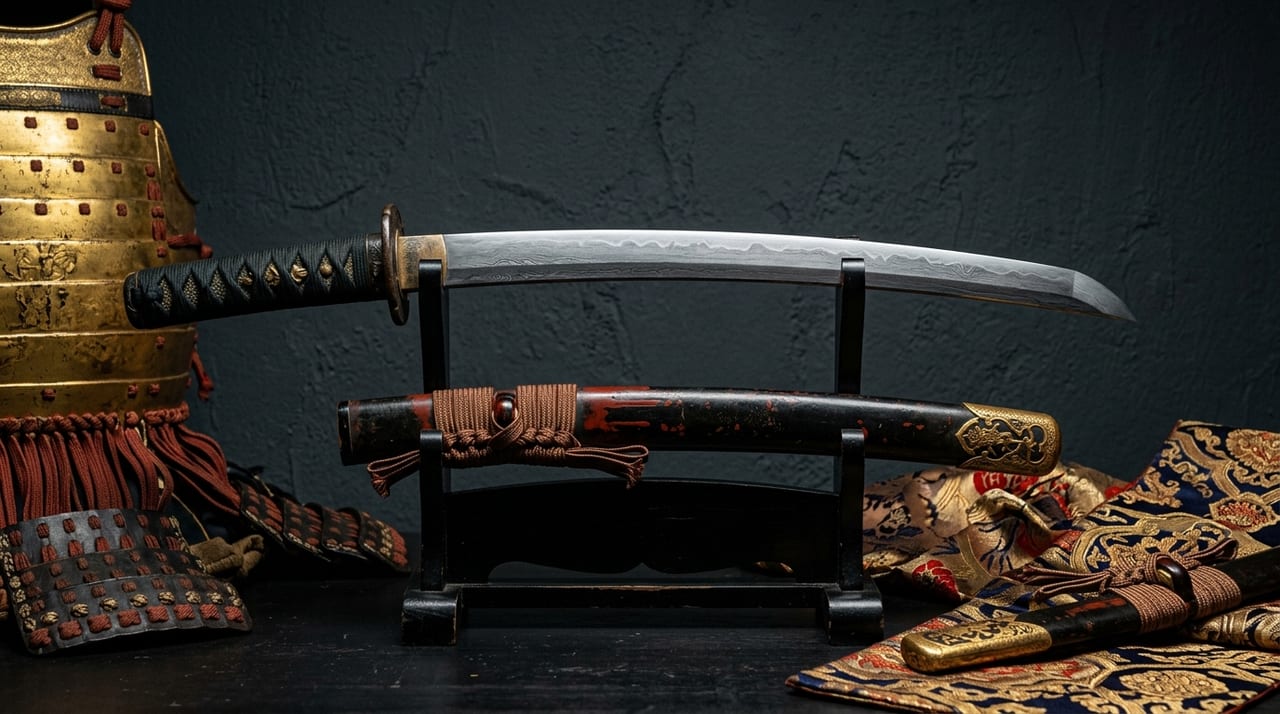 * Image is for illustrative purposes only.
Table of Contents
The Totsukanotsurugi—The "Unit of Sword" in Japanese Mythology
The term "totsukanotsurugi" does not refer to a specific single sword, but rather is a general name in Japanese mythology for "a sword of length ten-tsukas (or ten fists—approximately ten fist-widths)." In ancient Japan, "tsuka" was used as a unit of length, with one tsuka estimated at approximately 12 centimeters, and ten tsuka at approximately 120 centimeters. While such a sword would be extraordinarily long by modern standards, it is believed that in the world of mythology, such specifications were set for weapons wielded by divine spirits.
Multiple "totsukanotsurugi" appear in the Kojiki (712) and Nihon Shoki (720), each bearing different divine names. Representative examples include the following:
- Ame-no-Ohabari: The sword with which Izanagi no Mikoto slew Kagutsuchi, the god of fire. At Isonokami Shrine, it is enshrined as the sacred object of the subordinate deity Futsushimitama no Okami under the name Ame-no-Habakiri, distinct from the sacred object of the principal deity, Futsuno-mitama.
- Futsuno-mitama no tsurugi: A sword appearing in the legend of the eastern conquest of Emperor Jinmu, believed to possess the power to subdue unruly enemies. The Kojiki and Nihon Shoki record the scene in which Takakuraji presented this sword to Emperor Jinmu.
- Ame-no-Habakiri: Known as the sword used by Susanoo no Mikoto when slaying Yamata no Orochi. The sword that was born in this scene (discovered from the tail of the great serpent) is known as "Kusanagi no tsurugi," which became one of the Three Imperial Regalia.
Isonokami Shrine and Futsuno-mitama—The Real-World Culmination of Mythological Blades
Isonokami Shrine, located in Tenri City, Nara Prefecture, is known as one of Japan's oldest shrines and enshrines "Futsuno-mitama no Okami" as its principal deity. During excavations conducted in 1874 (Meiji 7), numerous ancient swords and iron implements were unearthed from the sacred precincts. This was noted as evidence supporting the tradition that "Futsuno-mitama (the mythological sword) had been transmitted as a real blade."
The "Shichishitou," a sacred treasure of Isonokami Shrine, is a fourth-century iron blade gifted from the King of Baekje to the King of Yamato. It has a distinctive form with six branches in total extending from both sides of the blade, and is believed to have been presented as a ceremonial rather than a practical weapon. The sacred object of Isonokami Shrine is the Futsuno-mitama no tsurugi, which was unearthed during excavations of the sacred precincts in 1874 (Meiji 7). The Shichishitou is currently designated as a National Treasure and is regarded by scholars as the actual example of the "sacred blade gifted from the continent" described in the Nihon Shoki.
The tradition of identifying mythological swords as real blades played an important role in elevating the spiritual value of the Japanese sword. The concept of viewing blades as vessels in which divine power dwells was reinforced by this connection between mythology and material reality.
Functional Typology of Mythological Blades—Cutting, Guarding, and Cursing
When Japanese mythological swords (totsukanotsurugi, Kusanagi no tsurugi, futsuno-mitama no tsurugi, etc.) are categorized by function, they can be organized into three categories:
- The function of cutting and wounding: The literal function as a weapon seen in the scene where Izanagi no Mikoto slew Kagutsuchi and where Susanoo no Mikoto slew Yamata no Orochi. The swords wielded by the gods possess absolute cutting power and are depicted as entities that make impossible feats of slicing possible in the world of mythology.
- The function of subjugation and conquest: Just as the futsuno-mitama no tsurugi is said to possess "the power to subjugate rebel armies" in the eastern conquest of Emperor Jinmu, the sword functions as a symbol of political and military authority. In this sense, the sword is not violence itself but a representation of "the legitimate right of authority to exercise force."
- The function of amulet and curse power: The belief that certain swords possess spiritual power to "banish evil" and "remove pollution" demonstrates the magical function of blades in Shinto. The practice of dedicating votive swords (honoutou) at shrines is the practical manifestation of this belief.
The Influence of Mythological Blades on the Design and Spirituality of the Japanese Sword
The image of sacred blades depicted in the Kojiki and Nihon Shoki exerted long-term influence on the spiritual values, design, and inscriptions of subsequent Japanese swords.
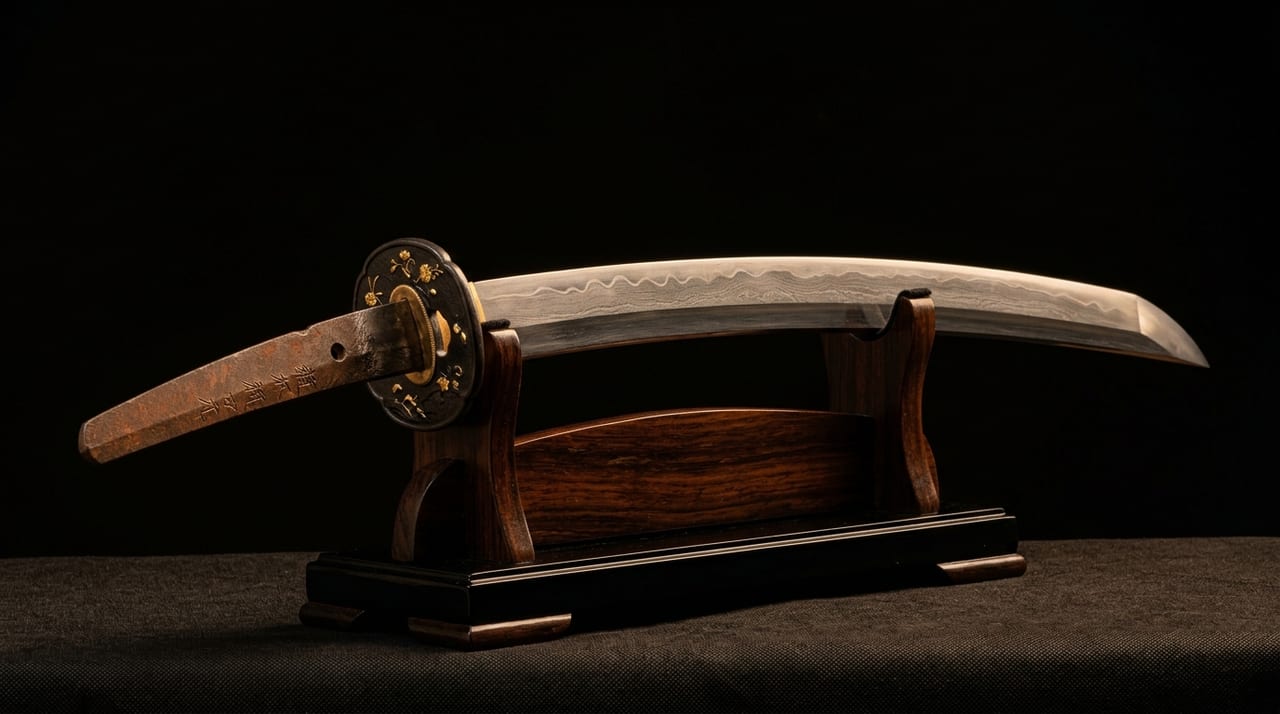
Influence on inscriptions: The practice of blade smiths inscribing signatures on the tang (nakago) with phrases such as "Tenka Ichi," "Shin'iki," and "Futsuno-mitama" reflects an awareness linking blades to divine power. Furthermore, blade smith names containing "kuni" (nation/realm) such as "Kunimune," "Kunitsuna," and "Kunimitsu" are also interpreted as a naming convention that inherits the linguistic sense of the age of the gods (kamiyo).
Religious dedication of blades: The custom of dedicating votive swords at temples and shrines demonstrates that blades functioned as a medium for prayers seeking the protection of kami and buddhas. From the Heian period onward, samurai performed the ritual of dedicating and receiving swords at shrines before going into battle, practicing a faith-based act intended to transfer the power of mythological sacred blades to the real battlefield.
Contemporary blade smiths' mythological consciousness: Among modern blade smiths, there are those who perform sacred prayers at shrines before and after blade making, emphasizing the ritual of dedicating their crafted swords to the gods. This practice represents the contemporary continuation of the consciousness that has persisted since mythological times—"blades are a medium connecting gods and humans."
Archaeological Study of Mythological Blades—Between Myth and Verification
Recent archaeological and blade research tends to reconsider mythological swords described in the Kojiki and Nihon Shoki not simply as narrative but as reflections of authentic ancient blade culture.
The excavation context and morphological analysis of burial swords from the Kofun period (3rd-7th centuries) are compared and examined against the characteristics (length, form, and ornamentation) of swords appearing in mythology, and are being utilized in elucidating the historical background of mythological narratives. Furthermore, as tangible materials such as the Shichishitou at Isonokami Shrine are collated with descriptions in the Nihon Shoki, the boundary between myth and history is being explored with increasing precision.
In understanding the Japanese sword, the mythological perspective on blades—viewing them as sacred vessels in which divine spirits dwell and which connect human society with the realm of the gods—provides an important cultural dimension alongside technological and morphological history.