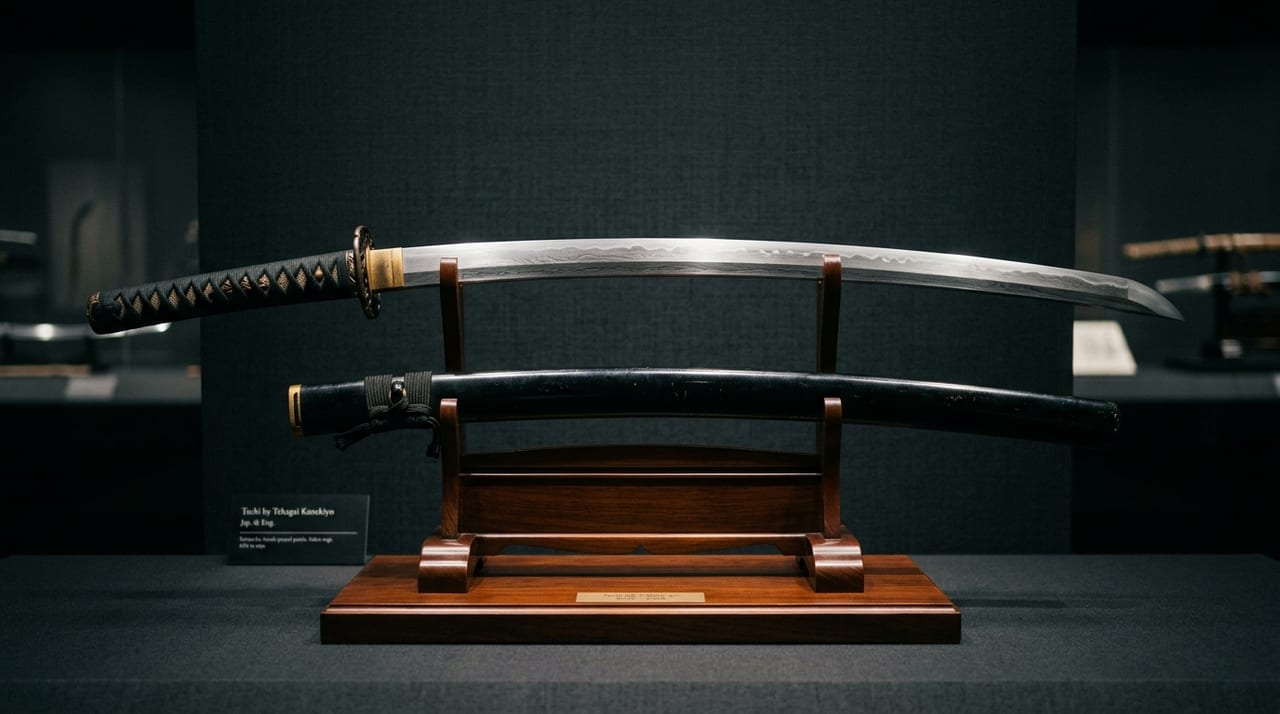
 * Image is for illustrative purposes only.
Sōshū Sadamune
相州貞宗
Also known as: Sadamune; eldest son of Masamune; master of the Soshu school; Hikoshiro Sadamune; Masamune's Ten Great Disciples
Description
Sōshū Sadamune (dates unknown) was a master swordsmith of the Sōshū tradition (Sōshū-den) active from the late Kamakura period through the early Nanbokuchō period, transmitted as the legitimate son or direct disciple of Masamune, and one of the most important smiths in the history of Japanese swords. Sadamune is evaluated as the smith who further deepened and perfected the Sōshū tradition established by his father Masamune, and is ranked foremost among the "Ten Great Disciples of Masamune" (Masamune jittetsu). Moreover, he has long been cherished as the "supreme master in the generation after Masamune" in the history of Japanese swords.
The hallmark of Sadamune's swords is his ability to inherit Masamune's bold and uninhibited ō-midare while elevating it to an even more refined and sophisticated expression. Sadamune's hamon—centered on ō-gunome-midare and notare-midare—exhibits vigorous nie with kinsuji (gold-thread lines) and sunagashi (sand-flow patterns) running in countless streams through the blade. Yet in contrast to Masamune's boldness, Sadamune's hamon achieves an exquisite overall balance: "elegant yet powerful"—providing the viewer with overwhelming aesthetic fulfillment. The jigane flows primarily in itame-hada, with abundant ji-nie, presenting a lustrous and beautiful appearance.
Among Sadamune's surviving works are multiple tachi and tantō designated as National Treasures, housed at the Tokyo National Museum and preserved throughout Japan. In particular, the named swords "Monoyoshi Sadamune," "Kiriha Sadamune," "Kikkō Sadamune," "Taikōgane Sadamune," and "Hachichō Nenbutsu Sadamune" are renowned throughout the sword world as meibutsu (name pieces)—celebrated as distinguished works treasured and transmitted by famous historical warriors and daimyō.
Sadamune stands as the sole smith in the Sōshū tradition who "inherited Masamune's technique while opening his own distinct aesthetic realm," and together with his father Masamune, forms one of the twin peaks of the Sōshū tradition, inscribed in the history of Japanese swords as one of its most revered masters.
Legends & Stories
Among the legends surrounding Sadamune, the most renowned concerns his connection to Tokugawa Ieyasu. The unifier of Japan was renowned as a connoisseur of swords, particularly cherishing works from the Soshu school—blades by Masamune, Sadamune, Hiromitsu, and Akihiro. The Monoyoshi Sadamune that came into Ieyasu's possession was treasured above all—a blade whose name signified 'the sword of auspicious fortune, bringing all matters to favorable conclusion.' Ieyasu, believing that wearing this Sadamune would inevitably bring good tidings, reportedly bore the blade when dispatching important envoys or making grave decisions.
In another tale, the spirit of Masamune is said to have appeared one night at the Kamakura forge where Sadamune was forging. The spirit of Masamune proclaimed, 'Your technique has already surpassed mine. Yet you have surpassed only technique; transcend me also in spirit.' Taking these words to heart, Sadamune thereafter pursued an ever-deeper spiritual dimension in his blade-forging. The blade forged from 'spirit' transcending technical polish—this, later sword connoisseurs have transmitted, is the wellspring of the refined aesthetic sensibility in Sadamune's work that some say surpasses Masamune.
A further legend concerning the Kiriha Sadamune tells that when supernatural disturbances occurred at the shrine where this tanto was enshrined, the blade of its own accord partially emerged from its scabbard to dispel malevolent forces—a tale of divine sword intervention. Veneration of the spiritual power inherent in Sadamune's blades spread not only among the warrior class but throughout common society, establishing as a central tenet of Japanese sword reverence the belief that 'Sadamune's blades cut evil and summon good fortune—divine swords.'