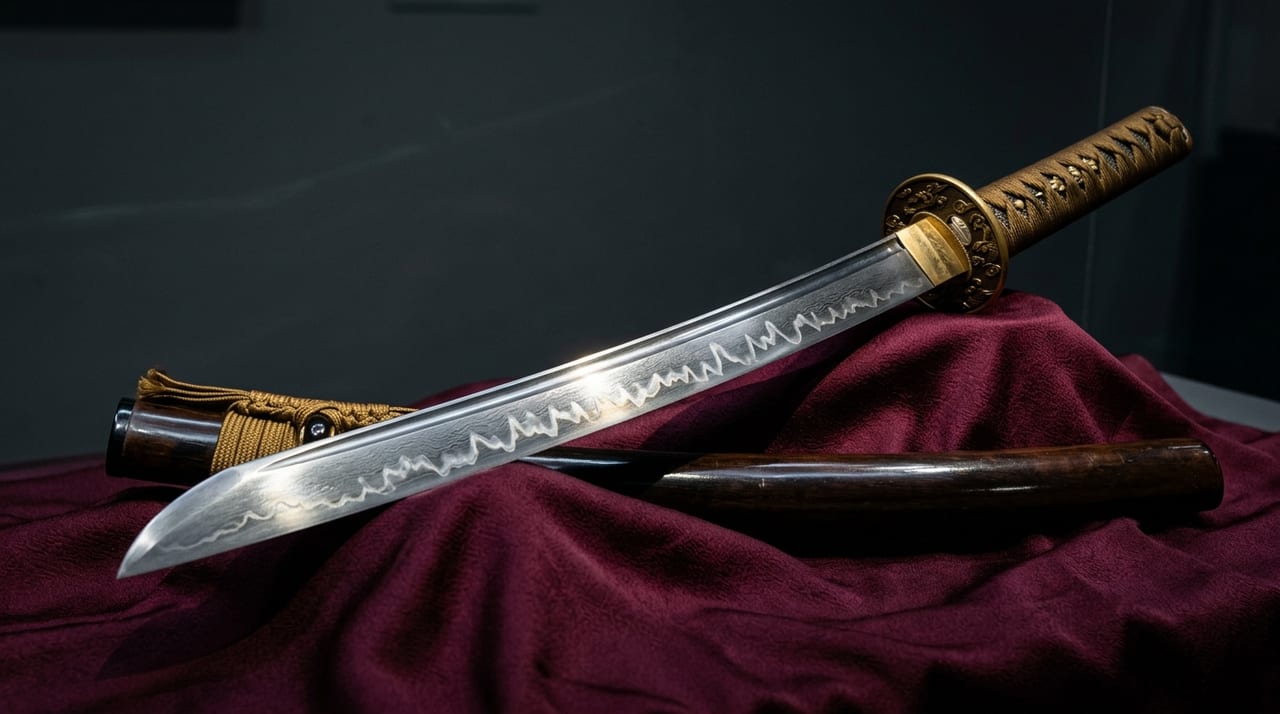
 * Image is for illustrative purposes only.
Shokudaikiri Mitsutada
燭台切光忠
Also known as: Shokudaikiri, Date Masamune's Beloved Sword and Guardian Blade of the Dokuganryū (One-Eyed Dragon)
Description
Overview of the Sword
Shokudaikiri Mitsutada is a tachi forged by the master smith Mitsutada of Bizen Province Osafune (present-day Osafune-chō, Setouchi City, Okayama Prefecture). It is the most widely known masterpiece as the beloved sword of Date Masamune. Mitsutada is a great figure who may be called the founder who established the Osafune school in the mid-Kamakura period, and his works are marked by a distinctive style, with richly flamboyant chōji-midare hamon and refined jigane. Shokudaikiri Mitsutada, as one of Mitsutada's masterpieces, continues to captivate people across seven centuries.
The Smith
Mitsutada holds an immortal position in the history of Japanese swordsmithing as the founder of the Bizen Osafune school. The greatest feature of Osafune school blades is the chōji-midare hamon, and Mitsutada's chōji-midare is especially varied and lively even compared with those of later Osafune smiths. It is highly valued alongside the hamon of the Fukuoka Ichimonji school. The jigane shows a tight ko-itame-hada, with fine jinie and a smooth luster. The bōshi is ko-maru ni kaeri, and overall the blade embodies the dignified style of the early-to-mid Kamakura period. Mitsutada's works have few surviving examples, and because of this rarity they have been treasured as peerless masterpieces. Shokudaikiri Mitsutada is the most famous of these, and its connection with the great warlord Date Masamune gives the sword an added weight of value.
Connection with Date Masamune
There are various theories on how Shokudaikiri Mitsutada came into Masamune's hands. One theory holds that it is the Mitsutada Masamune received from Toyotomi Hideyoshi, having presented a gozabune (state boat) when he took part in the construction of Fushimi Castle. The anecdote that gave the name 'Shokudaikiri' is that Masamune cut down a retainer who had committed a fault, the retainer hid behind a candlestick, and the candlestick was cut along with him. This anecdote has been passed down as an episode showing the terrifying sharpness of the blade. This tachi, both the beloved sword of Masamune and a treasure of the Sendai Domain, was later transferred to the Mito Tokugawa family, closely tied to the Tokugawa shogunate, and was kept as a treasure of the Mito Domain throughout the Edo period.
The Great Kantō Earthquake and the Replica
In the Great Kantō Earthquake of Taishō 12 (1923), the Mito Tokugawa family's Koume residence in Honjo was also heavily damaged, and Shokudaikiri Mitsutada was affected along with many furnishings and treasures. For a long time it was believed lost in the earthquake. However, in 2015 it was announced that it had been found in storage at the Tokugawa Museum's warehouse in its burnt (yakemi) state. No restoration has been applied to the burnt blade. In 2018, a replica by the swordsmith Miyairi Norihiro was completed and displayed alongside the burnt original. The sword has not received any cultural property designation and is kept at the Tokugawa Museum.
Sendai and the Bond with the Sword
TOUKENZA's home base, Sendai, is precisely the castle town built by Date Masamune, the original owner of Shokudaikiri Mitsutada. In Sendai, the land where Masamune established the foundation of the Sendai Domain with 620,000 koku, speaking of the lord's beloved sword is also a return to our shop's origins. As the embodiment of the fusion of 'martial' and 'beauty' that Masamune represented, Shokudaikiri Mitsutada continues to speak to us today. When the splendid chōji-midare and refined jigane of Osafune Mitsutada overlap with the fierce life of the One-Eyed Dragon, one cannot help being moved by the sense that seven centuries of history are condensed into a single tachi.
Legends & Stories
The Candlestick Legend
The anecdote behind the name 'Shokudaikiri' reveals both Date Masamune's severe style of rule and the terrifying sharpness of this tachi. One day, a retainer of Masamune committed some kind of misconduct (accounts vary on the details). Masamune drew this tachi on the spot and struck the retainer down. The blow was so deep and sharp that it is said to have also cut in two a bronze candlestick placed beside the retainer. The name 'Shokudaikiri' (candlestick-cutting) derives from this anecdote, and shows that the sword's sharpness was such that it could cut not merely flesh but even a metal candlestick.
Of course, cutting a bronze candlestick with a Japanese sword would not be physically easy, and the anecdote very likely contains exaggeration. Yet whether or not the story is true, since the name 'Shokudaikiri' was given to the beloved sword of Masamune, this tachi has become more than a famous blade. It has established its status as a meibutsu embodying the individuality and martial majesty of Date Masamune, the One-Eyed Dragon.
Transmission to the Mito Tokugawa Family
When and how Shokudaikiri Mitsutada passed from the Date family to the Mito Tokugawa family is not recorded with certainty. The Buko Tōsan, a sword register of the Mito Tokugawa family compiled in the late Edo period, states that Tokugawa Mitsukuni forcibly took away what Masamune had been unwilling to give. The Tōkenroku by Aoyama Nobumitsu from the late Edo period holds that Tokugawa Yorifusa obtained it by request. On the other hand, no record has been found on the Date family's side of Masamune presenting Mitsutada to the Mito Tokugawa family.
The Earthquake and Revival
The Great Kantō Earthquake of September 1, Taishō 12 (1923), dealt a great loss to the history of Japanese swords as well. As many famous blades were burned or scattered, Shokudaikiri Mitsutada was also affected at that time, and for a long time it was treated as a 'lost famous sword.' In 2015, after inquiries surged prompted by the game Touken Ranbu, it was discovered and announced that the sword had survived in the Tokugawa Museum's warehouse in its burnt (yakemi) state. The blade damaged by fire remains in its burnt condition to this day, so the forging and chōji-midare of its former work cannot be seen directly. The Tokugawa Museum therefore used donations to commission the swordsmith Miyairi Norihiro to create a replica depicting the sword's pre-disaster appearance, which was completed in 2018. The path the original took through disaster, and the effort to bring its form back to life in the present day, speak to the depth of people's passion for famous swords. TOUKENZA's location in Sendai, Masamune's castle town, makes this sword our spiritual origin as well.