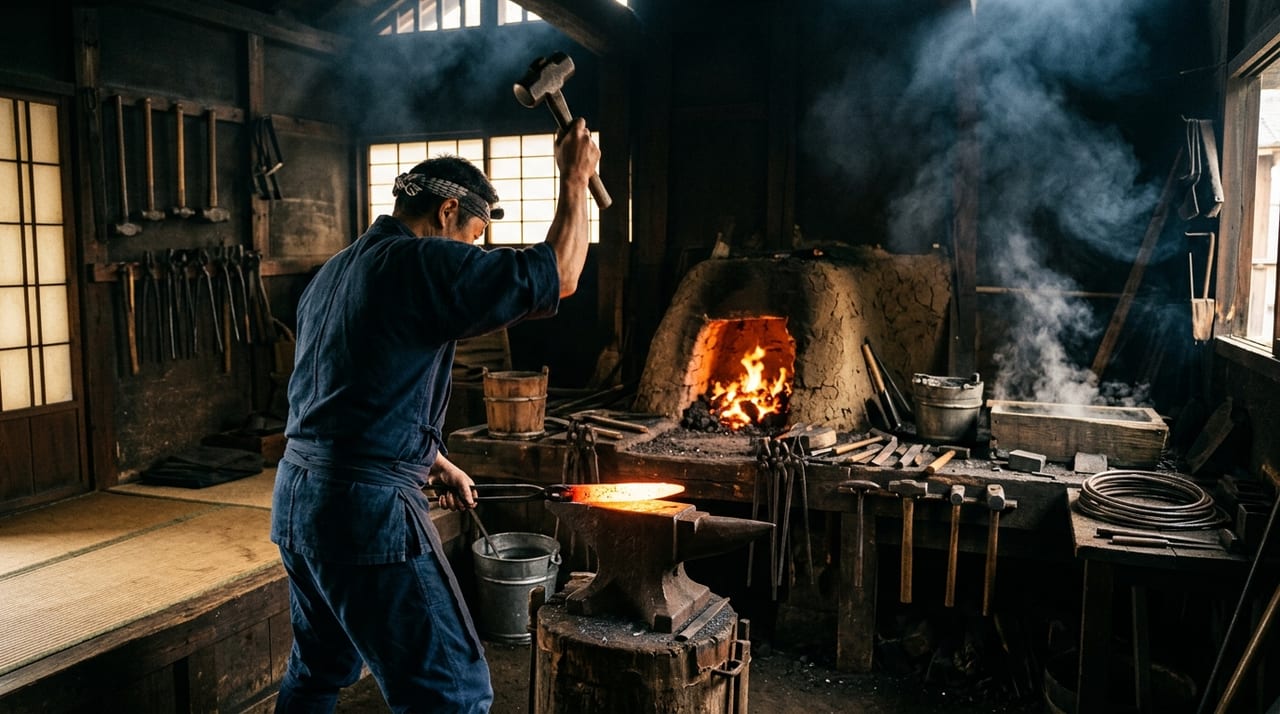
 * Image is for illustrative purposes only.
Osafune Mitsutada
長船光忠
Description
Osafune Mitsutada is a master smith of the mid-Kamakura period, revered as the de facto founder of the Osafune school, which arose in the Osafune area of Oku District, Bizen Province. The old text Kokon Meizukushi says he was active in the Hōji and Kenchō eras (around 1247–1255), but the years of his birth and death are not known in detail. Although there is a theory that his father was Chikatada, it lacks firm evidence, and it is customary, based on extant works, to take Mitsutada as the starting point of the school. His child Nagamitsu became the second-generation sōryō, and on the foundation Mitsutada built, Nagamitsu, Sanenaga and others followed, so that Bizen Osafune grew into the largest school in the history of the Japanese sword.
His style is splendid and majestic. The hamon is mainly chōji-midare, with kawazuko chōji (whose round, bulging heads resemble tadpoles) and large, connected ō-chōji covering the blade surface, and gunome is also mixed in. The jigane is often ko-itame, finely packed and exquisite, and midare-utsuri stands out vividly in the hamon and in the jigane. His proportions feature a broad blade width, and he excelled in majestic tachi with ikubi-style kissaki, conveying the vigor of the mid-Kamakura period. Another distinctive feature is the wide range of his styles, from calm suguha works to splendid great midare.
Many of his representative works are famous meibutsu. “Ikoma Mitsutada” is a single blade that takes its name from its possession by Ikoma Sanuki no Kami Chikamasa; it is said to be the most splendid of Mitsutada's works, passed to the Hosokawa family, and it is now held by Eisei Bunko in Tokyo and designated a National Treasure. “Shokudaikiri Mitsutada” is an unsigned tachi that has been authenticated as Mitsutada's work, and its name comes from the anecdote that Date Masamune cut down a retainer together with a candlestand. It is said to have been given by Masamune to the Mito Tokugawa family (there is also a theory that Masamune received it from Toyotomi Hideyoshi). It was damaged by fire in the Great Kantō Earthquake of Taishō 12 (1923), and it is now preserved by the Tokugawa Museum in Mito, Ibaraki. Also, “Jikkyū Mitsutada” is a blade associated with Miyoshi Jikkyū. Oda Nobunaga deeply treasured it, and in the Honnō-ji Incident of Tenshō 10 (1582) it was burned, but it is said that Hashiba (Toyotomi) Hideyoshi later recovered it and had it restored. Nobunaga was especially fond of Mitsutada's splendid works, and it is also recorded that he collected more than twenty blades.
In later ages, Mitsutada was placed among the saijōsaku and is highly valued as a representative smith of Bizen blades, which take pride in their chōji-midare. His school produced Nagamitsu, Kagemitsu, Kanemitsu and others and reached its peak of prosperity. Osafune Mitsutada can indeed be called a master who laid the foundation for the flourishing of Bizen Osafune.
Famous Works
- Shokudaikiri Mitsutada (Tokugawa Museum)
- Jikkyū Mitsutada (named sword)