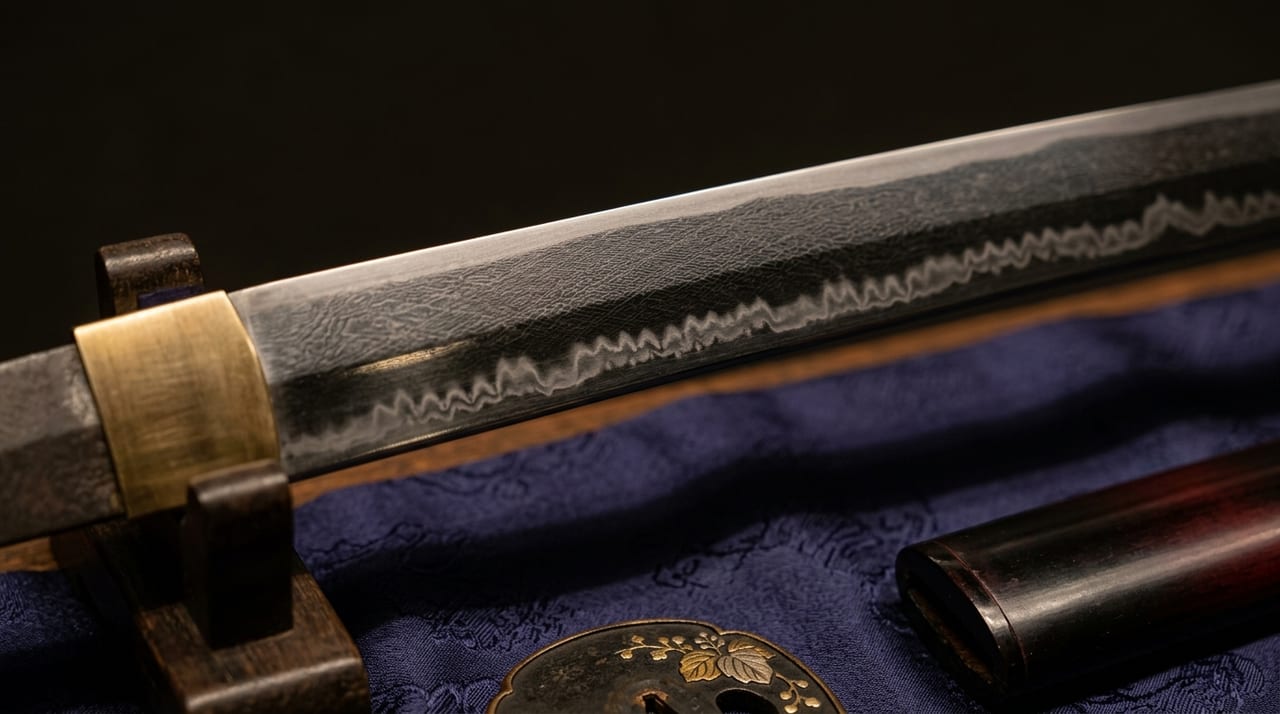
 * Image is for illustrative purposes only.
Rai Kunitoshi
来国俊
Also known as: Perfector of the Rai School; Pinnacle of Yamashiro Tradition
- Smith
- Rai Kunitoshi
- Era
- Mid to Late Kamakura period (late 13th – early 14th century)
- Type
- Tachi / Tantō
- Designation
- National Treasure / Important Cultural Property (multiple works)
- Location
- Tokugawa Art Museum, Atsuta Shrine, Futarasan Shrine, private collections, and others
Description
Overview of Rai Kunitoshi and His Place in the Rai School
Rai Kunitoshi was a swordsmith who was active in Yamashiro Province (present-day Kyoto Prefecture) from the mid to late Kamakura period. He holds a firmly established place in the history of the Japanese sword as a representative master of the Rai school. The Rai school, together with the Awataguchi school, is a representative school of the Yamashiro tradition. Within it, Kunitoshi carried on the foundations of Rai Kuniyuki, who is considered his father, while also opening up a realm of his own. The smiths of the Rai school all shared the character "Rai" in their work, yet each had his own individuality. Kunitoshi is the figure with the largest number of extant works and the highest reputation among them. Opinions differ on whether he and Niji Kunitoshi ("two-character Kunitoshi"), the smith who signed simply "Kunitoshi" in two characters, were the same person. The view that they were different smiths is considered the more likely one, based on differences in style. Together with Rai Kunimitsu and Rai Kunitsugu, he is positioned as one of the most important figures who supported the golden age of the Rai school.
Technical Characteristics of Kunitoshi's Swords
The greatest feature of Rai Kunitoshi's swords lies in the "jigane peculiar to the Rai school." The jigane of the Rai school has tightly packed ko-itame hada, fine ji-nie across the whole surface, and nie-utsuri. Weakly forged hada often appears on one side or on both sides in part. This is called "Rai-hada" and is regarded as a point of focus in appraisal. The hamon is based on suguha, with fine ko-midare and ko-gunome mixing in quietly. The variation is restrained overall, yet it contains a deep complexity. The bōshi either continues straight and returns in a small round tip, or runs in with midare, shows hakikake and returns in a small round tip, among other forms.
Mastery in Both Tachi and Tantō
One notable point about Kunitoshi is that he left works of the highest standard in both the tachi and tantō fields. The late Kamakura period was an era in which demand for tantō rose, and warriors prized the tantō both as a practical protective blade and as a gift. Kunitoshi's tantō are known as outstanding examples of late Kamakura tantō for their graceful form and precise hamon. The tantō bearing the Shōwa 5 (1316) signature held by Atsuta Shrine is among those designated National Treasures. In the tachi field too, he left many slender and gentle masterpieces. He is therefore evaluated as a rare smith who realized the highest standard of the Yamashiro tradition in both tachi and tantō. Multiple works have been designated National Treasures, and the quality and quantity of his extant works stand out even within the Rai school as a whole.
Forging Techniques of the Rai School and the Position of the Yamashiro Tradition
Smiths of the Yamashiro tradition worked from the late Heian period onward in Kyoto, a center of culture, and they brought into sword expression a refined sense of beauty strongly influenced by aristocratic culture. The Rai school is known in particular as a school that embodies this "Kyoto sense of beauty." It is said to possess an "aristocratic dignity" that sets it apart from the martial and practical beauty of the Bizen tradition. The composure of Kunitoshi's straight hamon, the luster of his finely packed jigane, and the well-proportioned form of his bōshi are all products of the aesthetic of Kyoto, a city that held cultural refinement, rather than military power, as the core of its value. To view Kunitoshi's swords is to directly experience the aesthetic sense of people who lived in Kyoto in the late Kamakura period. It is also a valuable opportunity to perceive the "spirituality of Yamashiro," which differs from the swords of Bizen.
Extant Works and Their Significance for Research
Rai Kunitoshi's extant works, from those with certain signatures to those presumed to be his, belong to the largest group within the Rai school. They form a first-class body of source material for studying the Yamashiro tradition of the late Kamakura period. Besides the National Treasures and Important Cultural Properties held by the Tokugawa Art Museum and the Kurokawa Institute of Ancient Cultures, fine works are also transmitted in dispersed form among shrines such as Atsuta Shrine, Futarasan Shrine, and Tanzan Shrine, and among private owners. Through comparison of the jigane and hamon of these extant works, researchers are studying the technical changes in the Yamashiro tradition during the late Kamakura period and the individual differences within the Rai school. In addition, Kunitoshi's works have functioned since the early modern period as standard works for sword connoisseurship (meikiki). There is a long history of them serving as reference points for authenticating works of the Rai school.
Overall Evaluation and Significance in the History of the Japanese Sword
Rai Kunitoshi is evaluated as a master smith representing the Yamashiro tradition and the Rai school. He is also regarded as one of those who carried the "Kamakura golden age of swords" together with Osafune Mitsutada and Nagamitsu, a father and son of the Bizen tradition. If the Bizen tradition is characterized by "brightness and utsuri," the Yamashiro Rai school is characterized by "depth and serenity." This pair of contrasting aesthetic poles is what makes the Japanese swords of the late Kamakura period unique among the art objects of the world. Appreciating Kunitoshi's swords is not merely looking at the work of a famous Kamakura smith. It is equivalent to experiencing the diversity and depth of the aesthetic sense of Japan's medieval period. Within the luster of the refined jigane, the "ideal of Japanese beauty" that a Yamashiro smith seven hundred years ago put into the blade still lives on. When standing before a Kunitoshi tachi and facing its deep jigane and calm hamon, one can directly experience the ultimate beauty that the thousand-year capital of Kyoto reached in the form of the Japanese sword. Kunitoshi's works are among the pinnacles of Japanese art history, and the perfection of his sword-making technique has long served as the ideal standard that later smiths aimed to reach.
Legends & Stories
Legendary Origins of the Rai School
Several traditions exist concerning the founder of the Rai school, but the most widely known holds that the ancestors of the Rai school were smiths who came from the Korean Peninsula (Goryeo). Several theories also exist regarding the origin of the name "Rai," but none is certain. Modern research has not established whether the theory of foreign origin is true, but as a legend it has become part of the cultural identity of the Rai school.
Niji Kunitoshi and Rai Kunitoshi: Same Smith or Different?
A question long debated in Rai school research is the relationship between the smith who signed "Kunitoshi" with a two-character signature (Niji Kunitoshi) and the smith who signed "Rai Kunitoshi" with a three-character signature. Works bearing a two-character signature dated Kōan 1 (1278), and a three-character signature inscribed with Shōō 2 (1289) at the age of seventy-five, serve as grounds for the view that they are the same person. At the same time, because their styles differ greatly, the view that they were different people is also influential. The Hon'ami family of the Edo period distinguished between the two in their origami (appraisal certificates) and treated them as father and son. Niji Kunitoshi displays a brilliant style with chōji and gunome mixed in, whereas Rai Kunitoshi displays a gentle style in the suguha manner, with ko-chōji and ko-ashi mixed in. After Rai Kunitoshi came Rai Kunimitsu, said to be his son, who carried the Rai school into the Nanboku-chō period.
Modern Appreciation and the Enduring Brilliance of Rai Kunitoshi
When viewing Rai Kunitoshi's tachi and tantō in modern sword appreciation settings, the luster of the tightly forged jigane and the quiet beauty of the suguha have not faded in the slightest, even after more than seven hundred years. In sword exhibitions, Rai Kunitoshi's works are given a special place each time as "the pinnacle of the Yamashiro tradition," allowing viewers to experience a beauty of "introspective depth" that differs from the brilliant hamon of the Bizen tradition. Standing before a Rai Kunitoshi blade, one feels that within its deep jigane lives the spirit of Kamakura-period Kyoto, a city where the highest intellect and technology of an age in which aristocratic and warrior culture intersected were concentrated. It is the moment that most directly lets one experience the Japanese sword as both a "sculpture in iron" and a "crystallization of the soul of an age." It is also the core of why the name of Rai Kunitoshi has been passed down for centuries.