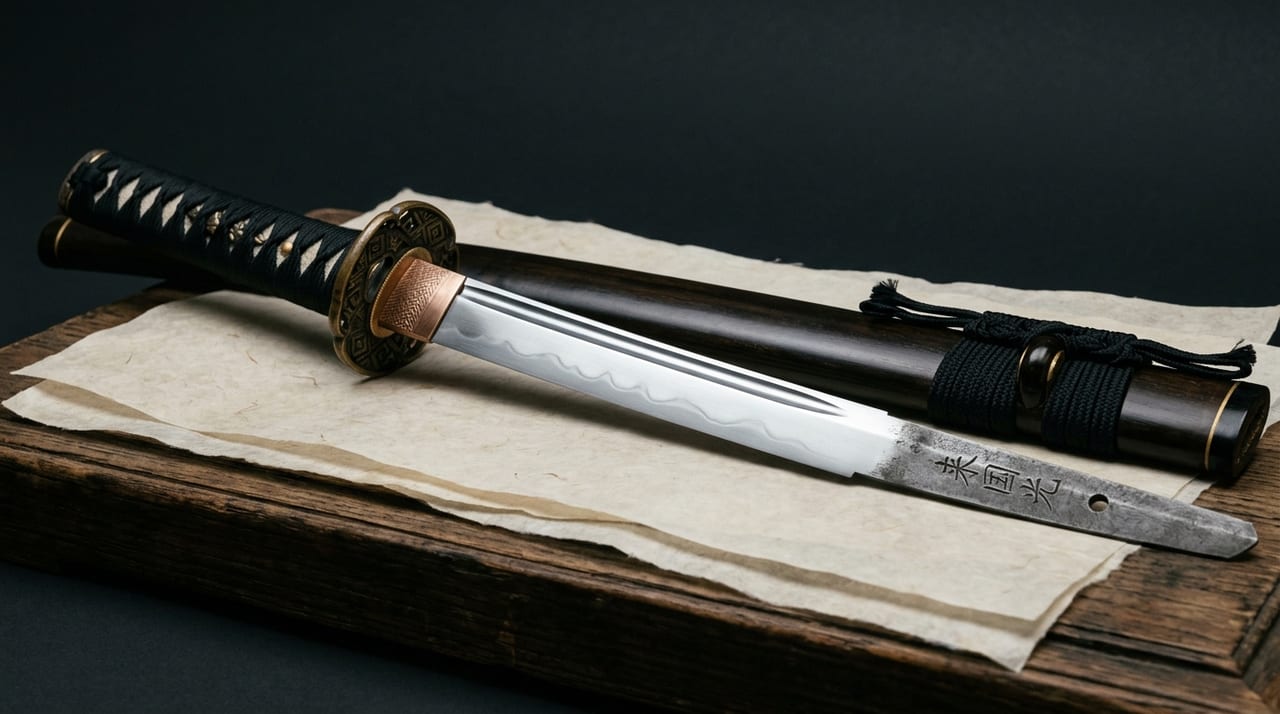
 * Image is for illustrative purposes only.
Rai Kunimitsu
来国光
Also known as: Rai Kunimitsu; Crown of the Rai School; Master of Late Kamakura Yamashiro
Description
Rai Kunimitsu is the greatest master of the Rai school — a group of Yamashiro-province swordsmiths who worked in Kyoto from the late Kamakura through the Nanbokuchō period. Founded by Rai Kuniyuki, the school's lineage of Kunitoshi, Kunimitsu, and Kunitsugu produced work of unmatched elegance in the Yamashiro tradition. Kunimitsu left more surviving works than any other Rai smith, including multiple National Treasures and Important Cultural Properties in both tachi and tantō formats. The Rai aesthetic is defined by a lustrous, densely packed ko-itame grain, fine even nie, and a calm hamon of elegant directness — quintessential Yamashiro refinement. His tantō in particular are considered among the finest small-format blades in Japanese sword history.
Legends & Stories
Legend of the Rai School's Birth
The etymology of the name "Rai" is variously explained, but most widely known is the theory that the kanji "Rai" (来) derives from the word for "one who has arrived" (来たる者)—reflecting a tradition that the founder of the Rai school, Rai Kuniyuki, was a descendant of a craftsman who came from China or the Korean peninsula, bringing with him a distinctive steelworking technique. This tradition seeks to explain the characteristic whitish luminescence of Rai jigane as "the influence of continental ironworking methods." Though modern research cannot verify the truth of this tradition, the pristine beauty of Rai swords—which stands distinctly apart from other schools—certainly gives viewers the impression that they "might possess a different origin," and the foundation for the legend lies in the beauty of the swords themselves.
Kunimitsu and the Shogunate
In the late Kamakura period, Rai Kunimitsu received commissions from powerful shogunate military commanders and produced numerous tachi and tantō. For eastern province warriors, commissioning swords from a master craftsman of Yamashiro Province (Kyoto) was an act demonstrating high prestige and cultural refinement. Kunimitsu's blades functioned as the supreme gifts and rewards in Kamakura warrior society. Many military commanders connected to the Minamoto and Hōjō clans are said to have possessed swords by Rai Kunimitsu, and specific anecdotes about them are scattered throughout the engi (founding chronicles) of temples and shrines across the country. Even after the fall of the Kamakura shogunate (1333), Kunimitsu's swords were highly valued by both the Nitta and Ashikaga clans, and through the Sengoku period into the Edo period, they were carefully preserved as treasured blades in the collections of the shōgun's family and daimyō.
The Ashikaga Shoguns and Rai Kunimitsu
Ashikaga Takauji and Yoshimitsu, who established the Muromachi shogunate, were avid sword collectors and managed Kunimitsu's tachi and tantō as treasured possessions of the shogun's house. In the era when Yoshimitsu fostered "Northern Mountain Culture," Kunimitsu's swords transcended their role as martial implements and came to be appreciated by tea masters and literati as refined artworks, standing alongside the tea ceremony, renga poetry, and Noh theatre. The culture of "sword appreciation" is said to have germinated in Kunimitsu's era and become established in the Muromachi period, with Kunimitsu's finest works at the center of this culture. Kunimitsu's tantō in particular, owing to their manageable size, possessed a dual function—both as everyday swords worn by military commanders and as treasured display pieces for the tokonoma (alcove).
Sword Appraisal and the History of Kunimitsu's Evaluation
In the Edo period, the Kyōhō Meibutsu-chō (Catalogue of Celebrated Swords), compiled under the command of Shogun Tokugawa Yoshimune, lists multiple works by Kunimitsu, demonstrating that the Edo shogunate officially recognized him as one of the highest pinnacles of Japanese sword-making. Master sword appraisers such as Honami Kōetsu and Honami Kōshitsu also held Kunimitsu in high regard, and the saying "Rai swords stand apart" became established doctrine among Edo-period sword connoisseurs. In modern Japanese sword appraisal, Kunimitsu is placed at the highest rank as the representative of the Yamashiro tradition, and his tantō are considered ideal when they remain unresharpened, bear a visible signature, and display high refinement. The fact that Kunimitsu's swords retain their luminous clarity seven hundred years later attests to the excellence of his forging technique and speaks to how carefully successive owners have preserved them.
Kunimitsu's Technical Legacy
The forging techniques of Rai Kunimitsu profoundly influenced later sword makers. The methods Kunimitsu developed in pursuing the beauty of Rai jigane are thought to have influenced master smiths of the Nanboku-chō period Sōshū tradition, and sword scholars point out that masters such as Masamune and Sadamune held Kunimitsu's "bright and pellucid jigane" in high esteem. Moreover, the aesthetic of tantō that Kunimitsu established—dignified, refined, merging practicality with artistry—stands alongside the tantō tradition of Awataguchi Yoshimitsu as the twin peaks of Kamakura short swords and continues to serve in modern times as one of the ideals of Japanese tantō form. The central role Kunimitsu played in the development of Japanese sword culture is most eloquently testified to by the fact that multiple works by him survive today as National Treasures. His swords, which continue to captivate viewers after seven hundred years, stand as the finest witness to the eternity and spiritual profundity of Japanese sword culture.
Modern Evaluation and Appreciation of Kunimitsu
In contemporary Japan, swords by Rai Kunimitsu hold the highest place among blades worthy of appreciation, and when fine examples appear at auction or sale, they command premium prices. Among sword scholars and enthusiasts, it is said that "observing the fine koitame grain of Kunimitsu's jigane is the starting point of Japanese sword appreciation," and thus his jigane is treated as both entry point and ultimate subject of connoisseurship. In sword exhibitions throughout the country, Kunimitsu's works are frequently displayed as centerpieces, and their pristine beauty moves general visitors with immediate emotional force. In particular, tachi displayed on stands present an exquisite harmony of elegant curve and slender form. In tantō, the carefully forged universe of steel is compressed within a size that fits in the palm of the hand. Modern sword enthusiasts who have encountered the profound beauty of Kunimitsu's blades sense within the steel the passion of the smith who labored at the forge in Yamashiro Province seven hundred years ago. The very fact that Kunimitsu's swords are preserved, studied, and appreciated as National Treasures testifies to the reverence and pride Japan holds for its own sword culture and perpetually proves the greatness of Master Kunimitsu. So long as the sword remains a culture born of the union of human spirit and technique, the name of Kunimitsu will endure in the brightest station of Japanese cultural history.