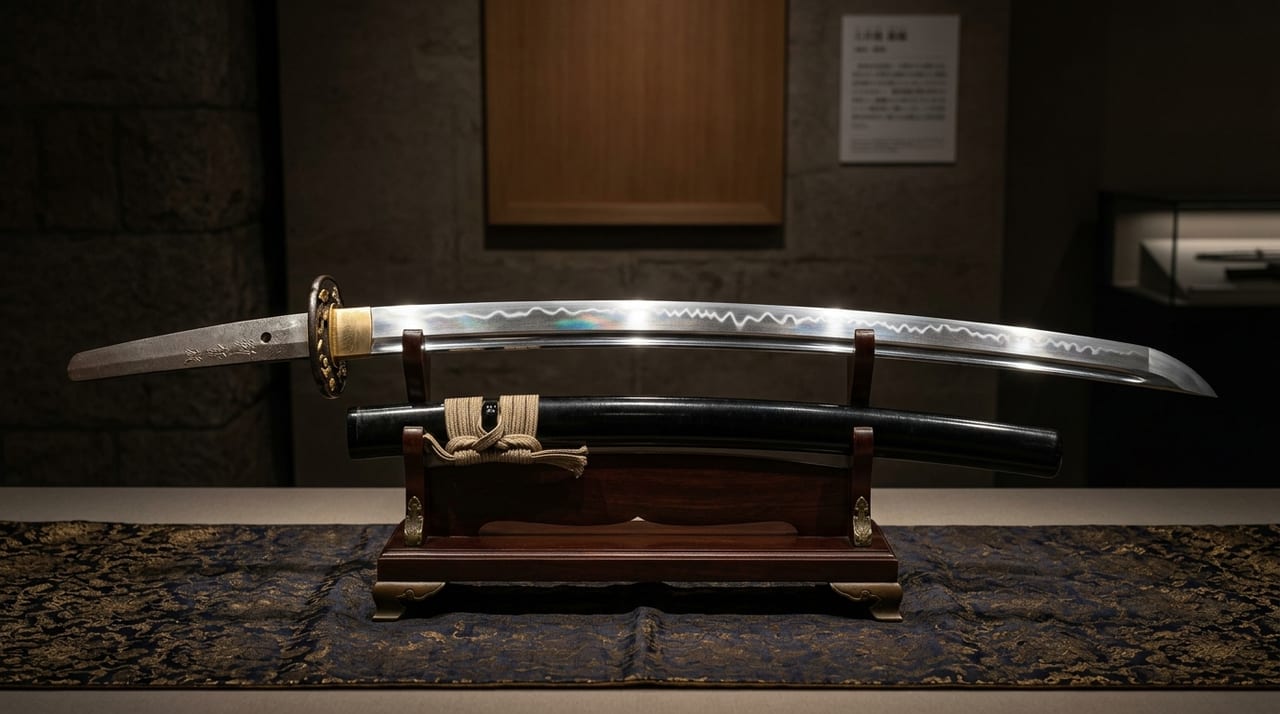
 * Image is for illustrative purposes only.
Osafune Mitsutada
長船光忠
Also known as: Mitsutada; Founder of the Osafune School; Who Made Bizen the Greatest Sword-Producing Region
Description
Overview of the Sword
Bizen Osafune Mitsutada (備前長船光忠) was the founder of the Osafune school, a master swordsmith who flourished in the mid-13th century in Osafune, Bizen Province (present-day Setouchi City, Osafune-chō, Okayama Prefecture), and established one of the most important sword-making guilds in Japanese sword history. Although swordsmiths are believed to have worked in the Osafune district before Mitsutada's time, the organization, establishment of the brand, and systematization of technique are said to have begun with Mitsutada, and in this sense he was the man who made the place name "Osafune" a synonym for "Japan's finest sword-producing center." He possesses multiple tachi designated as National Treasures, and their dignity and technical perfection receive an unshaken assessment from later sword researchers as the apex of mid-Kamakura tachi.
Mitsutada's Technique and Style
The jigane of Mitsutada's tachi features itame mixed with mokume, and the utsuri emerges with vivid clarity. This "utsuri" is the defining characteristic of Bizen Osafune Mitsutada and the Osafune school — the distinctive beauty of the Bizen tradition where a haze-like radiance floats within the jigane — which Mitsutada established at Osafune. The hamon is based on varied disarray combining chōji and gunome, displaying a bright and refined finish with clear nie. Overall, "methodical and powerful" forms the essence of Mitsutada's style — a more ordered beauty than the "grand majesty of large chōji" pursued by the Ichimonji school, yet conveying overwhelming dignity. The kissaki is small-rounded or trailed, displaying the standard tachi form of mid-Kamakura. The nakago often retains its original surface, bearing signatures such as "Made by Mitsutada" or "Mitsutada, resident of Osafune, Bizen Province."
Founding and Organization of the Osafune School
By organizing a guild of swordsmiths at Osafune and establishing systems of quality control and technical transmission, Mitsutada transformed the location from a place of individual craftsmen into an organized center of sword production. This organization itself became the foundation upon which the later Osafune school could maintain the highest quality across generations — one of Mitsutada's greatest achievements. The lineage of four generations — his son Nagamitsu (長光), grandson Kagemitsu (景光), and great-grandson Kanemitsu (兼光) — who inherited Mitsutada's technique, stood at the forefront of Japanese sword culture for over a century, from mid-Kamakura through the Nanboku-chō period. This continuous succession of four generations is a rare achievement in Japanese sword history, and would have been impossible without the strength of the technical and organizational foundation that Mitsutada established.
Kamakura Warriors and Mitsutada's Tachi
The mid-Kamakura period in which Mitsutada was active was an era when military government was consolidated following the Jōkyū Rebellion (1221), and the warrior class of the eastern provinces was developing cultural maturity. As the Hōjō clan and powerful lords competed to acquire fine swords, Mitsutada's tachi earned the highest praise as "Bizen's finest tachi." For a Kamakura warrior, to wear a tachi by Mitsutada was the greatest honor, and as Kamakura warrior culture matured, his fame spread throughout the realm. Mitsutada's tachi with documented provenance are distributed widely — from the possession of powerful shogunal officials to votive offerings at shrines and temples — and this broad distribution contributed to forming the evaluation that "Osafune blades are first under heaven."
Representative Transmitted Examples and Modern Evaluation
The National Treasure tachi (signature: Mitsutada) in the collection of the Tokugawa Art Museum (Nagoya) is known as Mitsutada's supreme masterpiece; with a blade length of 2 feet 6 inches (approximately 78.8 cm), it displays the imposing form of a mid-Kamakura tachi, and the beauty of its jigane with vivid utsuri and varied chōji hamon embodies the highest standard of Bizen swords of the mid-Kamakura period. In modern sword authentication, a Mitsutada tachi with reliable signature is treated as a work receiving the highest valuation in the Japanese sword market, and the cultural value of a single National Treasure Mitsutada is said to transcend any monetary assessment. The name of Bizen Osafune Mitsutada, as the finest achievement of the Kamakura period when Japanese sword culture first came into flower, will shine eternally.
The Origin of "Bizen Blades Are First Under Heaven"
The evaluation "Bizen blades are first under heaven," established in the Edo period, was formed as the result of long historical accumulation; yet its origin lies in the superior quality standards that Mitsutada established at Osafune. From Mitsutada onward, the place name Osafune became the synonym for all Bizen blades, and the word "Osafune blade" became incorporated into the Japanese language as a common noun meaning the finest-quality sword. The fact that Mitsutada stands at the beginning of this cultural establishment is one of the finest examples of the depth of influence that a single master craftsman can exert upon history and culture.
Mitsutada's Legacy and Modern Osafune
In the present day, the name of Bizen Osafune Mitsutada invariably appears in Japanese sword history textbooks and holds an unshaken position as founder of the Osafune school. The Bizen Osafune Sword Museum is located in Setouchi City, Okayama Prefecture (formerly Osafune-chō), and works by Mitsutada and other Osafune smiths are on permanent display. This museum functions as a hub transmitting nearly a thousand years of Osafune sword culture to the present day, and attracts many sword enthusiasts and researchers from Japan and abroad. Mitsutada's blades are not mere historical relics but "living cultural assets" that continue to be actively appreciated and studied as finest works of art in the modern age, and their radiance has not dimmed one whit even eight hundred years later. Bizen Osafune Mitsutada — his name will continue to be inscribed in the very foundation of Japanese sword culture as the pride of Bizen blades. The emotion that Mitsutada's work bestows upon the viewer transcends words, and those who stand before his rich utsuri and refined chōji disarray will feel in their very being the profound depths of the world of beauty that is the Bizen tradition.
Legends & Stories
The Birth of the Place Name Osafune
The place name "Osafune" (長船) had existed in Bizen Province from ancient times, but it was Mitsutada's work that transformed it into a synonym for "the sacred ground of Japanese swords." When Mitsutada established a workshop in Osafune and organized a system for mass-producing high-quality tachi, the equation "Osafune-made swords = supreme quality" became established. Once this equation took hold, a demand flow emerged in which samurai from across the nation "traveled to Bizen seeking Osafune tachi or sent emissaries," and Osafune developed into the greatest sword-making center gathering commissions from throughout the Japanese archipelago. Mitsutada's ability to establish such a position in a single generation resulted not only from his technical excellence but also from his construction of a system to handle demand organizationally; Mitsutada was a rare figure possessing both the talents of a "master craftsman" and an "entrepreneur."
Competition and Coexistence with the Ichimonji School
During the mid-Kamakura period when Mitsutada flourished, the Ichimonji school—including makers such as Fukuoka Ichimonji and Yoshifusa—already commanded the highest acclaim as sword-makers in Bizen Province. Mitsutada's Osafune school developed within competition with the Ichimonji school, and established its unique position by championing a distinct aesthetic line: "strength within refined beauty," in contrast to the grand power of Ichimonji's large notches (ōchōji). The contrast between "Ichimonji's grandeur" and "Osafune's dignity" became a crucial axis of the aesthetics of Bizen blades generally, and both came to be spoken of as "the pinnacle of Bizen." This coexistence of two traditions revealed the richness and diversity of Bizen's sword-making culture, and the significance of Mitsutada anchoring one pole of that richness is immeasurable.
Legacy to Descendants: The Lineage of Nagamitsu, Kagemitsu, and Kanemitsu
Mitsutada's greatest legacy is the four-generation lineage: his son Nagamitsu, grandson Kagemitsu, and great-grandson Kanemitsu. Nagamitsu developed his father's techniques in response to changing demand after the Mongol invasions, Kagemitsu established the beauty of "made-to-order tachi" (shimaban—the distinctive tachi form of the Nanboku period and beyond) as the pinnacle of the late Kamakura era, and Kanemitsu embodied the grand power of the Nanboku period. Over more than a century, these four generations kept Osafune at the center of Japanese sword culture, proving the solidity of the foundation Mitsutada had built. In Japanese sword history, the example of "four consecutive generations of master craftsmen" is exceedingly rare, and the richness of Mitsutada's legacy was proven by the achievements of his successors.
Modern Osafune: Inheriting the Sword Village
In Osafune Town, Setouchi City, Okayama Prefecture, the "Bizen Osafune Sword Heritage" has been established in the modern era with a museum and forging ground, where contemporary sword-smiths continue to craft swords while inheriting the tradition of Bizen blades since Mitsutada. At the annual sword festival gathered from across the nation, sword enthusiasts and researchers confirm that the land of Osafune, which Mitsutada opened, functions today as a sacred ground of Japanese sword culture. The fact that the eight-hundred-year tradition beginning with Mitsutada continues alive in the modern era means that it transcends mere transmission of tradition and continues as a living legacy of the values that master craftsman Mitsutada imbued—the pride of artisans in relentlessly pursuing the highest quality. The name Osafune Mitsutada will, as long as the history of Japanese swords endures, continue to be praised as one of the first great names.
A Great Witness to Kamakura Culture
When we look upon a tachi by Mitsutada, we directly encounter a crucial turning point in Japanese culture—the Kamakura period. During the Kamakura era, when the establishment of warrior government, the introduction of Zen culture, and the genesis of bushidō all occurred simultaneously, Mitsutada's tachi functioned as a spiritual pillar for the warrior class. The notion that a sword possesses a soul became established among Kamakura warriors precisely because the overwhelming dignity and presence manifested in the works of master craftsmen like Mitsutada made them feel that "the soul dwells in the blade." Modern viewers like ourselves, standing before a National Treasure tachi by Mitsutada, can likewise experience this same sensation—this is why Japanese sword culture continues to captivate people even after eight hundred years, and why Mitsutada, as a master craftsman standing at the source of this allure, continues to be honored eternally.
The Cultural Meaning of Mitsutada and the Land of Osafune
The fact that "Osafune" became a synonym in the Japanese language for "supreme quality swords" is one of the greatest legacies a single region and a single master craftsman can leave to cultural history. When we recognize that it was Mitsutada who initiated all the thousand years of technique, aesthetics, and spirit that are contained within the two characters "Osafune," we cannot but feel anew the weight of one sword-maker's achievement. The "beauty of Bizen" embodied in Mitsutada's blades was inherited by the subsequent Osafune-school masters—Nagamitsu, Kagemitsu, and Kanemitsu—and continued to shine at the center of Japanese sword culture through the Muromachi period to the Sengoku period. As the starting point of this brilliant tradition, the name Mitsutada is eternally inscribed in the most significant position in the history of Japanese swords.
Modern Research on Osafune Mitsutada
In modern sword research, "confirmation of authentic signatures" has become one of the paramount challenges regarding Mitsutada's works. Because Mitsutada's reputation was extraordinarily high, there is a history of many spuriously signed blades produced from the medieval period into the early modern era, and modern researchers and appraisers undertake identification of authentic works through rigorous scientific and artistic analysis. When a reliable signed Mitsutada work is discovered and confirmed, the discovery becomes a cultural event celebrated by the entire sword world. This accumulated research gradually reveals the true nature of Mitsutada and deepens our understanding of the origins of the Bizen Osafune tradition. Mitsutada's blades continue to live as subjects of joint inquiry by researchers, enthusiasts, and contemporary sword-smiths, which itself is testimony to the cultural vitality that this master craftsman Mitsutada possesses.