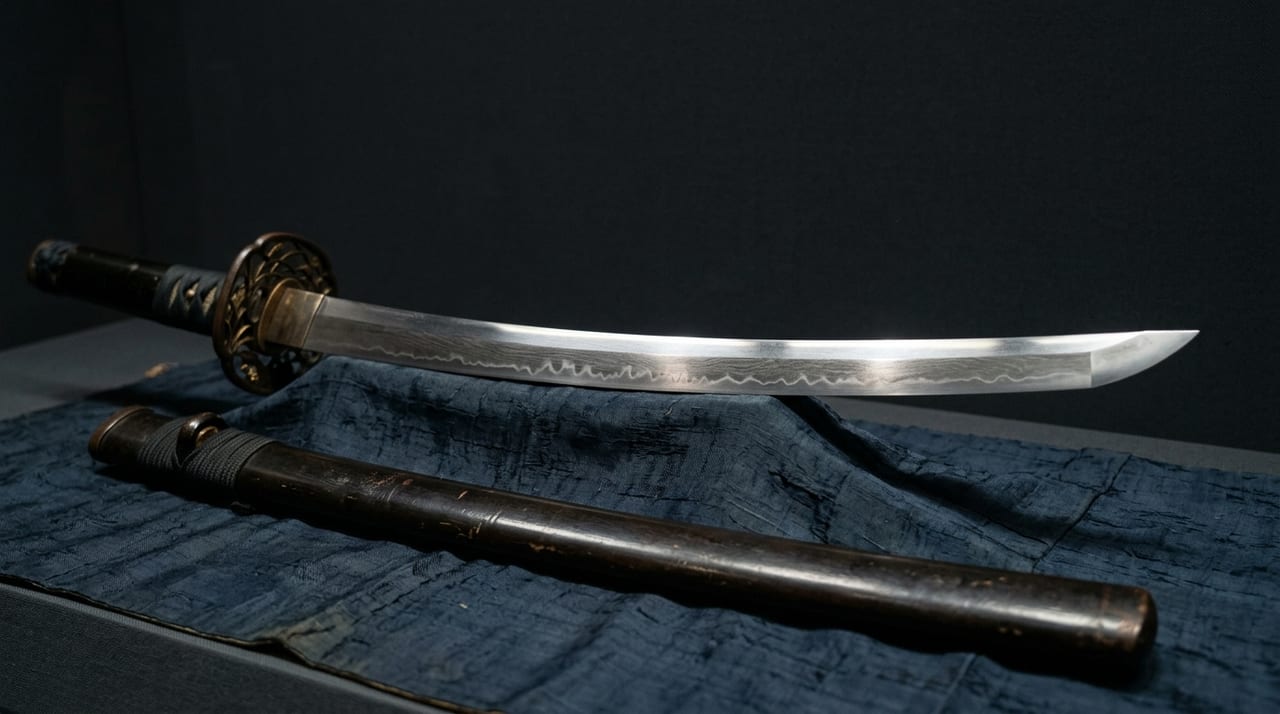
 * Image is for illustrative purposes only.
Osafune Kagemitsu
長船景光
Also known as: Kagemitsu; Pinnacle of Late Kamakura Osafune; Perfector of the Shimoban Tachi
Description
Overview of the Blade
Bizen Osafune Kagemitsu (備前長船景光) was a master swordsmith of the Osafune school who flourished in the early 14th century, during the late Kamakura and early Nanbokuchō periods. He was the grandson of Mitsutada and son of Nagamitsu, bearing the apex of the Osafune lineage. As Nagamitsu's son, Kagemitsu inherited his father's broad range of work while establishing his own distinctive aesthetic at this pivotal moment of the late Kamakura period. He is historically recognized as the craftsman who perfected the distinctive hamon pattern called "kata-ochi-gunome" (asymmetrical scallop), in which the gunome head inclines to one side. Kagemitsu's slim, small-pointed tachi exemplify the canonical late-Kamakura style, representing the typological and pedagogical standard in Japanese sword history. He holds multiple works designated as National Treasures and maintains an unassailable reputation as a master craftsman embodying the highest refinement of Bizen swordsmithing in the late Kamakura to early Nanbokuchō periods.
Kagemitsu's Technique and Aesthetics—The Aesthetic of the Small Point
The defining characteristic of Kagemitsu's tachi lies in the "ko-kissaki" (small point). The kissaki is the tip section of the blade; whereas tachi from the early and middle Kamakura periods featured the chū-kissaki and dai-kissaki, in Kagemitsu's era the ko-kissaki—a sharp, slender tip—was pursued as the symbol of refinement. This small point, combined with its overall proportions, displays "slenderness," in which the blade-width tapers gracefully from hilt to point, embodying the refined aesthetic consciousness of the late Kamakura period. The jigane exemplifies Bizen tradition with itame grain mixed with moku, displaying lustrous markings (utsuori) with exceptional clarity. The hamon shows a complex composition of ko-midare, gunome, and choji interweaving in varied patterns, inheriting the rich variation of his father Nagamitsu while displaying further elevated refinement and dignity. The boushi is elegantly formed with a slight curve, returning in a small round without excessive elaboration.
Long Inscriptions and Kagemitsu's Legacy
Multiple surviving works by Kagemitsu bear detailed long inscriptions (nagamei) such as "Bizen-no-kuni Osafune-jū Kagemitsu" and "Shōwa 3, third month, [day]," recording the place of manufacture, maker, and date. These long-inscribed works serve as invaluable primary source material in sword research, enabling scholars to ascertain precisely Kagemitsu's working period and to trace chronologically the evolution of his style. Kagemitsu's frequent use of long inscriptions is interpreted as stemming from profound pride in his own work and a strong consciousness of "recording for posterity"—understood by scholars as the self-awareness of an "artist" transcending the mere role of craftsman.
The Kata-ochi-Gunome and Small Point Style
The kata-ochi-gunome hamon and the slender, small-pointed tachi silhouette perfected by Kagemitsu symbolize the sword aesthetic of this pivotal late Kamakura transformation. Following the Mongol invasions (1274, 1281), changes in combat style created demand for slim, elongated-point tachi suited to thrusting. Kagemitsu synthesized this practical requirement with the beauty of Bizen tradition, perfecting the "refined silhouette of slender proportions with small point." This form would later evolve in the Nanbokuchō period into the "Nanbokuchō proportions"—larger tachi with larger points—but Kagemitsu's small-pointed elegance occupies a unique place in sword history as "the most refined form immediately before this transformation."
Comparison with Father Nagamitsu and the Establishment of Individual Identity
Kagemitsu's father, Nagamitsu, is characterized by a broad range of work and diverse modes of expression, while Kagemitsu—from within this breadth—selected "the most refined elements," elevating them into his own distinctive aesthetic. This shift from Nagamitsu's "richness" to Kagemitsu's "refinement" represents the archetypal pattern of generational succession in Osafune history: the father expands possibilities, the son refines and elevates the essence from within them. Compared to Nagamitsu, Kagemitsu's works display greater dignity and grace, earning evaluation as the "apex of refinement," yet this dignity rests upon the foundation of his father's rich compositional range.
Modern Evaluation
In contemporary sword connoisseurship, Kagemitsu is ranked among the "three greatest masters of Osafune" alongside his father Nagamitsu and Kanemitsu. This evaluation is supported by the survival of numerous superior works designated as National Treasures and Important Cultural Properties. Particularly, long-inscribed works bearing dates receive the highest scholarly recognition as primary research material, consistently occupying central positions in exhibitions at the Tokyo National Museum and Kyoto National Museum. Kagemitsu's tachi—embodying the "ultimate refinement immediately before transformation" of the late Kamakura era—continue to captivate scholars and enthusiasts in the present day as indispensable masterworks for understanding the evolutionary history of the Japanese sword.
Kagemitsu's Comprehensive Legacy
Kagemitsu's greatest legacy to Japanese sword history lies in the "establishment of refinement as a value." Mitsutada founded the Osafune lineage; Nagamitsu expanded its potential. Kagemitsu selected from these achievements the purest, most dignified elements, realizing the aesthetic apex of the late Kamakura era. The refined silhouette of Kagemitsu's small-pointed tachi, the lustrous gleam of his jigane, the varied yet controlled hamon—all of these became the standard for later swordsmiths and connoisseurs as "the ultimate refinement of Bizen tradition." The technical foundations he transmitted to his successor Kanemitsu supported the grand tachi aesthetic of the subsequent Nanbokuchō age. To study Kagemitsu's works is not merely to study one craftsman; it is to understand in its purest form the essential beauty of the Japanese sword—the unity of functional and decorative beauty.
Legends & Stories
The Aesthetics of the Late Kamakura Period
The late Kamakura period (early 14th century) was an age when Japan's medieval first phase of "stable military rule" began to crumble from within. The authority of the Hōjō clan was waning, Emperor Go-Daigo plotted the overthrow of the shogunate (Genkō Incident, 1331), and a few years later the Kamakura shogunate fell (1333). The art of this age—suffused with "the premonition of decline"—sometimes harbors a unique refinement: "the final age becomes most precise," a law that repeats throughout Japanese cultural history. The delicate beauty of Kagemitsu's small-pointed tachi embodies precisely this "aesthetics of decline," bearing the radiance of the moment just before Kamakura military culture, in its most refined form, passed to the next era. Standing before a Kagemitsu tachi, one can sense in the depths of its elegant small point the atmosphere of the Kamakura period's twilight—and that very sensation lies at the heart of the historical profundity that Kagemitsu's blade possesses.
Long Inscriptions as Self-Expression
The long signatures frequently seen on Kagemitsu's tachi—"Bizen no Kuni Osafune ju Kagemitsu," "(era name) year (month) day"—merit attention as an act of self-expression by a swordsmith of that era. In contrast to Heian swordsmiths who inscribed brief signatures like "Munenaka" or "Yasutuna," Kagemitsu recorded detailed information on the blade itself: production location, name, and era. This trend toward longer signatures began in the late Kamakura period and was most systematically practiced by Kagemitsu. A swordsmith's act of inscribing detailed records on his work represents a strong consciousness to "transmit my work accurately to posterity," and in the history of the Japanese sword it holds special significance as evidence of a shift from craftsman consciousness to artistic consciousness. That in the present day, seven centuries later, Kagemitsu's long signatures provide scholars with first-rate materials proves that Kagemitsu's intention to "record for posterity" succeeded completely.
The Kemmu Restoration and the Osafune Smiths
The Kamakura shogunate fell (1333), Emperor Go-Daigo's "Kemmu Restoration" continued briefly, and then Ashikaga Takauji founded a new shogunate (1336)—amid these upheavals, how did the Osafune smiths respond? Kagemitsu's active period lay just before this transition, yet his successors and disciples continued Osafune blade production through the turbulent shift from Kamakura to Muromachi. The fact that demand for Osafune swords did not falter despite changes in political patronage demonstrates that Kagemitsu, Kanemitsu, and the other Osafune smiths had established a universal reputation for technical excellence that transcended political upheaval. "Quality surpasses politics"—this truth that Kagemitsu's refined tachi embodies was the greatest reason the Osafune school endured for centuries.
Kagemitsu and Kanemitsu—Father and Son in Contrast
Kanemitsu, Kagemitsu's son, is known for the vigorous, broad-bladed tachi of the Nanbokuchō period, bearing a power that stood in stark contrast to his father's delicate small point. This contrast demonstrates the wide range of stylistic variation within the Osafune school, and the emergence of both "the extreme of delicacy" and "the extreme of vigor" from the same bloodline proves the depth of Osafune's technical mastery. In sword connoisseurship, it is held that "one cannot discuss Kanemitsu without knowing Kagemitsu," and understanding Osafune's historical evolution through the contrast between these two masters has become one of the paramount methodologies of Osafune research. The transformation from the elegant small point of Kagemitsu to the vigorous broad blade of Kanemitsu—this change is history's most eloquent spokesman, narrating in the language of the sword the great transition from the late Kamakura to the Nanbokuchō era.
Contemporary Display and Appreciation
Kagemitsu's National Treasure and Important Cultural Property tachi held in the Tokyo National Museum and Kyoto National Museum are displayed regularly as the pinnacle of late-Kamakura Bizen blade beauty, conveying to countless viewers the aesthetic of "the first completion of military culture." Standing before a Kagemitsu tachi, there is an experience as if the sensation of the moment when Kagemitsu wielded his hammer in the Bizen smithy seven centuries ago, subtly adjusting the form of the small point, is transmitted across time. It is direct dialogue with history transcending mere art appreciation—one of the finest experiences of the deepest allure Japanese swords possess: the material bridge connecting past and present. The experience of standing before a Kagemitsu tachi brings fresh discovery equally to the novice newly entering the world of sword appreciation and to the seasoned researcher who has viewed blades for decades—this is the inexhaustible power that a true masterpiece possesses.
Modern Research on Osafune Kagemitsu
In contemporary Japanese sword research, Kagemitsu's works hold special research value as "a group of dated works." By arranging in chronological order works bearing era names such as Shōwa, Karyaku, and Gentoku, one can trace Kagemitsu's stylistic evolution with precision, and from that evolution one can discern the changes in aesthetic consciousness during the late Kamakura period. Researchers at the Tokyo National Museum and Kyoto National Museum continue to utilize Kagemitsu's works as core materials for Osafune school research, and with advances in modern conservation techniques, analysis of the blade's grain patterns and details of the hardened edge has deepened. Seven centuries later, still at the forefront of research, Kagemitsu's tachi most eloquently demonstrates the cultural essence of the Japanese sword—that "works continue to speak"—and stands as an imperishable masterpiece that all who seek to explore the history of Japanese beauty must see.