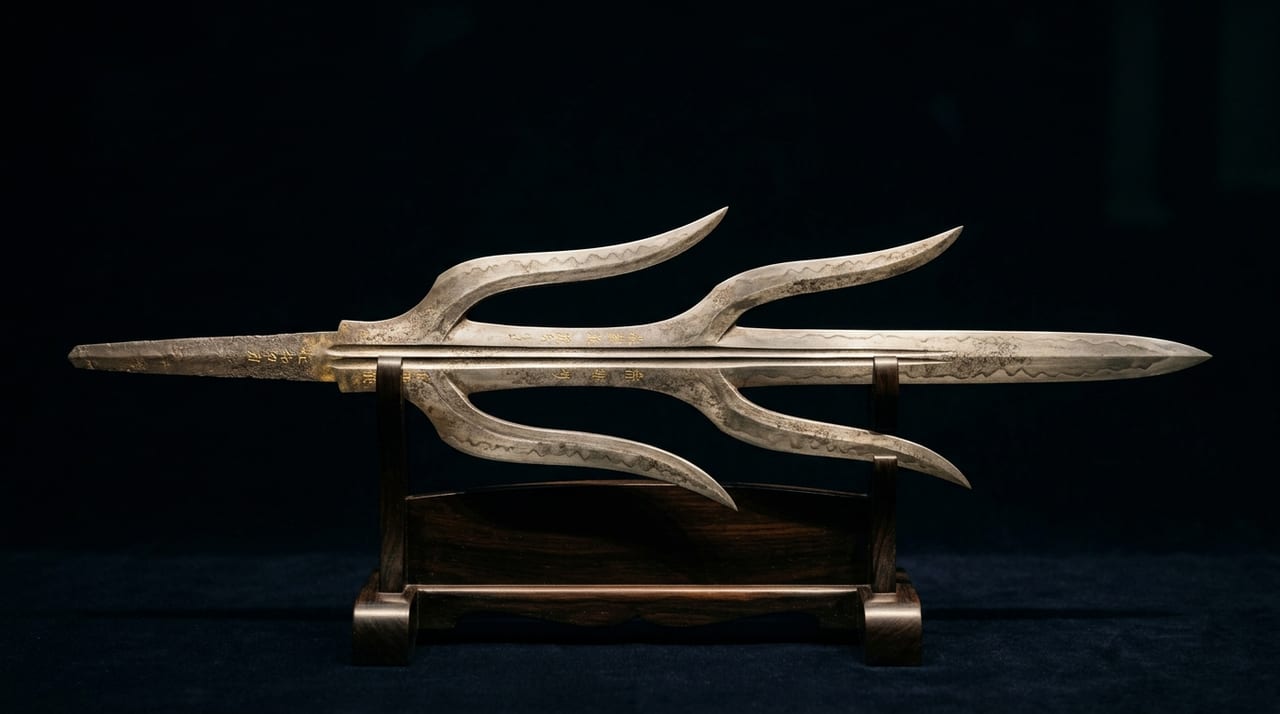
 * Image is for illustrative purposes only.
Nanatsusaya-no-Tachi
七支刀
Also known as: Seven-Branched Sword
Description
The Nanatsusaya-no-Tachi (Seven-Branched Sword) is the oldest National Treasure sword in Japan, enshrined at Isonokami Jingū in Nara. Dating to approximately 369 CE, it is unique among all surviving ancient swords: its blade bears three lateral branches on each side — six branch-blades plus the central blade, seven in all — making it clearly a ceremonial and diplomatic object rather than a weapon. Gold-inlaid inscriptions (61 readable characters) record its creation date and identify it as a gift from the king of Baekje (ancient Korea) to the king of Wa (Japan). The inscription's exact reading has been debated for over a century, as it bears directly on the diplomatic relationship between Baekje and Yamato Japan in the 4th century. Referenced in the Nihon Shoki under the entry for Empress Jingū, the sword is one of the most important physical documents of ancient East Asian international relations. Preserved for over 1,600 years within the sacred precinct of Isonokami Jingū — one of Japan's oldest shrines, dedicated to divine swords — it was designated a National Treasure in 1953 and remains largely inaccessible even to researchers.
Legends & Stories
The Legends of the Seven-Branched Sword—Divine Blade and Baekje's Envoy
The legends surrounding the Seven-Branched Sword are inseparably bound to the grand theme of relations between ancient Japan and the Korean peninsula. The Nihon Shoki records that in the fifty-second year of Empress Jingū's reign, King Geun Socho—the grandfather of King Chim-ryu of Baekje—presented the Seven-Branched Blade to Empress Jingū of Japan. Empress Jingū is described in the Nihon Shoki as a legendary empress who undertook the "Conquest of Three Han," and the narrative of the presentation of the Seven-Branched Blade, framed within the context of Baekje's submission to her reign, is deeply connected to debates concerning the political and religious implications of the Seven-Branched Sword. Modern historical scholarship has rejected the historical veracity of this "Conquest of Three Han," yet the fact that a sword was presented from Baekje to Wa in 4th-century diplomatic exchange is corroborated by the inscription on the Seven-Branched Sword itself. As a rare object that bridges legend and historical fact, the Seven-Branched Sword continues to command substantial interest in both scholarly circles and general society today.
The Divine Sword Traditions of Isonokami Jingū—The Connection to Futsu-no-Mitama
The principal deity enshrined at Isonokami Jingū is the divine sword known as the Futsu-no-Mitama, which according to the records and myths was brought down by Takemikazuchi-no-Mikoto when he descended to aid Emperor Jinmu in his eastern campaign. Isonokami Jingū, as a shrine dedicated to this divine sword, has been recognized since ancient times as possessing the highest sacred status, and was served by the Mononobe, a powerful ancient clan. The reason the Seven-Branched Sword came to be preserved at this shrine lies in the fundamental character of Isonokami Jingū as a place that "enshrines swords as sacred objects"; the "mysterious seven-bladed sword" sent from Baekje was accepted as a fitting object to be preserved in this "sacred realm of divine swords." The positioning of the Seven-Branched Sword as "a foreign ritual sword preserved in a shrine dedicated to divine swords" vividly demonstrates an ancient Japanese worldview in which religion and diplomacy were interwoven.
The Historical Drama of Inscription Decipherment
The history of deciphering the inscription on the Seven-Branched Sword is itself a form of intellectual drama. In the Meiji period (1874), the Shinto scholar Suga Masatomo first reported the existence of the inscription on the Seven-Branched Sword in academic terms, initiating scholarly debate concerning its reading. Questions over whether the year notation "Taiwa 4" in the inscription represents an era name of the Eastern Jin or a unique Baekje era name; disputes over the reading—whether it reads as "present" (供) or "bestow" (賜)—whereby the hierarchical relationship between Wa and Baekje is completely reversed; and differences of interpretation concerning the political implications of the phrase "to be transmitted to posterity"—all such questions are directly connected to the still politically and historically sensitive theme of "the fundamental character of 4th-century Japanese-Korean relations." As a rare historical document whose inscription caused a single sword to become the center of scholarly controversy sixteen centuries later, the Seven-Branched Sword continues to kindle the passion of ancient history scholars even today.
The Fall of the Mononobe Clan and the Protection of the Seven-Branched Sword
The Mononobe clan, which served as the priests of Isonokami Jingū in ancient times and were the guardians of the Seven-Branched Sword, perished in 585–587 CE in political and religious conflict with the Soga clan (the Rebellion of Mononobe-Moriya). This "fall of the Mononobe clan" also marked a watershed moment in religious history—the clash between Buddhism (which the Soga clan supported) and Shinto (the ancient religion maintained by the Mononobe clan). After the Mononobe clan's defeat, Isonokami Jingū lost the protection of the Mononobe, yet continued to exist under the patronage of the imperial house and the Yamato polity. The Seven-Branched Sword, by maintaining its sacred status as the "principal deity of the shrine," survived this political turmoil. The "survival story" of the Seven-Branched Sword—preserved within the shrine even as the ancient Mononobe clan experienced its rise and fall—offers profound insight into how important cultural properties came to be protected amidst Japan's religious and political transformations.
The Technological Exchange of Ancient East Asia as Demonstrated by the Seven-Branched Sword
The manufacturing technique of the Seven-Branched Sword stands as evidence of the advanced metalworking technology that existed in 4th-century East Asia and holds particular significance in the history of technological exchange between Japan and the Korean peninsula. The technical achievement of Baekje smiths in using gold inlay techniques to forge in a single piece a complex-form sword bearing six branch blades demonstrates the highest level of 4th-century East Asian metalworking, and the influence this technology subsequently exerted on Japanese sword-making and metalcraft cannot be overestimated. Although the continuity from "Seven-Branched Sword technology" to "Japanese sword technology" is not direct, within the historical context of craftspeople migrating (immigrant technicians) from Baekje to Wa, the Seven-Branched Sword is sometimes interpreted as "one of the first brilliant pieces of evidence that continental technology reached the Japanese islands." The Seven-Branched Sword is a sword, a diplomatic document, evidence of technological history, and the principal deity of a shrine—and an object bearing such multivalent significance is extraordinarily rare among Japan's cultural properties. Even in the modern era, the Seven-Branched Sword continues to be carefully preserved deep within Isonokami Jingū, quietly yet powerfully bearing witness to sixteen hundred years of history.