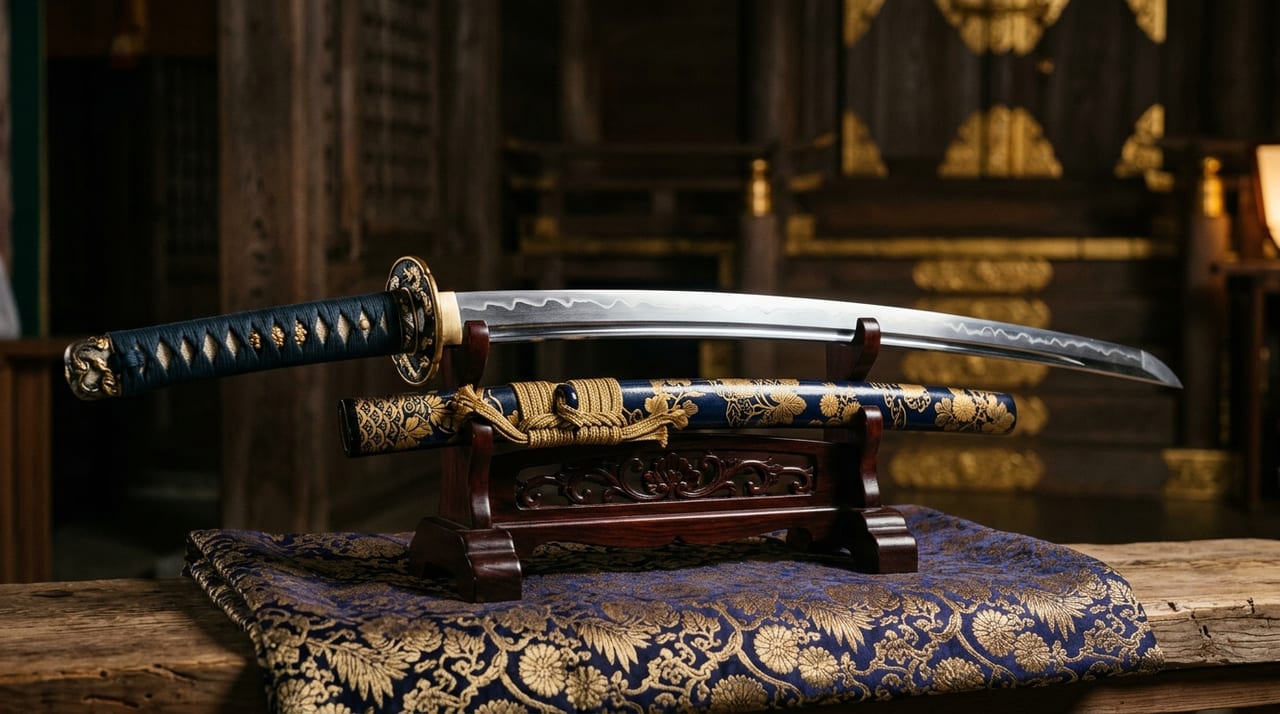
 * Image is for illustrative purposes only.
Miike Tenta Mitsuyō's Tachi
三池典太光世の太刀
Also known as: Tenta Mitsuyō
Description
Miike Tenta Mitsuyō was a master smith representing the Miike-ha (Miike School), the oldest and largest group of sword smiths from the Koto period, based in Miike in Chikugo, Kyushu (present-day Fukuoka Prefecture). Tenta Mitsuyō is also known as the creator of Ōdenta Mitsuyō, one of the Five Swords Under Heaven, and is positioned at the highest level in Japanese sword history as a foundational figure who forged multiple National Treasure tachi from Japan's earliest periods. This tachi has a blade length of approximately 78 centimeters and features the characteristic broad gunome-midare (comb-tooth irregular pattern), also called "ukkari," extending throughout the blade, distinctive to the Miike tradition. The jihada (steel surface) is distinguished by its dark tone characteristic of the Koto period and its large itame (wood-grain) pattern. The sori (curve) displays the deep koshizori (hip curvature) characteristic of the Koto period, and the entire blade exudes a sense of substantial presence and classical elegance. Very few tachi by Miike Tenta Mitsuyō survive today, and each one is designated as either a National Treasure or Important Cultural Property. As an embodiment of the pinnacle of sword culture from the late Heian through early Kamakura periods, this blade serves as one of the most important resources in sword research. His masterpiece, Ōdenta Mitsuyō, one of the Five Swords Under Heaven, is known as a National Treasure held by the Maeda Ikutoku Foundation.
Legends & Stories
Miike Tenta Mitsuyō was revered as the 'God of Swords,' and his blades were described as 'steel imbued with the power of the earth.' According to legend, blades forged by Mitsuyō using water from the sacred spring of Mt. Miike were infused with the power of the mountain deity, and warriors who wielded such swords would not fall even after being struck by countless arrows on the battlefield. There is also a tradition that during a conflict in the late Heian period, when a Minamoto general used this tachi to strike down a Taira commander, the blade shone with seven colors of light. It is also said that Mitsuyō's forge was illuminated by supernatural flame, a sacred place so hallowed that people dared not approach it, and his spiritual essence was believed to be directly connected to the spiritual quality of the blades. Together with Ōdenta Mitsuyō, one of the Five Swords Under Heaven, this tachi is revered today as a sacred weapon embodying the mythical origins of the Japanese sword.