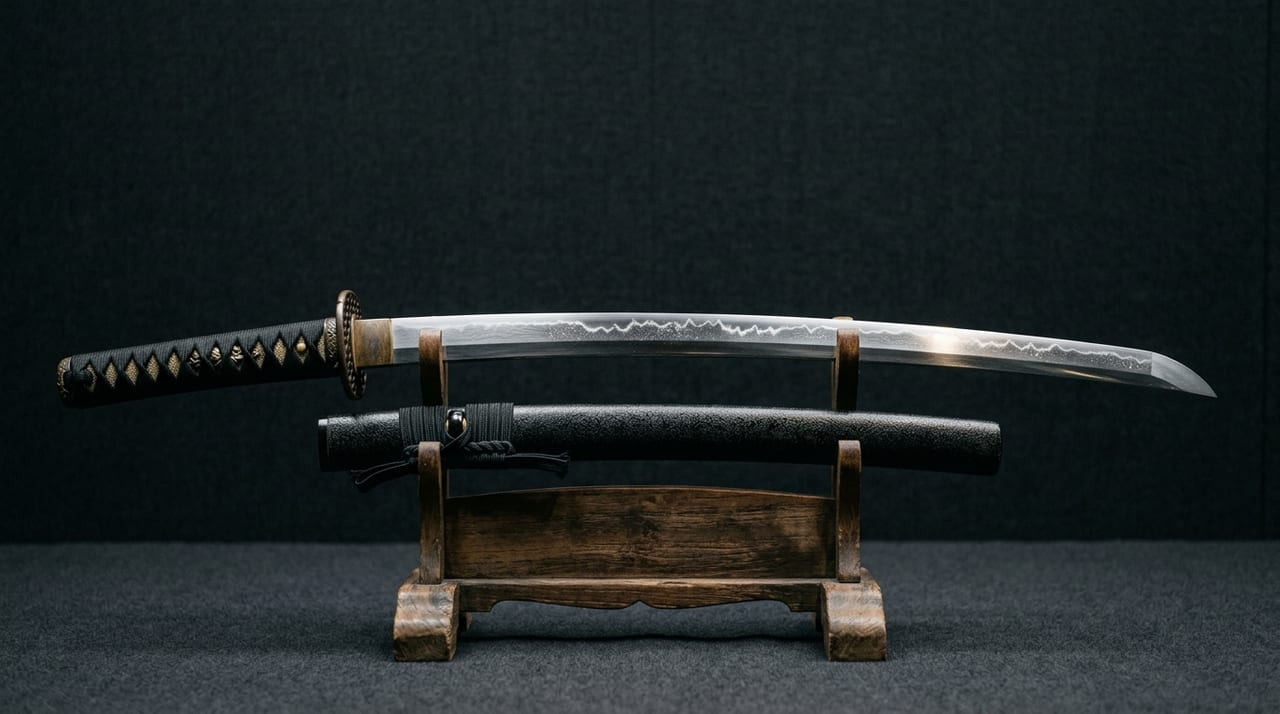
 * Image is for illustrative purposes only.
Honjō Masamune
本庄正宗
Also known as: Honjō Masamune / The Unrivaled Masamune of All Japan / The Lost Legendary Blade
Description
Overview of Honjō Masamune — A Lost National Treasure
Honjō Masamune is a katana attributed to Goro Nyudo Masamune, the supreme master swordsmith of Soshu who flourished in the late Kamakura period. Though designated a National Treasure in 1939 (Showa 14), it disappeared in the chaos immediately following the end of World War II and is known as a 'phantom National Treasure sword.' Its name derives from being possessed in the Sengoku period by Honjo Shigenaga, a retainer of Uesugi Kenshin. It later passed through the Toyotomi and others to the Tokugawa family and was recorded in the Kyoho Meibutsu-cho as a legendary blade of Japan, remaining celebrated in history. After Japan's defeat in 1945, Honjō Masamune was confiscated from the Tokugawa family and handed over to GHQ (the Allied Occupation) following the war's end, but its whereabouts have remained unknown to the present day.
Masamune the Master — The Pinnacle of Soshu-den
To understand Honjō Masamune, one must first grasp the greatness of its maker, Goro Nyudo Masamune. Masamune was a swordsmith who flourished in Kamakura, Sagami Province (present-day Kanagawa Prefecture), during the late Kamakura period (late 13th to early 14th century). He earned the appellation 'Kami of the Japanese sword' and 'Saint of the blade' and stands as the greatest master craftsman in history, achieving absolute reverence across generations. Masamune's revolutionary technical contribution lay in perfecting the nie-deki hamon. The striking visual effect of fine granular metal particles (nie) densely clustered along the blade edge was a breakthrough impossible to achieve in the Yamato-den, Yamashiro-den, and Bizen-den traditions that preceded him, establishing the entirely new aesthetics of Soshu-den. Masamune's masterworks possess an overwhelming presence—the hamon seems to move with life, and the appearance changes with each viewing. They overwhelm the observer and were treasured by successive rulers of Japan, each eager to possess them.
Provenance of Honjō Masamune — From Uesugi Kenshin to the Tokugawa Shoguns
The provenance of Honjō Masamune is deeply intertwined with the history of the samurai elite from Japan's Sengoku period through the Edo period. Honjo Shigenaga, after whom this blade is named, was a retainer of Uesugi Kenshin and is said to have prized it highly after acquiring it in battle. Honjō Masamune passed from the Uesugi family through the hands of Toyotomi Hideyoshi, the Shimazu clan, and Tokugawa Ieyasu before becoming part of the Tokugawa shogunal collection. During the Edo bakufu, it was recorded in the Kyoho Meibutsu-cho, compiled by Honami Mitsutada at the command of Tokugawa Yoshimune in 1719 (Kyoho 4), and was officially recognized as a 'legendary blade of Japan.' Inclusion in the Kyoho Meibutsu-cho meant recognition in the official register of Japan's supreme blades, confirming that Honjō Masamune held the highest rank among swords valued during the Edo period.
National Treasure Designation and World War II
In 1939 (Showa 14), Honjō Masamune was formally designated a National Treasure. However, following Japan's defeat in August 1945, GHQ (Supreme Commander for the Allied Powers) ordered the confiscation of swords throughout Japan. Honjō Masamune was confiscated from the Tokugawa family and transferred to the Allied Occupation authorities. The American serviceman to whom it was handed over has never been identified due to conflicting records, and the blade has remained missing ever since. The unprecedented situation of a National Treasure disappearing shocked Japan's cultural heritage community, and searches for Honjō Masamune have continued for over seventy years. Sword researchers and private investigators have pursued various leads, but Honjō Masamune's current location remains undetermined.
The Cultural Significance of a Lost National Treasure
The disappearance of Honjō Masamune stands as one of the most emblematic cases of cultural heritage loss, etched deeply in Japan's history of cultural preservation. The fact that a supreme National Treasure designated in 1939 vanished within merely seven years offers a tragic lesson: the National Treasure designation system proved powerless against the violence of war. Yet the fact that Honjō Masamune has not been found also means it might yet exist somewhere, making it a symbol of hope for sword enthusiasts and cultural researchers who await the day it might return to Japan from wherever it lies. Though existing Masamune works hold supreme artistic value, the story of Honjō Masamune—the lost masterpiece of Japan's most celebrated swordsmith—remains the greatest mystery in Japanese sword culture.
Symbolic Significance of Honjō Masamune in Modern Times
In contemporary times, Honjō Masamune holds special cultural significance as a symbol of lost Japanese heritage. The story of Honjō Masamune is repeatedly cited in discussions of Japan's cultural preservation policy as a stark example of irreplaceable cultural loss inflicted by war. The romantic mystery of a missing National Treasure has also been taken up in contemporary popular culture and mystery literature, and the narrative possibility of discovering and recovering Honjō Masamune from somewhere in the world continues to inspire interest in and respect for Japanese sword culture. More than seventy years later, the search for Honjō Masamune continues, and hopes for its return resonate far beyond the sword community as a broader concern for Japanese cultural heritage. Honjō Masamune—an 'invisible masterpiece'—paradoxically achieved maximum significance through its loss, remaining enshrined as both the most poignant and most hopeful chapter in the history of Japanese swords.
Legends & Stories
Honjo Shigenaga's Battles and the Blade's Origins
Honjo Shigenaga (1540–1614), whose name became the origin of "Honjō Masamune," was a military commander serving Uesugi Kenshin, based in Echigo Province (present-day Niigata Prefecture). Shigenaga is said to have taken this masterwork from an enemy commander whose blow had split his helmet in battle. In any case, that the name "Honjō Masamune" became established through "the sword owned by Honjo Shigenaga" exemplifies the typical Japanese sword naming convention of attaching an owner's name to a blade. This embodies a fundamental pattern of Japanese sword culture: a masterwork gains eternal narrative when bound to a hero's name. Uesugi Kenshin, hailed as the "God of War," was among the most formidable commanders of his age; naturally, a masterwork owned by his retainer Shigenaga came to bear the legendary aura of a "treasure blade of the War God's domain." This narrative structure—the bond between hero and legendary blade—positions Honjō Masamune as more than a mere artwork: it is a living witness to the tales of the Sengoku period.
The Kyoho Meibutsu-cho and Edo-Period Sword Culture
In the peaceful Edo period, a culture of collecting and appreciating Sengoku-period masterblades flourished within samurai society. The Kyoho Meibutsu-cho was a groundbreaking document compiled by Honami Mitsutada (thirteenth generation of the Honami family) under orders from Tokugawa Yoshimune, the eighth shogun, and submitted to the bakufu in Kyoho 4 (1719). It provided the official register of legendary blades known throughout the realm. That Honjō Masamune was included in this registry meant it was granted the highest authority as an "officially recognized legendary treasure of the realm"; thereafter it was unquestionably acknowledged as one of Japan's supreme swords. The Kyoho Meibutsu-cho remains one of the most essential reference materials in Japanese sword authentication today, and blades listed within it carry special authority as "masterworks certified by history." The disappearance of Honjō Masamune represents the most dramatic betrayal of this authority, yet its status as a "lost masterpiece from the registry" has paradoxically heightened its legendary value.
The Tragedy of 1946 — The Final Sighting
Records of Honjō Masamune's "final confirmed sighting" are repeatedly cited as among the most important historical documents in Japanese cultural heritage history. In December 1945, as Japan was occupied by Allied forces and GHQ-ordered confiscation of swords proceeded, the Tokugawa family's sword collection was submitted to and confiscated by the Mejiro Police Station. Then, in January 1946, Honjō Masamune was handed over to a man recorded as a sergeant of the Foreign Liquidations Commission of AFWESPAC (U.S. Army Forces, Western Pacific), "Sgt. Coldy Bimore." However, the name may be a garbled phonetic rendering of his real name, greatly complicating subsequent attempts to trace the blade. The opacity of this transfer positions Honjō Masamune's disappearance as a tragedy lost through bureaucratic cracks, and it is often remarked that proper documentation would surely have allowed its recovery.