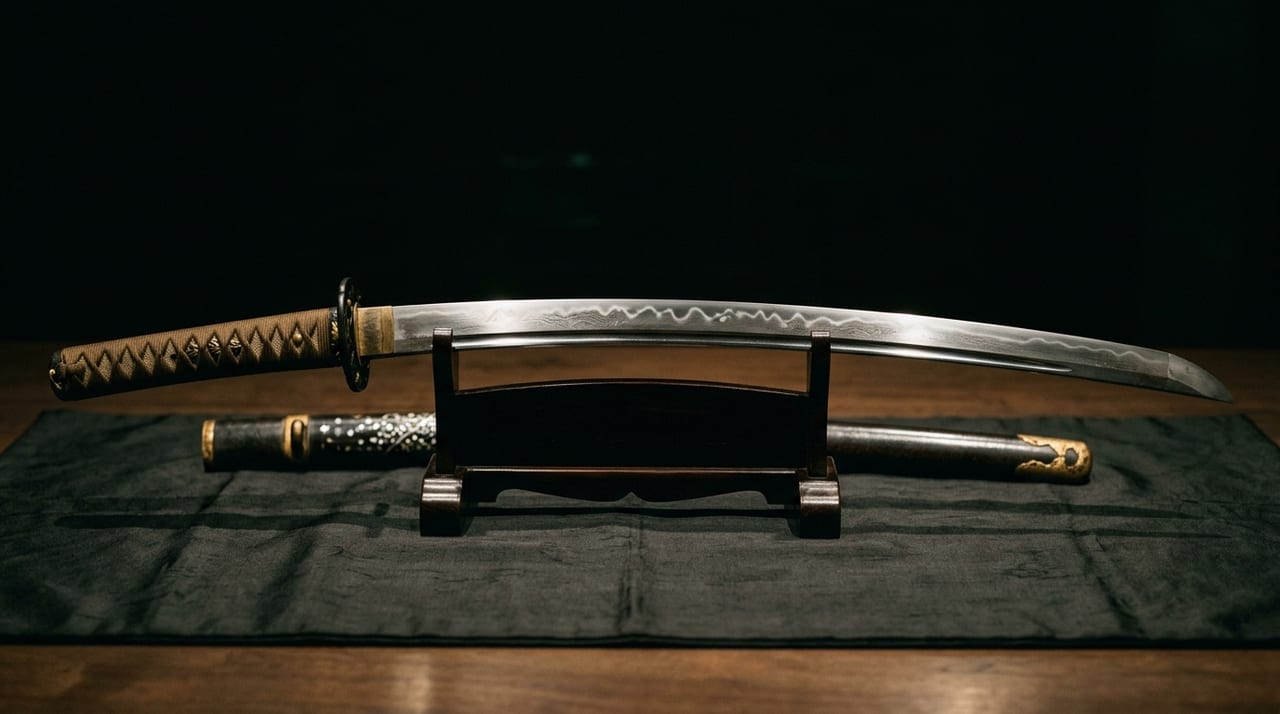
 * Image is for illustrative purposes only.
Hasebe Kunishige
長谷部国重
Also known as: Kunishige; Who Planted Sōshū Tradition in Kyoto; Master Swordsmith of the Ashikaga Shōguns
Description
Hasebe Kunishige is the smith who transplanted the Sōshū tradition from Kamakura to Kyoto — one of Masamune's Ten Disciples who settled in Yamashiro Province and worked under the patronage of the early Ashikaga shōguns. The result was a distinctive fusion: the heavy nie, complex activity, and undulating hamon of Sōshū combined with the refined sensibility of the old Yamashiro capital. His famous piece 'Meibutsu Hasebe' passed through Ashikaga Yoshiteru, Oda Nobunaga, and Toyotomi Hideyoshi as a ranked treasure. Multiple National Treasures and Important Cultural Properties survive; the Hasebe school he founded maintained his legacy through the Muromachi period.
Legends & Stories
"Meibutsu Hasebe"—A Legendary Blade in the Hands of Rulers
The anecdote most widely preserved and celebrated through the ages concerning Hasebe Kunishige's name is found in the provenance of the blade known as "Meibutsu Hasebe" (Named-Treasure Hasebe), a polished-up tachi. This sword is known to have been in the possession of Oda Nobunaga. The name derives from a celebrated anecdote: when Nobunaga sought to punish a tea-house attendant named Kanai who had shown disrespect, and Kanai hid beneath the kitchen shelves, Nobunaga pressed the blade against him and cut him down—an episode known as the "pressing cut" (oshigiri). The blade subsequently passed from Nobunaga to Toyotomi Hideyoshi, and from Hideyoshi was granted to Kuroda Takakage (Kanbe) and Kuroda Nagamasa. It then became a treasured heirloom of the Kuroda clan, lords of Fukuoka Domain. Today it is housed in the Fukuoka City Museum and designated a National Treasure. The provenance of this Hasebe exemplifies how Kunishige's blades transcended mere masterpieces to function as "proof of heavenly authority"—an anecdote long transmitted as embodying the samurai society's faith that "the one who wields the blade commands the realm."
Kyoto and the Meeting of Sōshū Tradition
The question of why the fierce beauty born in Sōshū (present-day Kanagawa Prefecture) took root in Kyoto, the "Capital of Refinement," contains a cultural mystery that cannot be explained by supply and demand alone. When the Ashikaga shōgunal house established its seat not in Kamakura but in Kyoto, the political capital of the warrior class shifted from east to west. This political movement profoundly affected sword culture: master smiths of the Sōshū tradition were summoned to or voluntarily settled in Kyoto, where they developed Sōshū technique on Yamashiro soil, creating a cultural fusion. Hasebe Kunishige stands as a symbolic figure of this historical turning point. The beauty born where two extremes—the fierceness of Sōshū and the refinement of Yamashiro—converged demonstrates the "richness of hybrid tradition" in Japanese sword culture. Great art is sometimes born not from "pure tradition" but from "rich mixture"—and Hasebe Kunishige's example embodies this truth beautifully.
Civil War and the Sword Maker's Path
How master smiths like Hasebe Kunishige found political patrons and maintained stable working conditions during the Nanboku-chō period, an era of internal strife, is a fascinating question from the perspective of a sword maker's life. Kunishige, able to work under the patronage of the Ashikaga shōgunal house, enjoyed a degree of stability even amid the Nanboku-chō turmoil. Yet shogunal patronage could destabilize with political and military shifts, and sword makers of Kunishige's time had to remain constantly alert to the fluctuations of power. The journey of the Oshigiri Hasebe from Oda Nobunaga to Toyotomi Hideyoshi to the Kuroda house reveals the resilience of works created by sword makers: blades endure longer than their makers and, while serving multiple rulers, become witnesses to history.
Successors of the Hasebe School and Muromachi Sword Culture
The fact that Hasebe Kunishige's successors flourished throughout the Muromachi period demonstrates that the "Yamashiro-style Sōshū tradition" he established was not a passing fashion but a sustained living tradition. The Muromachi era witnessed high demand for swords, and various regional smith collectives competed to serve diverse patrons—shōguns, daimyo, temples, and shrines. That the Hasebe school survived and developed amid this competition testifies to the persuasiveness and universality of Kunishige's aesthetic. In modern times, Hasebe Kunishige's name invariably appears in Japanese sword history textbooks, and as a symbol of "a turning point in the geography of sword culture"—marking the transplantation of Sōshū tradition to Yamashiro—his name is transmitted to posterity as a figure of historical significance. The greatness of Hasebe Kunishige lies not merely in individual masterpieces but in his geographic and cultural influence, which altered the trajectory of an entire tradition.
Hasebe Kunishige in the Modern Age
For contemporary sword enthusiasts, Hasebe Kunishige holds a unique status as "the supreme smith known only to those who truly know." Though perhaps not as widely recognized as Masamune, Gō Yoshihiro, or Yoshimitsu, his reputation grows with deeper study—a structure in which connoisseurship increases appreciation for his originality and technical mastery. Among discerning collectors, he commands singular respect as a "connoisseur's smith." When one examines a blade by Kunishige in person—or views it close at hand in an exhibition—confronting its extraordinary ground texture and the fierce flow of its blade pattern, one experiences something powerful: the intensity of the Nanboku-chō era of turmoil seems frozen in steel. This is the power of a Hasebe Kunishige blade, the reason it continues to move hearts even across seven centuries as a living work of art. To appreciate a Kunishige blade is to encounter one of the most richly varied aesthetic experiences offered by Japanese sword culture—to read, inscribed in steel as an eternal record, the moment when two great traditions, Sōshū and Yamashiro, fused in the hands of one genius. The name of Hasebe Kunishige will forever shine brightly in the most important chapters of Japanese sword history.