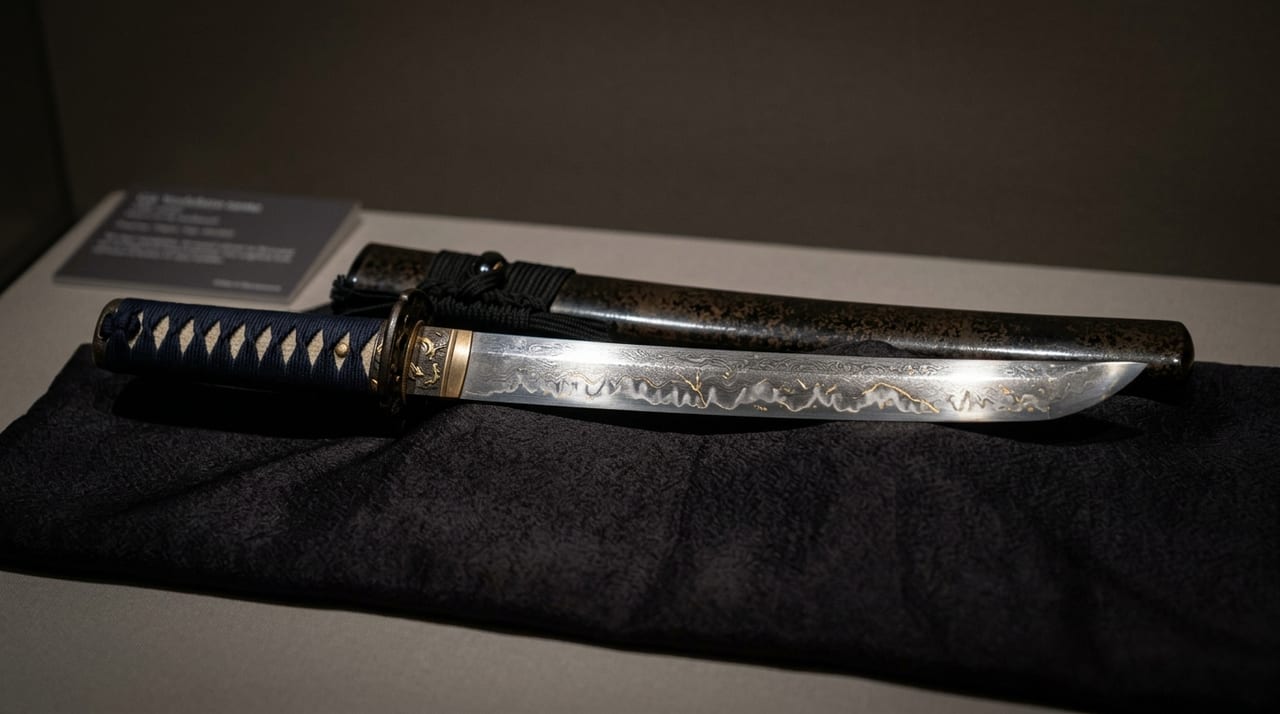
 * Image is for illustrative purposes only.
Gō Yoshihiro
郷義弘
Also known as: Gō Yoshihiro; Genius of Etchū Gō; One of Masamune's Ten Great Disciples
- Smith
- Gō Yoshihiro
- Era
- Late Kamakura to Nanbokuchō period (first half of 14th century)
- Type
- Katana
- Designation
- National Treasure / Important Cultural Property (multiple works)
- Location
- Maeda Ikutokukai, Kashiwabara Art Museum (Iwakuni, Yamaguchi Prefecture), Kyoto National Museum, and others
Description
Overview of the Sword
Gō Yoshihiro was a swordsmith who worked in Etchū Province (present-day Toyama Prefecture) from the late Kamakura period through the Nanboku-chō period (first half of the 14th century). He is counted among the Masamune Juttetsu, the Ten Great Disciples of Masamune, the giant of the Sōshū-den, and is a legendary master. He is commonly called "Gō" or "Gō Yoshihiro." The Kyōhō Meibutsuchō lists him together with Sōshū Masamune and Awataguchi Yoshimitsu as the "Meibutsu Sansaku." Extant works by Gō Yoshihiro are extremely scarce, and this rarity has given them a mythic value. Several works have been designated National Treasures and Important Cultural Properties, yet no blade has been confirmed to bear a signature cut by Yoshihiro himself. "Gō kiwame," blades certified by the Hon'ami family as works of Gō Yoshihiro and accompanied by a certificate of appraisal (origami), receive the highest rating in the sword market.
Gō Yoshihiro's Techniques and Style
The greatest feature of Gō Yoshihiro is that, while adapting the techniques of the Sōshū-den to the materials and environment of Etchū Province, he achieved a style in which both the jigane and the hamon are bright and clear. The jigane shows a complex mix of itame and mokume, with abundant ji-nie. The hamon is based on gunome and notare, and strong nie gathers in mura that cover the habuchi. Many hataraki appear, such as kinsuji, inazuma, and tobiyaki. The scenery within the blade is as violent as a storm, with an overwhelming force that stuns the viewer.
Scarcity of Signed Works and "Gō kiwame"
The most pressing problem with Gō Yoshihiro's works is the scarcity of signed examples. Many sword researchers hold two competing theories: that "Gō Yoshihiro originally made many unsigned blades," and that "the signatures were lost through suriage in later times." In either case, no work signed by Yoshihiro himself has been confirmed, and it was said that "no one has ever seen a Gō or a ghost." This rarity greatly raised the value of Gō kiwame, blades certified by the Hon'ami family with a certificate (origami) as works of Gō Yoshihiro. It gave rise to an Edo-period sword culture in which a single Gō kiwame was said to rival a meibutsu tea-room utensil in value.
Etchū and Gō Yoshihiro
Etchū Province (present-day Toyama Prefecture), where Gō Yoshihiro was active, is a mountainous region surrounded by Kaga, Noto, and Hida. When Yoshihiro, said to have studied under Masamune (or Etchū Norishige), wielded the techniques of the Sōshū-den in the land of Etchū, a distinctive beauty was born. This is one of the best examples of a phenomenon that recurred in Japanese sword history: when local materials merge with the skill of a genius, the highest results emerge. The paradox of a genius born in Etchū, a "periphery" far from Sōshū, the "center of tradition," shows the diversity and depth of Japanese sword culture.
Masamune Juttetsu and Their Evaluation
"Masamune Juttetsu" is the name given in the late Edo period to ten senior disciples of Masamune (not all of them were direct disciples). They are listed as Sadamune, Kanemitsu, Chōgi, Samonji, Rai Kunitsugu, Hasebe Kunishige, Gō Yoshihiro, Etchū Norishige, Shizu Saburō Kaneuji, and Kaneshige. (Some theories include Sekishū Naotsuna in place of Sadamune.) The concept of the Masamune Juttetsu itself symbolizes the golden age of the Sōshū-den, with the genius Masamune at its peak.
The Special Brilliance of Gō Yoshihiro's Blades
Gō Yoshihiro's blades employ the techniques of the Sōshū-den, yet they possess a unique world of beauty that is clearly distinct from other Sōshū-den smiths. In the fineness of the nie in the jigane, the density of its luster, and the natural movement of the hamon, Yoshihiro's works embody the utmost potential of the Sōshū-den. How such a genius could arise in Etchū, far from the home of the Sōshū-den, remains one of the greatest mysteries in Japanese sword history. That mystery deepens Gō Yoshihiro's legend and is a source of appeal that has not faded in more than seven hundred years. That his works are still carefully preserved today as National Treasures and Important Cultural Properties is proof that their artistic and historical value has been formally recognized by the Japanese nation. They carry the mission of being passed down to later generations as one of the peaks of Japanese sword culture. When you view a Gō Yoshihiro blade, you may feel as though you are seeing, in the sea of nie floating on the steel's surface, the young Yoshihiro, trained under the master Masamune, swinging his hammer at a forge in Etchū seven hundred years ago. That is the timeless power of Gō Yoshihiro's blades to speak to us.
Legends & Stories
The Myth of Being Masamune's Disciple
The process by which Gō Yoshihiro became legendary as one of the Masamune Juttetsu (the Ten Great Disciples of Masamune) reflects a cultural dynamic in the history of the Japanese sword: the mythologizing of master-disciple transmission. Being a disciple of Masamune, a smith of unprecedented genius, was in itself the highest form of authority. Being recognized as one who had correctly inherited Masamune's technique dramatically raised the value of a sword. In Yoshihiro's case, the technical excellence shown by his rare surviving works supports the legend, so the reputation rests not on myth alone but on evaluation grounded in evidence. The name Masamune Juttetsu came into use only in the bakumatsu period, yet Yoshihiro's name already appears as a disciple of Gorō Nyūdō (Masamune) in the mid-Muromachi sword treatise Ōjakushō.
Toyotomi Hideyoshi and Gō Yoshihiro
Toyotomi Hideyoshi is said to have called Gō Yoshihiro, together with Sōshū Masamune and Awataguchi Yoshimitsu, "the three famous smiths of the realm." Later, in the Kyōhō Meibutsuchō, the works of these three smiths were recorded more than those of any others, and they came to be called the Meibutsu Sansaku (the Three Famous Works). Each daimyo eagerly sought to acquire Yoshihiro's works.
The Hon'ami Family and the Culture of "Gō Kiwame"
In the Edo period, the Hon'ami family, generation after generation, bore responsibility for sword appraisal for the shogunal house and the daimyo houses. The attribution "Gō Yoshihiro" issued by the Hon'ami family raised the value of a sword astronomically. This Gō kiwame culture shows the particular character of Edo-period sword culture, in which appraisal of Japanese swords went beyond specialist knowledge to become an act carrying political and economic power. Hon'ami Kōetsu, also a master of calligraphy, ceramics, and maki-e, took part in the attribution of Yoshihiro's works. The name of Gō Yoshihiro was always present at the place where the world of swords and the world of art intersect.
Etchū, a Frontier That Produced a Genius
Etchū Province (present-day Toyama Prefecture), where Gō Yoshihiro was active, lay far from Kyoto and Kamakura, the centers of sword culture at the time. After studying under Masamune in Sōshū (Kanagawa), Yoshihiro returned to his home province of Etchū. Combining the clear waters of its mountain streams, the iron sand of Etchū, and the finest techniques he had learned in Sōshū, he pioneered an original style in which both the jigane and the hamon are bright and vivid. The paradox that the greatest genius emerges on the periphery, far from the center, is a theme that recurs throughout Japanese cultural history, and Gō Yoshihiro is one of its best examples. The possibility that the land of Etchū influenced the intense expression of Yoshihiro's work, through its mountainous terrain, its severe climate, and its freedom from the center, is a topic of lively discussion among sword enthusiasts. The story is passed down as the finest episode illustrating how the fusion of land, people, and technique gives birth to genius.
Gō Yoshihiro's Position in the Present Day
In today's sword world, Gō Yoshihiro is established as a smith of the highest rank, alongside Masamune, and his works are presumably among the hardest to obtain of all Japanese swords. Even in the appraisals of the Nihon Bijutsu Tōken Hozon Kyōkai, regarded as the supreme authority on Japanese sword appraisal, being certified as a work of Gō Yoshihiro is considered one of the highest honors. The rarity of signed works and the difficulty of appraisal paradoxically raise Gō Yoshihiro's value even further, and the legend of him as a genius of many mysteries continues to deepen today. Gō Yoshihiro has maintained the highest reputation for seven centuries, and is one of the best witnesses to the eternity of the Japanese sword as art.
Gō Yoshihiro and Contemporary Sword Culture
In contemporary sword exhibitions, Gō Yoshihiro's works always draw the greatest attention. Because signed works are extremely rare, swords exhibited as "Gō Yoshihiro" (certified by appraisal) are a major interest for sword fans, and many enthusiasts gather at exhibition venues. Viewers standing before a Gō Yoshihiro sword commonly describe an overwhelming presence beyond words. That emotion rests on an intuitive sense that the sword holds something spiritual beyond the technical achievements of the Sōshū-den. Masamune and Gō Yoshihiro are always named side by side when the summit of Japanese swords is discussed, and as the crystallization of the highest technique and beauty produced by Japanese culture, they will be revered forever. The essence of the Sōshū-den transmitted by Gō Yoshihiro's swords most convincingly shows that the Japanese sword is the supreme art form born from the fusion of human technique and sensibility. Its legacy continues to nourish sword enthusiasts, scholars, and contemporary smiths alike. The power of beauty held in Gō Yoshihiro's swords has a universality that transcends the ages, and it will continue to be revered as the summit of Japanese sword culture.