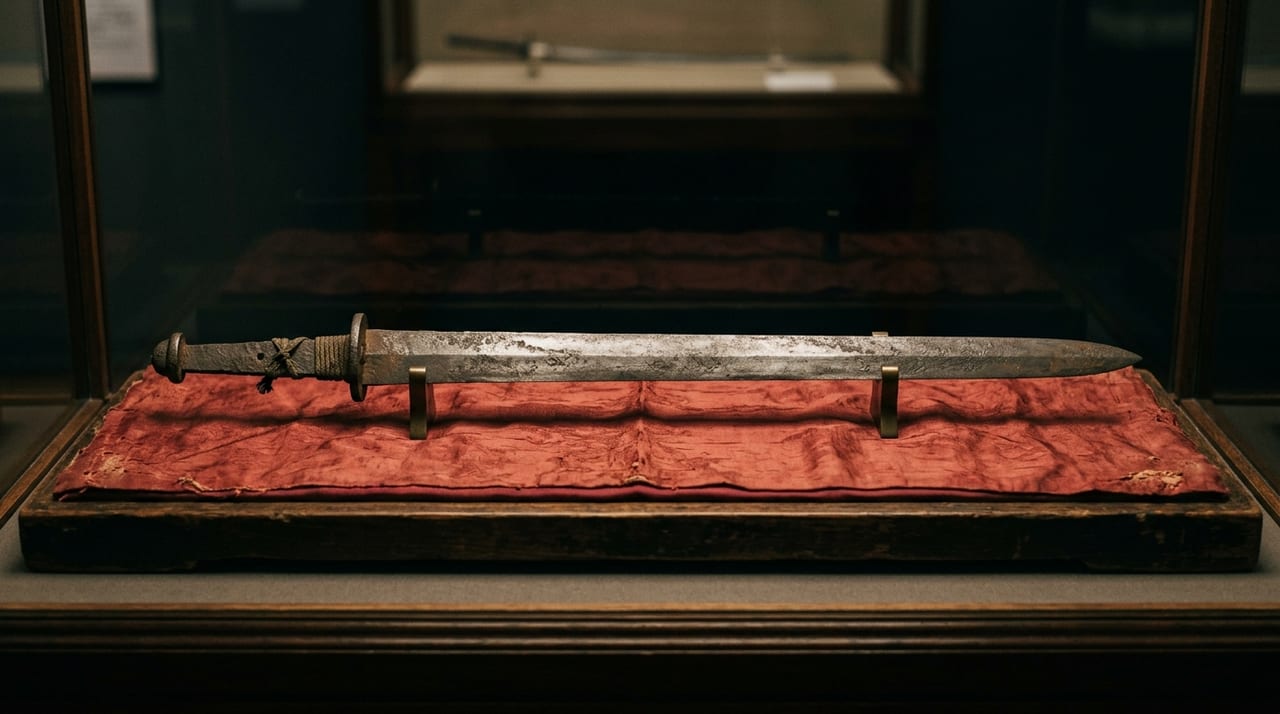
 * Image is for illustrative purposes only.
Futsunomitama
布都御魂
Also known as: Futsunomitama-no-Tsurugi — The Sword Spirit Futsunomitama; National Treasure at Isonokami Jingū
Description
Futsunomitama is an ancient divine sword enshrined as the sacred body (shintai) of Isonokami Jingū in Tenri City, Nara Prefecture, and is widely known as one of Japan's oldest divine swords. The name "Futsunomitama" refers to the divine spirit and spiritual power itself, and the sword is also called the "Futsunomitama-no-Tsurugi." Since antiquity it has been revered as the supreme treasure of the Mononobe clan, embodying martial divine power.
Isonokami Jingū was a shrine enshrined and venerated by the Mononobe clan in ancient times, and the sacred forbidden precinct (kinsokkuchi) of the shrine remained closed to human entry until the Meiji era. In 1874 (Meiji 7), under the direction of Chief Priest Kan Masatomo, an excavation of the sacred precinct was conducted, and numerous ancient swords, mirrors, curved jewels (magatama), and other sacred treasures were discovered underground. Among these was the Futsunomitama sword, which from its form as an iron straight sword (jikitō) is estimated to date from the Yayoi to Kofun period. The sword is still kept under strict protection as the sacred body of Isonokami Jingū and is not exhibited to the public.
The form of the blade is a straight "jikitō," completely different from the curved swords we are familiar with today as "Japanese swords" (nihontō). It is an ancient iron blade that bears the strong influence of iron-working culture brought from the Asian continent and the Korean peninsula, and as a precious surviving example showing the origins of sword culture in the Japanese islands before the Heian period when curved Japanese swords were established, its academic value is incalculable.
The Mononobe clan served the Yamato court as a powerful clan undertaking military and religious duties in ancient times, and is known as a clan responsible for managing weapons. Futsunomitama was the most sacred sword enshrined by the Mononobe clan and was deeply involved in protecting the imperial family and maintaining the state. From before Japanese sword culture was established, it has been regarded as a supreme embodiment of "martial divine power." The enshrined deity of Isonokami Jingū, Futsunomitama-no-Ōkami, is the deified spirit of this very sword. The form of belief in which deity and blade are unified transmits to the present day the original form of sword veneration in Japanese Shinto.
Legends & Stories
The legend of Futsunomitama is deeply inscribed at the very foundation of Japanese mythology. In the accounts of Emperor Jinmu's Eastern Expedition (Jinmu Tōsei) recorded in the Nihon Shoki and Kojiki, when Emperor Jinmu's forces were overwhelmed and fell into a stupor from the curse of the fierce gods of Kumano (present-day Wakayama and Mie Prefectures), a man named Takakuraji received in a dream the command of Amaterasu-Ōmikami and Takagi-no-Kami. Reaching into a heavenly storehouse, he retrieved the divine sword and presented it to Emperor Jinmu. This sword was Futsunomitama — its divine power broke the curse, revived the imperial forces, and enabled the pacification of Yamato. In still older myth, Futsunomitama is identified as the sword wielded by Takemikazuchi-no-Kami when he subdued the terrestrial realm (Ashihara-no-Nakatsukuni). At his negotiation with Ōkuninushi-no-Mikoto, Takemikazuchi drove the blade of Futsunomitama into the earth — and by its overwhelming divine authority, Ōkuninushi yielded the land of Japan. The word "futsu" in ancient Japanese is interpreted to mean "wondrous sharpness" or "lightning-like cutting power," making Futsunomitama the most fearsome embodiment of martial divine power in the mythic cosmos. According to Isonokami Jingū's tradition, Umashimaji-no-Mikoto, the progenitor of the Mononobe clan, enshrined Futsunomitama at Isonokami, and from that time this sword has stood at the heart of the shrine revered as the "supreme shrine of martial power" — drawing the devotion of warrior houses across every age. Even at the Eye-Opening Ceremony of the Great Buddha at Tōdai-ji in 752, offerings were made to Isonokami Jingū alongside the ceremony, testament to the unshaken divine authority of Futsunomitama even in the age when Buddhist culture flourished.