Kunitomo Firearms Kaji — The Gun Village of Ōmi and Its Connection to Sword-Forging Techniques
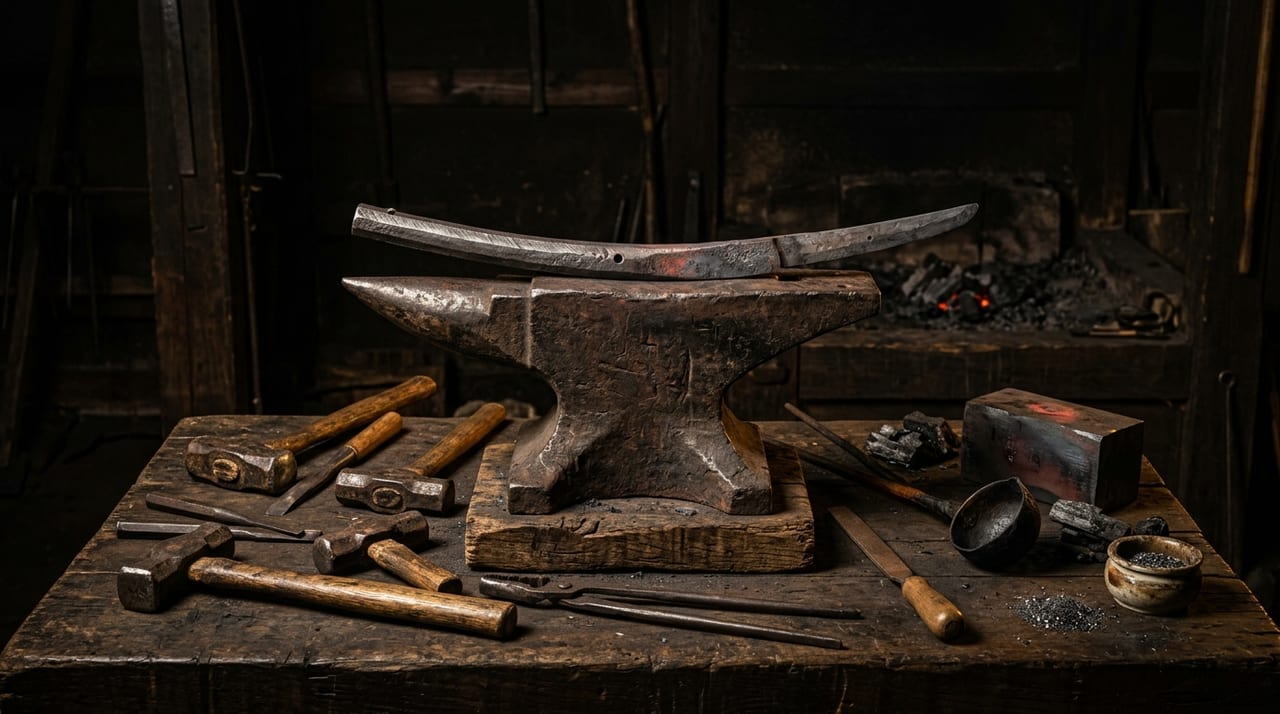 * Image is for illustrative purposes only.
Table of Contents
Kunitomo in Ōmi Province (present-day Nagahama, Shiga Prefecture) was a place known as a village of firearms production from the Sengoku period through the Edo period. It may seem surprising to discuss a center of firearms production in the context of Japanese sword commentary. However, firearms kaji, like sword kaji, were craftsmen who heated iron, hammered it, and joined pieces together — they are inseparable from any consideration of weapons production in the Sengoku period. This article examines how the Kunitomo firearms kaji came to be, the role they played, and where their craft intersected with sword-forging techniques.
The Origins of the Kunitomo Firearms Kaji
Firearms are said to have reached Japan in the mid-sixteenth century. The circumstances of their arrival are covered in a separate article, "Firearms Arrival (1543) and Japanese Swords," alongside the role of swords on the battlefield; here we focus solely on Kunitomo.
Regarding the origins of Kunitomo, it is said that in Tenbun 13 (1544), Kunitomo Zenbei was shown a sample firearm by the shogun Ashikaga Yoshiharu and completed a barrel several months later. This account is based on a record known as the Kunitomo Teppōki, and there are various theories about the origins; it cannot be stated as established historical fact. What is certain is that shortly after the introduction of firearms, one of the earliest domestic centers of firearms production was established at Kunitomo.
The following conditions are thought to have contributed to Kunitomo becoming a center of firearms production. These are not supported by definitive records and represent only a general view.
- It is thought that craftsmen with existing metalworking kaji skills were present in the region
- Ōmi was close to Kyoto and Mino, making it easier to gain connections with daimyo and the shogunate
- The transportation links allowed iron, charcoal, and other materials to be brought in
With these conditions aligned, Kunitomo developed into a village where kaji concentrated in numbers. At its peak, it is said that several dozen workshops of kaji lined the streets and craftsmen numbered in the hundreds, though figures vary by source; here we note only that the scale ran to "several dozen workshops."
From the Sengoku Period to the Edo Period — A Succession of Patrons
A firearm is not a weapon that ends with the production of a single unit. For a daimyo to organize an army, production centers capable of supplying substantial quantities on a continuing basis were needed. Kunitomo was one of the places that filled this role, and it is said to have grown in influence by meeting the demands of neighboring Sengoku daimyo. It is often said that the men who unified the realm — Oda Nobunaga, Toyotomi Hideyoshi, and Tokugawa Ieyasu — patronized the firearms kaji of Kunitomo.
The reality of weapons procurement in the Sengoku period is examined in "The Sengoku Arms Industry" as a division of labor among tōkō, armorers, and bowyers. The same was true for firearms: the work was divided into stages — kaji who made the barrel, craftsmen who made the matchlock mechanism, and craftsmen who shaped the wooden stock.
When the Edo period began, firearms took on more of the character of objects to be controlled than weapons for the battlefield. It is said that the shogunate placed the Kunitomo firearms kaji under its administration and maintained a system by which orders for firearms were directed to Kunitomo. Kunitomo is known as the place that supplied firearms to the Edo shogunate for a long period. The continuation of kaji work even during peacetime is considered one of the reasons Kunitomo was able to continue accumulating technical expertise.
Points of Contact with Sword-Forging Techniques
Firearms kaji and sword kaji had different occupational roles, but the basic techniques they used overlapped.
- Fire-shaping: the work of heating iron until red-hot and shaping it with a hammer
- Forge-welding: the work of stacking iron and joining it into one piece at high temperature
- Heat treatment and finishing: the work of bringing the material to the required hardness and form for its intended use
For a gun barrel, a commonly known method involves wrapping an iron plate around a mandrel and forge-welding it into a tube. Joining the wrapped seam without splitting requires experience in reading temperature from the color of the fire and protecting the joint surface using straw ash and the like. This intuitive skill has much in common with the process of forge-welding the kawagane (jacket steel) and shingane (core steel) of a sword. The processes on the sword side are also touched on in the article "Kokaji and Ōkaji."
At the same time, the differences are clear. A sword is crafted so that hard and tough sections coexist within a single blade, with yaki-ire (quenching) producing the hamon (temper line) — an aspect that belongs to the applied arts. A gun barrel, by contrast, requires strength to withstand the pressure of gunpowder and smoothness on the inside. Even within the same kaji tradition, the direction of the required performance differed.
It should be noted that stories about tōkō switching to firearms production during the Sengoku period are often told, but sources that allow individual cases to be verified are limited. Here we confine ourselves to the general understanding that "forging techniques were shared across neighboring fields."
Kunitomo Ikkansai — From Forging Craft to Science
The name Kunitomo is also associated with Kunitomo Ikkansai (1778–1840), a figure from the late Edo period. Ikkansai was born into a family of Kunitomo firearms kaji and is credited with devising a type of air gun known as a kihō and a reflecting telescope, among other inventions.
The reflecting telescope made in Tenpō 5 (1834) was of the Gregorian type and is recorded as having a magnification of approximately 70×. The example held at the Ueda City Museum was designated a jūyō bunkazai (Important Cultural Property) in 2012. A description can be found on Bunkazai Online, so for more details please refer to the page listed in the section "Public Sources Consulted."
It is an example of forging craft — cutting, polishing, and assembling metal — extending even into the making of precision instruments such as a telescope, and it illustrates the breadth of technical skill among Edo craftsmen.
Resources for On-Site Learning
The Kunitomo Firearms Museum exists as a facility that conveys the history of Kunitomo. The site's encyclopedia page also introduces the "Kunitomo Firearms Museum," so those with an interest in the world of firearms kaji are encouraged to consult it.
For those wishing to learn about Japanese swords themselves, the online catalog (sword listing) offers a good starting point for comparing the styles and forms of each period. Even without any intention of purchase, simply looking at the differences in form from period to period makes it easy to get a sense of how the nature of weapons changed from the Sengoku period to the Edo period. Questions about Japanese swords can be directed via the contact form.