The System of Kaji Tools — A Treatise on Tools: The Hammer, Anvil, Bellows, and Quenching Water That Support the Tōshō's Craft
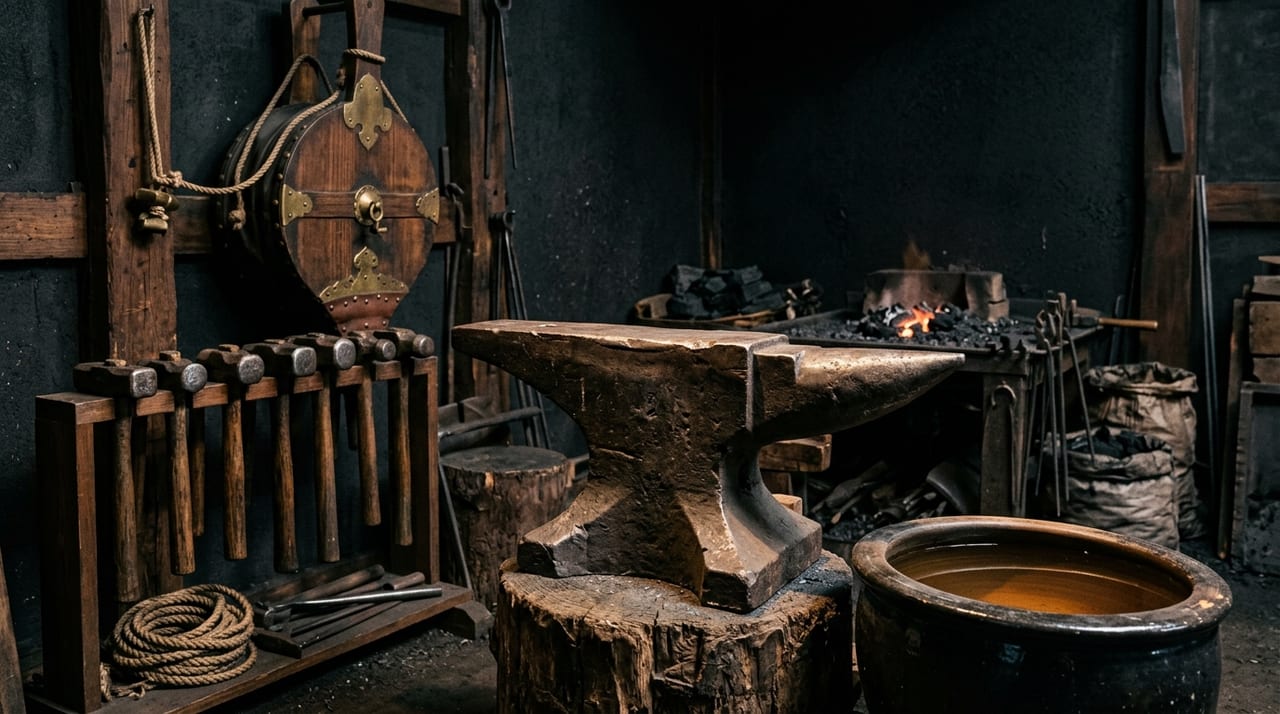 * Image is for illustrative purposes only.
Table of Contents
Tools Define Technique — The Significance of Kaji Tool Theory
"Kōbō does not choose his brush" is a well-known saying, but in nihontō forging the rule is "the tōshō chooses his tools." The finer the tōshō, the stronger his attachment to his tools; selecting, adjusting, and even crafting them himself is part of his art.
Every stage of the nihontō forging process — heating the tamahagane, tanren (forging), shaping, and yaki-ire (quenching) — requires dedicated tools. These tools are not mere "equipment"; they are a precise tool system that embodies the tōshō's technical philosophy. The overall tool configuration of the workshop is also covered in detail in The Tōkō's Tools and Workshop Layout.
Tsuchi (Hammer) — The Lead Actor in Shaping Steel
Ōtsuchi (Large Hammer) — Building the Framework
The ōtsuchi is a heavy hammer used in the first stages of the forging process. It plays the central role in consolidating the tamahagane, performing orikaeshi tanren (folding), and creating the rough shape of the blade (sunobe).
Weight: The preferred weight of the ōtsuchi varies by the tōshō's physique and forging style, and multiple weights may be used within the same workshop. Too heavy and fatigue sets in quickly; too light and the steel cannot be drawn out sufficiently. Which weight to choose is a sense the tōshō acquires through years of experience.
Material: The head is typically steel and the handle wooden (hounoki, kurinoki, etc.). The balance between the hardness of the head's steel and that of the kanatoko (anvil) is critical: a hammer that is too hard damages the steel, while one that is too soft reduces efficiency.
The Role of the Sakideshi: In a traditional kajiba, the master (tōshō) keeps rhythm with a small hammer while the leading apprentice (sakideshi) swings the ōtsuchi — a division of labor. The master's small hammer indicates "where to strike," and the sakideshi's ōtsuchi applies force to that spot. This "unity of iki (breath)" determines the efficiency and quality of the orikaeshi tanren (folding).
Kozuchi (Small Hammer) — A Tool for Precise Shaping
After the ōtsuchi creates the rough form, the kozuchi is used for precise shaping. The tōshō holds it directly in hand to refine the details.
Weight: Far lighter than the ōtsuchi, it is chosen to match the feel of the tōshō's hand. Being able to use it as an extension of the hand is essential for fine, differentiated striking.
Variety of Shapes: The kozuchi comes in different shapes depending on the purpose. Different hammers are used to suit the shaping of each part of the blade (kissaki, shinogi, machi).
- The "hiratsuchi (flat hammer)" with a flat striking face
- The "kakutsuchi (square hammer)" with angular faces
- The "marutsuchi (round hammer)" with a round striking face
Kizuchi (Wooden Mallet) — Collaboration with the Sayashi and Tsukashi
The wooden mallet is used to shape materials without striking metal directly. It is also used when the tsukamakishi (hilt-wrapper) applies the samegawa (ray skin), and when the togishi (polisher) works with whetstones. Wooden tools are indispensable in the work of the craftsmen who support the blade.
Kanatoko (Anvil) — The Foundation That Receives the Steel
The Function of the Kanatoko
The kanatoko is the stand that receives the steel struck by the hammer. Throughout the entire forging process, the steel is worked on the kanatoko. The kanatoko's true role is to serve as a stable platform that transmits the force of each blow solely into the steel, without wasting it.
Material: The kanatoko is generally made of steel, but the hardness of its surface (degree of quenching) is critical. Too hard and the steel is easily damaged; too soft and the kanatoko itself deforms.
Weight and Stability: The heavier the kanatoko, the more stable it is. A light kanatoko shifts under the impact of the hammer, making precise shaping difficult. In large kajiba, anvils of considerable weight may be installed, and their placement is tied directly to the workshop's design.
Shapes of the Kanatoko
- Flat type (heimengata): The most basic form. Supports the steel on a wide flat surface.
- Horned type (horn type): Has a projection called a "tsuno (horn)" on one or both ends. Bending and detailed shaping can be done on the horn. Used for shaping curves such as the kissaki.
- Grooved type (mizotsuikigata): A kanatoko with grooves carved into its surface. Used to stabilize round-bar stock in the groove during shaping.
Fuigo (Bellows) — The Wind Tool That Commands the Flame
The Function and Principle of the Fuigo
The fuigo is a blowing device that forces air (oxygen) into the furnace (kamado). Forced air onto the fuel (primarily charcoal) is necessary to heat the iron to the high temperatures required for working. The technique of reading this temperature by color is systematized separately as The Art of Hishoku: Reading Fire Color.
The traditional fuigo is a wooden box-type blower called the "hakofuigo (box bellows)." Inside the box is a piston-like board (fuigoita) which, when moved back and forth, forces out air.
Managing Air Volume — The True Meaning of "Hikagen"
The volume of air fed into the furnace directly controls the heating temperature of the steel. More air (strong blast) raises the temperature; less air (weak blast) lowers it. The tōshō adjusts this air volume by varying the speed of the fuigo, and judges the correct temperature by watching the color of the steel (the difference between red heat, yellow heat, and white heat).
"Reading the hikagen (fire adjustment)" in practice refers to the complex management of both fuigo operation (air volume) and fuel arrangement inside the furnace (amount and placement of charcoal). Even with the same fuigo, the character of the flame changes greatly depending on how the charcoal is arranged. For this reason, operating the tools and handling the charcoal have been passed down as an inseparable, unified technique.
Modern Fuigo
In modern kajiba, electric blowers have become widespread. They are easier to stabilize air volume than manual hakofuigo and consume less of the apprentice's physical energy. However, some tōshō maintain the traditional hakofuigo on the grounds that "electric blowers cannot replicate the subtle operation of the fuigo." The evolution of tools and the maintenance of tradition coexist as a choice made individually by each workshop.
Yakimizu (Quenching Water) — The Lifeblood of Yaki-ire
The Role of Yakimizu in Yaki-ire
Yaki-ire is the most critical process in nihontō production, the one that creates the hamon. By rapidly quenching the white-hot blade in water (yakimizu), the edge portion (high-carbon area) undergoes martensitic transformation, producing a hard edge.
The water used for this rapid quenching is the "yakimizu." The water quality, temperature, and material of the container (water tank) of the yakimizu greatly affect the results of the yaki-ire: the shape of the hamon, sharpness, and the degree of sori. The choice of cooling medium itself is explored further in How the Choice of Quenching Liquid Determines Blade Hardness.
Water Quality — The "Character of Water" the Tōshō Values
"Soft water (nansui)" is considered suitable for nihontō yaki-ire. Hard water (water with a high mineral content) can affect quenching efficiency.
Many historical documents record that the tōkō of famous blade-producing regions placed great importance on the quality of their water. Many modern tōshō also insist on using local water, well water, or specific spring water. Water is an invisible material, but the fact that the tōshō consciously selects it for its character speaks to the delicacy of the yaki-ire process.
Water Temperature — Managing Season and Timing
The target temperature for yakimizu varies from tōshō to tōshō. Some use body temperature as a reference point, but in practice the temperature is adjusted according to the season, the volume of water in the tank, and the size of the blade.
Since water temperature changes between winter and summer, the yakimizu may be heated or cooled to adjust its temperature by season. "Yaki-ire is more difficult in winter" is said because when water temperature is too low, quenching efficiency changes and the risk of cracking (yakiware) increases.
Material of the Water Tank (Mizuoke)
The container for the yakimizu is also a matter of personal preference for each tōshō. A wooden tub (oke) is traditional; wood has the property of gently maintaining the water's temperature. In the modern era, metal and plastic water tanks are also used, but some tōshō insist that "it must be a wooden oke." Even in the choice of a single material, the accumulated experience of each workshop lives on.
Design of the Kajiba (Forge) — The Space That Makes Tools Work
Placement and Orientation of the Furnace
The position of the furnace (combustion apparatus) is the heart of kajiba design. The positional relationship among the three points — furnace, kanatoko, and yakimizu tank — is designed so that the tōshō can work as efficiently as possible during forging.
The relationship between the orientation of the furnace (direction of the flame) and light (daylighting) is also important. Because the tōshō visually reads the color (temperature) of the steel, a kajiba where natural light and firelight are properly secured is necessary.
Temperature and Humidity Management
The temperature and humidity of the kajiba also affect forging. In the yaki-ire process in particular, ambient temperature affects the yakimizu temperature, so a work plan that accounts for the season is necessary. This is why many workshops have a practice of concentrating the yaki-ire process in winter.
Summary — Tools Are the Tōshō's "Second Hands"
Nihontō forging is a place where the tōshō's "eyes," "ears," "hands," and "intuition" all operate at full capacity. But for those senses to function, the tools that support them must be precisely in order.
A hammer of appropriate weight, a precisely flat kanatoko, a fuigo capable of delicately adjusting air volume, yakimizu of optimal water quality and temperature — only when all of these are in place does the tōshō's skill come to fruition in the blade.
To know the tools is to know the tōshō's work. The hammers and kanatoko lined up in the kajiba are not mere lumps of metal, but the material foundation of the precise technical system that produces the nihontō as a work of art.