What Is Inome——The Meaning of the Heart-Shaped Sukashi and Where It Appears on Tsuba and Metal Fittings
 * Image is for illustrative purposes only.
Table of Contents
When browsing catalogues of tsuba and tōsōgu, you may come across small heart-shaped sukashi. This is inome. It is a motif used not only on tōsōgu but also on the decorative metal fittings of other objects. This article surveys, within verifiable bounds, the shape and etymology of inome, where it appears on tōsōgu, what to look for in the finish, and the points to check when appreciating it.
The Shape and Etymology of Inome
Inome is a pattern made by cutting a heart shape out of a flat material. Because the shape resembles the eye of a boar (inoshishi), it is called inome-gata (the inome form), and a sukashi pierced in that shape is called inome sukashi.
The Nara National Museum's glossary for the Shōsōin Exhibition states that a sukashi pierced in the inome-gata form in decorative metal fittings and similar objects is called inome sukashi (Nara National Museum, Shōsōin Exhibition Glossary, "Inome"). The term is also used in explanations of Shōsōin treasures.
The Seisen-ban Nihon Kokugo Daijiten describes inome sukashi as a sukashi-bori (openwork) decoration that takes a heart shape, sometimes with fukurin added around its perimeter (Seisen-ban Nihon Kokugo Daijiten, "Inome Sukashi"). Here, fukurin refers to a narrow covering of metal applied along the rim of an object, which guards against damage and also serves as decoration (Seisen-ban Nihon Kokugo Daijiten, "Fukurin").
Examples of Inome in Tōsōgu
Regarding the typical locations where inome appears in tōsōgu, the Seisen-ban Nihon Kokugo Daijiten entry on inome sukashi lists the following.
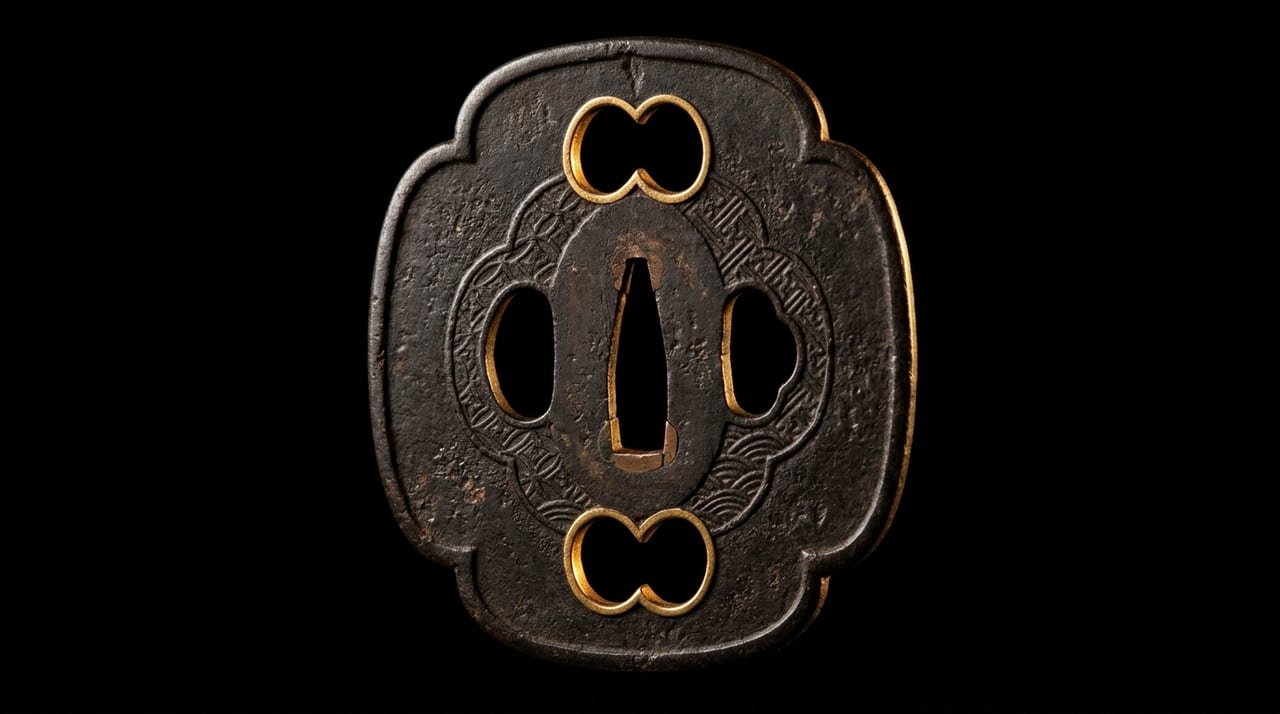
- Inside the notches at the four corners of mokō tsuba and aoi tsuba
- Inside the notches of hassō kanamono
Mokō tsuba are tsuba that take their name from mokō, with notches at the four corners. Mokō is a cloth hung horizontally along the top of misu blinds and curtained daises; from the pattern used on it, the word also became another name for the ka-mon (mokkō) motif (Digital Daijisen, "Mokō"). The typical form of inome on a mokō tsuba is a small heart-shaped sukashi set inside these notches.
Aoi tsuba likewise have notches at the four corners, and inome may similarly be placed inside the notches.
Hassō kanamono are oblong metal fittings whose ends are split in two, attached to the seats of the paired rivets on armor, to gate doors, and to itakarado (plank doors) (Seisen-ban Nihon Kokugo Daijiten, "Hassō Kanamono"). Inome may also be used in the notched portions.
In each case, the structure is one in which inome is placed within notches set at the outline, with the combination of notch and inome forming the overall design. As for the varieties of tsuba shapes, it is easier to identify where the sukashi is located if you first grasp the overall form of each — mokō tsuba and aoi tsuba — before checking the position of the inome.
Fukurin and What to Look for in the Finish
There are cases where fukurin is applied to the edge of the inome and cases where it is not. When fukurin is added, the rim of the sukashi opening becomes clearly defined and the heart-shaped outline stands out sharply. Inome without fukurin has the cut edge finished as-is, and tends to give a more straightforward impression.
The appearance of sukashi finishing in metalwork changes depending on the thickness of the material and the type of base metal. Fukurin have names such as kin-fukurin, which uses gilding, and gin-fukurin, which uses silver plating (Nihon Daihyakka Zensho, "Fukurin"). When examining a catalogue or an actual piece, checking what treatment has been applied to the edge of the inome makes it easier to discern the care in the craftsman's handiwork and the intent of the design.
Even among mokō tsuba, looking at whether the size and orientation of the inome in each notch are uniform or whether variation has been deliberately introduced reveals how much care has been put into the design.
How to Interpret the Meaning of Inome
Explanations stating that inome carries the meaning of warding off evil or protecting against fire can be found in general introductory articles. However, neither the Nara National Museum's Shōsōin Exhibition glossary nor dictionary definitions contain any such attribution of meaning. Because the underlying sources cannot be verified, this article does not present such interpretations as definitive meanings.
That said, the inome form is also used outside tōsōgu. In architecture, a gegyo (gable pendant) carved with inome is called an inome gegyo (Seisen-ban Nihon Kokugo Daijiten, "Inome Gegyo"). Inome in tōsōgu can also be viewed in the context of this broader decorative tradition.
In appreciation, rather than seeking an answer to the "meaning" of inome first, the starting point is to observe the placement and finish of the sukashi and read its role within the overall design. Looking at inome as a form is the foundation for interpretation.
Points to Check When Appreciating Inome
When looking at a tsuba or tōsōgu that features inome, checking the following points in order deepens your observation.
- Check whether the inome is set inside a notch or stands as an independent sukashi opening.
- Look at which direction the tip (the pointed end) of the heart shape is facing.
- Check whether fukurin (a metal edging) has been applied to the rim.
- Look at how large the inome is relative to the overall size of the tsuba.
- Check the balance of placement in relation to other sukashi and carving.
For the lineages of sukashi tsuba, see The Lineages of Sukashi Tsuba——The Designs of the Three Major Schools in Owari, Kyō, and Higo Sukashi; for how to read tsuba motifs, see Reading Tsuba Motifs——The Meaning of Designs Incorporating Family Crests, Auspicious Symbols, and Narratives; and for carving and sukashi techniques, see also Complete Guide to Tsuba Carving Techniques.
Summary
- Inome is a pattern pierced in a heart shape; the name comes from its resemblance to the eye of a boar.
- A sukashi pierced in the inome-gata form in decorative metal fittings and similar objects is called inome sukashi, and it is used widely beyond tōsōgu alone.
- In tōsōgu, it may be applied inside the notches at the four corners of mokō tsuba and aoi tsuba, or inside the notches of hassō kanamono.
- Whether fukurin is added to the edge changes the impression of the finish, and serves as a point of reference for observation.
- Attributions of meaning such as warding off evil cannot be confirmed with reliable sources and are therefore not stated as definitive; beginning with observation of the form itself is the sound approach.
When you want to compare sukashi designs on tsuba and tōsōgu, you can browse swords currently listed in TOUKENZA's online catalogue. For enquiries, please contact us via the enquiry form.