Complete Guide to Tsuba Carving Techniques: Ke-Bori, Katakiribori, Maru-Bori, Taka-Bori and How to Tell Them Apart
 * Image is for illustrative purposes only.
Table of Contents
The Role of Carving in Tsuba
In the decoration of tsuba, "hori" (carving) is one of the most important techniques. Hori refers to the general term for techniques that create patterns and shapes by using metal tools called nomi (chisels) and tagane (gravers) to remove, compress, and deform the surface of metal.
Hori techniques are broadly divided into "removal carving (removing surface to create depressions)" and "compression carving (pressing and deforming the surface)." By using different techniques according to purpose, or by combining them, diverse visual effects are created.
Kebori—The Art of Delicate Lines
Kebori is a technique of continuously carving extremely thin lines. Meaning "carving as fine as hair," it uses specialized kebori gravers to engrave dozens to hundreds of thin lines.
Uses of kebori:
- Animal fur and feathers
- Plant veins and stem fibers
- Human hair and clothing wrinkles
- Complementary work to the "nanako (fish-roe pattern)" of the ground
The quality of kebori is judged by the density, uniformity, and consistency of line weight. In the work of skilled craftsmen, kebori lines continue at even intervals without breaking, and when lit, they display a texture like fibers. Particularly, the kebori of the Three Masters of Nara metalwork (especially Nara Toshinaga) exhibits a level of precision that overwhelms the naked eye.
Katakiri-bori—The Technique of Adding Shadow
Katakiri-bori is a technique of inserting a single-edged graver at an angle to carve a groove with an asymmetrical cross-section. Because one wall of the groove is steep while the other has a gradual slope, shadow and light are created depending on how light strikes it, adding three-dimensionality and shading to the carving.
Katakiri-bori is particularly often used to express characters and fine contour lines. When calligraphy (hiragana or kanji) is engraved on a tsuba, katakiri-bori can express the inflection characteristic of brushwork.
Marubori—Smooth Three-Dimensionality
Marubori is a technique of carving a motif into a rounded shape, where the cross-section of the carved area takes on a form close to a rounded hemisphere. It is used to express plant fruits, stones, spherical motifs, and similar forms.
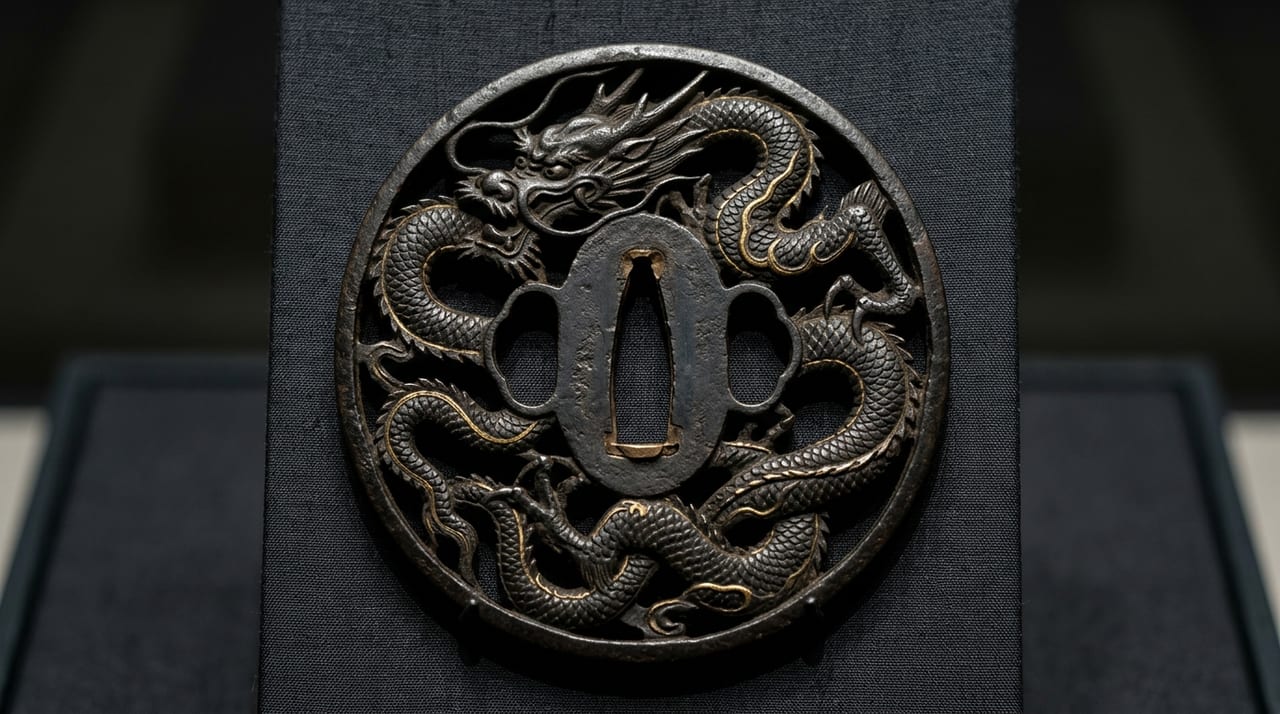
While marubori can be used alone, it is particularly effective when combined with takabori or kebori. For example, by arranging marubori scales on a dragon's body and adding fine kebori details to each individual scale, an extremely realistic representation of a dragon becomes possible.
Takabori—The Highest Level of Three-Dimensional Expression
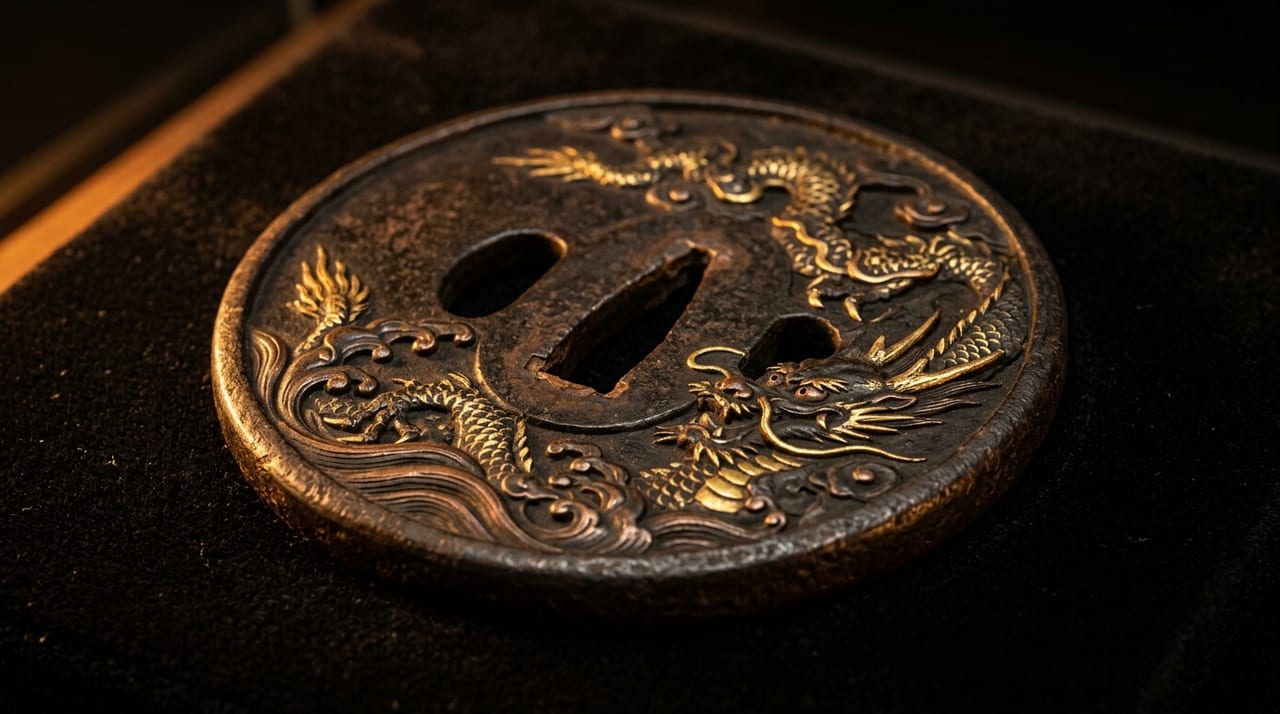
Takabori is a three-dimensional carving in which a motif is raised prominently above its surroundings. Technically, there are two approaches: "carving away the surroundings to leave the motif raised" and "pushing up from below to create height (uchidashi)."
The takabori seen in representative works of the Gotō family, the Umetada school, and Nara metalwork sometimes possesses a height of several millimeters or more from the base plane, functioning as nearly three-dimensional sculpture. To achieve this level of takabori, advanced technique is required in every aspect of how the material is forged, carved, and finished.
Evaluation points for takabori:
- Height difference between the highest point (apex) and surroundings
- Smoothness of the slope on the sides
- Completeness of fine details (eyes, scales, fur, etc.)
- Beauty of shadows created by light from below
Shishibori and Usujishi-bori
Shishibori is a lower relief than takabori, referring to a state where the motif is raised to a moderate height. Usujishi-bori is an even thinner relief, positioned between hirabori and takabori.
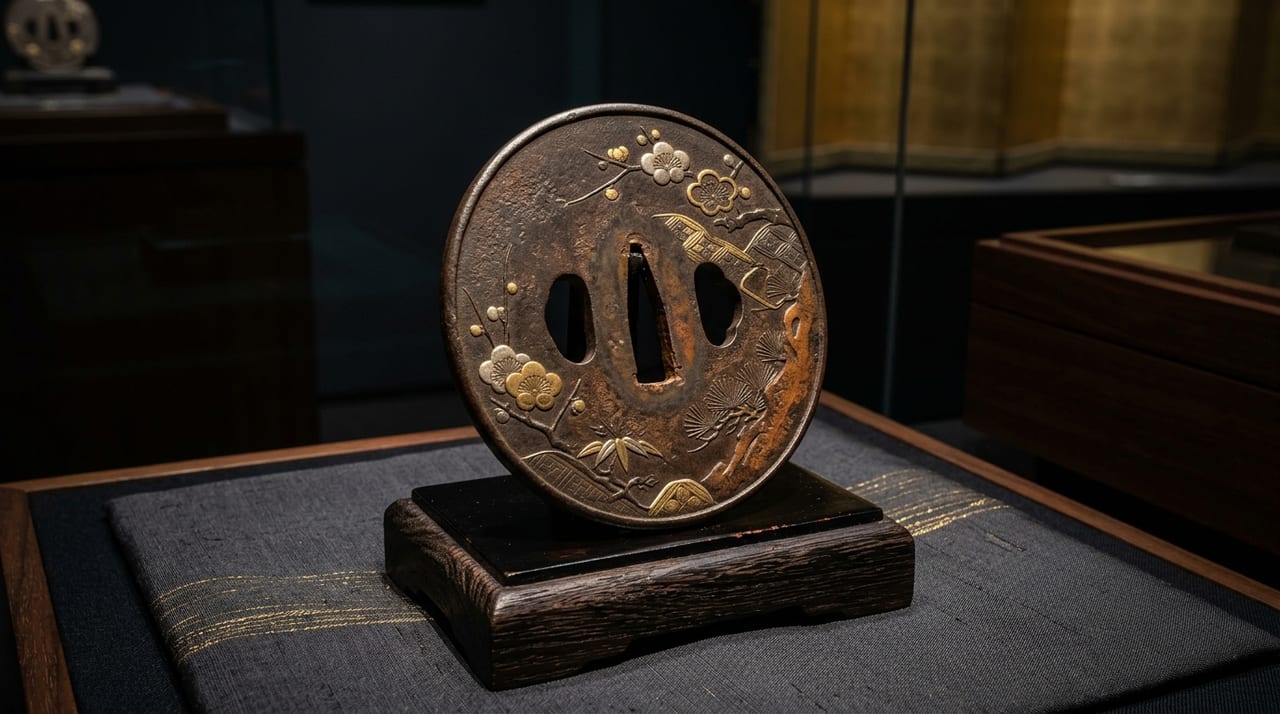
In many tsuba, takabori and shishibori are used for primary motifs, while usujishi-bori, kebori, and katakiri-bori are combined to express fine details. This combination of multiple techniques creates depth and variation in a single tsuba.
Hirabori and Shizumi-bori
Hirabori is a technique of carving shallow and horizontally into the surface, creating a plane that is slightly recessed from the ground. Shizumi-bori is carved somewhat deeper than hirabori, forming a more distinct depression.
These techniques are particularly important as preparatory work for inlay (zogan), used to create the "holes" into which gold, silver, shakudō, and similar materials are fitted.
Combined Use of Carving Techniques—Layering of Techniques in Masterpieces
The carving in excellent tsuba works is a complex expression where multiple techniques are organically combined. For example, in a masterpiece such as Nara Toshinaga's "Tiger Tsuba (Torazu-tsuba)":
- Tiger's body: takabori (highest points)
- Tiger's stripes: usujishi-bori (slightly lower than the body surface)
- Tiger's fur: kebori (carved layered over the stripes)
- Background bamboo: katakiri-bori (representing distant view)
- Ground of the space: nanako (background texture)
The layering of these multiple techniques enhances the overall perfection. When viewing, it is effective to change the angle of light and confirm how each technique is functioning.
Conclusion—Reading Carving is Dialogue with the Artist
Understanding tsuba carving techniques deepens appreciation from mere visual impression to direct dialogue between the viewer's understanding and the artist's intent and skill. The work of changing the angle of light and confirming each carving technique used one by one is one of the most intellectual pleasures of tsuba appreciation. By knowing the differences between kebori, katakiri-bori, marubori, and takabori, the world of sword fittings opens before you in ever richer and deeper ways.