Tsuba Authentication: How Experts Detect Fakes, Later Works, and Alterations
 * Image is for illustrative purposes only.
Table of Contents
The Difficulty of Tsuba Authentication——Why Counterfeits Exist
The authentication of a tsuba (鍔) is as challenging as authenticating the Japanese sword itself, and sometimes requires even more specialized knowledge. While swords have relatively systematic evaluation axes——signature, form, jihada, and hamon——tsubas present nearly infinite combinations of school, technique, subject matter, and period, making the judgment criteria far more complex.
From a historical perspective, since the Edo period, highly sought-after school tsubas were produced in large quantities as "koudai-uchi (後代打ち)"——later-period craftsmen imitating the style of popular masters. While this practice itself was a custom of the time and not necessarily "counterfeit," serious problems arise when incorrect signatures are later engraved and the pieces circulate as works of famous masters. Works by the Gotou family lineage and pieces by renowned Higo metalworkers command high prices, and modern counterfeits with forged signatures continue to appear on the market today.
The mechanism by which collecting value and rising market prices create motivation for counterfeiting began after the mid-Edo period, when tsubas ceased their role as weapons and began to be treated purely as works of art. Understanding this historical context becomes the foundation for cultivating a discerning eye.
Distinguishing Rust and Period by Iron Ground Patina
One of the most fundamental clues to determining a tsuba's authenticity is "sabi (錆)" or rust.
Authentic patina (seishu / 正銹) is naturally formed over long periods, displaying uniform thickness in black-brown to reddish-brown tones, and is integrated with the iron ground. Under magnification (10-30x), fine crystalline structures are visible, showing complex, intricate microstructures on the surface. The rust layer has penetrated deep into the iron ground itself and does not flake off with light touch. Reproducing this artificially is extremely difficult.
Artificially created rust appears as excessively uniform coloration, thin rust layers with weak adhesion that flake easily, or conversely, unnaturally thick corrosion layers. Forced rusting with acid produces unnatural color tones with visible streaking, and rust crystals tend to be coarse and lack uniformity. Objects colored black with paint or chemicals may show color loss when wiped with solvent.
However, rust conditions change over time due to maintenance or previous polishing, making it impossible to determine the period by rust alone. Rust should be understood solely as one of multiple assessment factors.
Reading Signatures (Mei) and Authenticity Judgment
The authenticity of a tsuba's mei (作者名・流派名, maker name or school name) is the critical question of authentication.
Characteristics of authentic signatures (shinmei / 真銘):
- The chisel cuts are sharp with deep V-shaped cross-sections
- The calligraphy bears school-specific characteristics (particular stroke patterns, rhythm of thick and thin lines, angle of brushwork, etc.)
- The position and orientation of the signature follow school conventions
- Rust has uniformly penetrated the grooves of the signature over time
- The context surrounding the signature (production date, place, etc.) aligns with school records
Characteristics of later-added signatures (nochimei / gimei / 後銘・疑銘):
- Cuts are shallow with rounded cross-sections (evidence of later engraving)
- Calligraphy appears unnaturally regular or conversely, crude
- Rust in the signature grooves differs markedly from the surface rust of the tsuba (old rust does not enter grooves added later)
- The signature's position or orientation deviates from school conventions
- The character style does not match other known examples from the same school and period
Signatures of famous makers from the Gotou family, Shoami school (正阿弥派), and Higo metalworkers are most frequently imitated, making examination by multiple specialists essential. As of 2026, highly sophisticated forged signatures using precision laser engraving have been documented, making close observation of fine chisel-cut details increasingly important.
Carving and Piercing Characteristics and Period Dating
The decorative techniques of a tsuba——carving, piercing (sukashi), inlay——also bear period and school-specific characteristics.
Iron tsubas of the Koto period (Heian to Muromachi) feature bold, simple piercings based on geometric forms or natural motifs. The iron ground possesses a distinctive black luster, with fine scratches and hand wear from long use uniformly distributed across the surface. This "uniformity of wear" clearly differs from artificially added damage.
The Momoyama period (late 16th to early 17th century) is characterized by precise carving and inlay representing the Umetada school (埋忠派). Gold, silver, and shakudo (赤銅) inlays are finely executed, with meticulous underdrawings (shitae). The inlay fitting technique is difficult to perfectly replicate even with modern precision machining, and fine processing marks at the joints become important indicators for period dating.
The Edo period (17th-19th centuries) shows large variations by school. Higo metalworkers are known for the beauty of their robust iron ground and restrained decorative expression, while Nara metalworkers and later Shoami masters feature realistic and highly decorative expression. Familiarity with the characteristic techniques favored by each school becomes the foundation of dating by carving style.
Distinguishing Repairs and State Falsification
Issues related to tsuba "condition" must not be overlooked.
Chip repairs (kake): When edges of the tsuba have chipped, the damage is filled with metal, polished, and rusted to conceal it. Observing at a low angle with changing light sources can reveal differences in reflectivity due to material differences or unnatural boundaries. Natural light or oblique lighting is more effective for identification than fluorescent light.
Added or altered piercings: Cases where original piercings are partially filled and redesigned, or new piercings added. These can sometimes be identified by differences in the age of the piercing edges or uneven rust conditions in surrounding areas. Fresh-cut edges show shallow rust and retained luster.
Color enhancement treatment (iro-age): Chemical treatment intentionally altering the color of iron ground or inlays to appear older. This differs from natural aging in light reflection characteristics, and when strong light is applied at an angle, the surface texture appears overly uniform. Enhanced inlays typically lack the natural wear detail at edges.
NBTHK and the Importance of Expert Authentication
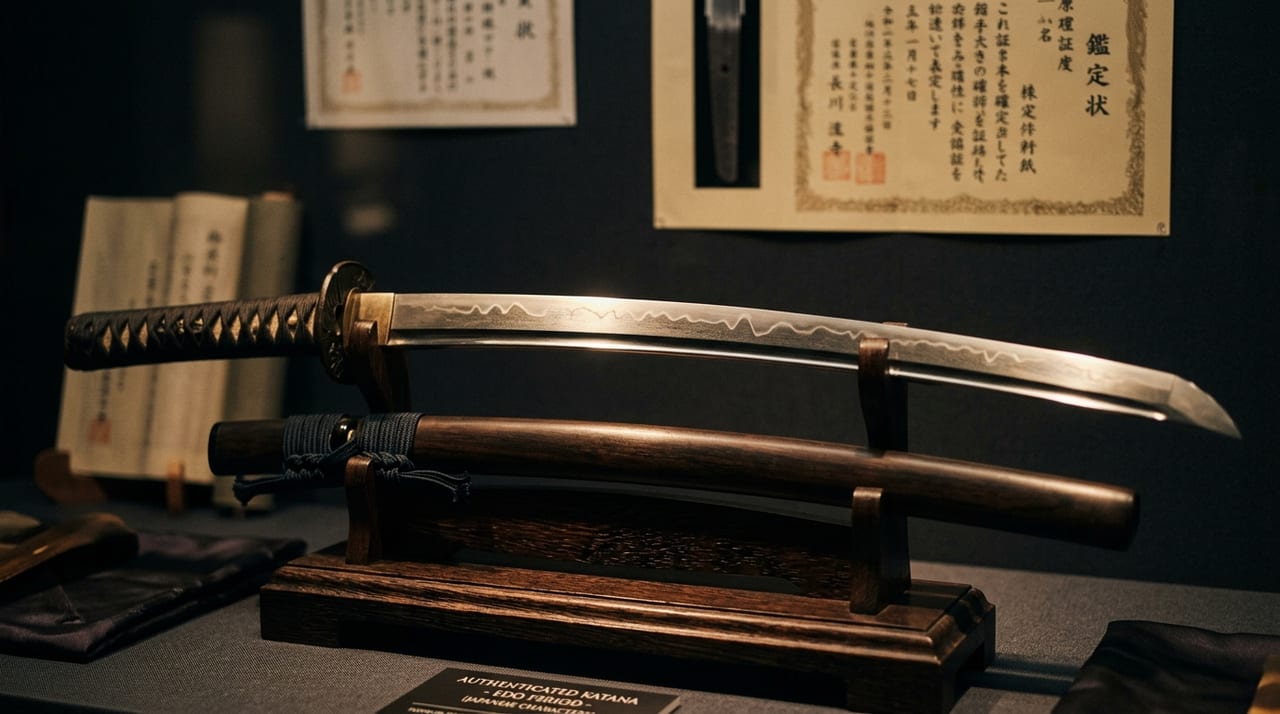
It is difficult for an individual to master all the above judgment criteria. When purchasing high-value tsubas, the standard practice is to choose pieces that have passed NBTHK (Nippon Bijutsu Token Hozon Kyokai / 日本美術刀剣保存協会) review or those accompanied by certification from a trusted specialist dealer.
Tsubas bearing NBTHK "Hozon Tousougu" or higher certificates have undergone deliberative examination by multiple specialists, making their authenticity assessment far more reliable. The certification ranks progress in strictness as "Hozon" → "Tokubetsu Hozon" → "Juyo," with particularly "Juyo Tousougu" designated pieces representing museum-level evaluation.
However, certification documents themselves can be forged, making it a final safety measure to verify the document number, calligraphy, and seal characteristics directly with the NBTHK. Certificates from foreign institutions accompanying tsubas acquired at overseas auctions may differ from NBTHK standards, and domestic re-authentication is recommended.
Conclusion——Authentication Skills Are Honed Over Time
The authentication of tsubas is not something acquired overnight. Repeatedly handling excellent originals, learning each school's characteristics through hands-on experience, seeking opinions from multiple specialists when in doubt——this accumulation is the only path to developing a discerning eye. Participation in museum public authentication sessions, attending sword markets, careful study of catalogs and academic papers all directly contribute to skill development.
To avoid acquiring counterfeits or later reproductions, always keep three warning signs in mind: "the price seems too low," "provenance is unclear," and "no authentication certificate." Building specialized knowledge gradually while enjoying your collection remains the wisest long-term approach.