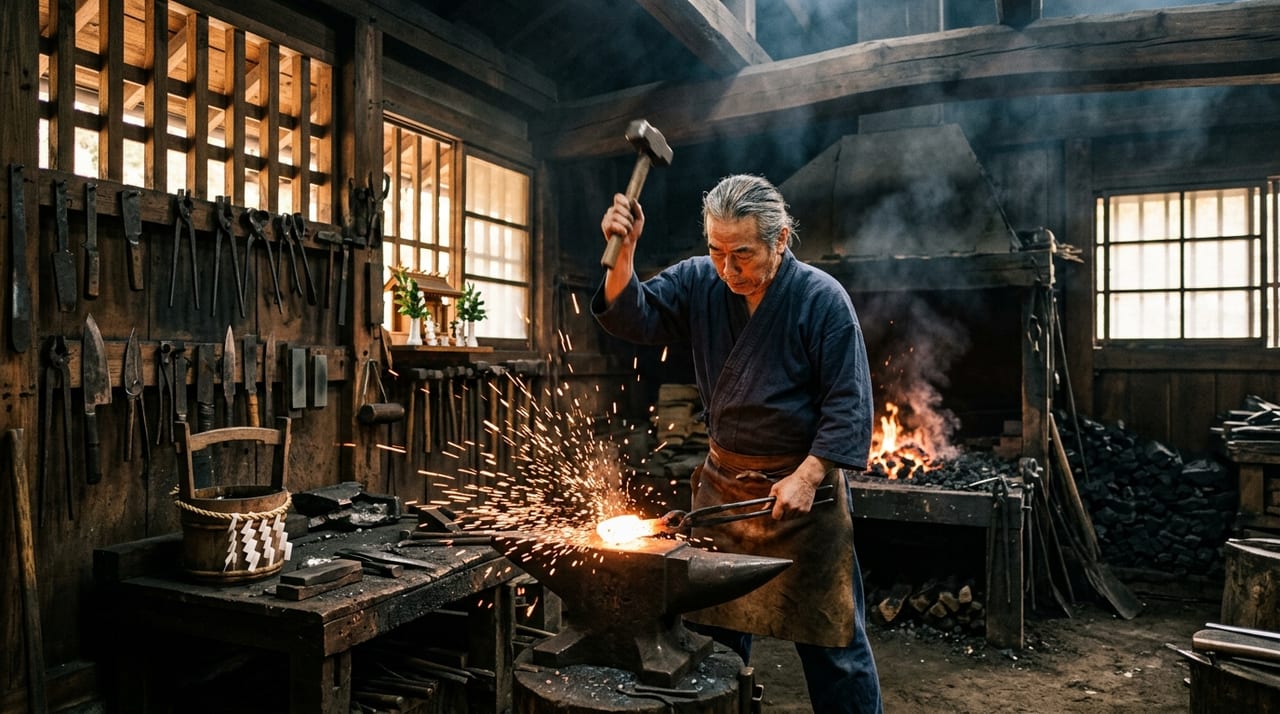
 * Image is for illustrative purposes only.
Tsuchiya Yasuchika
土屋安親
Description
Tsuchiya Yasuchika was a master metalworker of sword fittings (tōsōgu) who was active in the mid-Edo period, and he is remembered for making tsuba, kozuka, kōgai, and other fittings. Together with Nara Toshinaga and Sugiura Jōi, he is counted among the Nara Sansaku (the "Three Masters of the Nara school"), the celebrated Edo metalworkers.
Yasuchika is said to have been born in Shōnai, Dewa Province (present-day Tsuruoka, Yamagata Prefecture), and he mastered metalworking techniques from an early age. As a metalworker of the Nara school, he made full use of the three-dimensional takabori technique of machi-bori and built a distinctive world of carving. His works take up a wide range of subjects, including kachō fūgetsu (flowers, birds, wind, and moon), sansui (landscapes), figures, and animals, and they are characterized by minute and precise carving.
In terms of technique, he skillfully used a wide variety of carving methods, including suemon, kebori, katakiri-bori, nikubori, and takabori, and he showed a superb discernment in choosing base metals. He selected materials such as shakudō, gold, silver, suaka, and shibuichi, matching each to the theme of the work, and in iro-e expression he also opened up a distinctive realm of his own. Works signed with Yasuchika's name (Yasuchika-mei) were widely circulated in later imitations and forged signatures, which paradoxically shows how highly prized and economically valuable his works were.
The tsuba that Yasuchika made are given a special rating as Yasuchika tsuba, and his style, which harmonizes the shape and design of the tsuba, is highly praised by researchers in Japan and abroad as one of the pinnacles of Japanese sword-fittings art. Several excellent metalworkers are said to have been trained as his disciples, and successors known as the Yasuchika school carried on their master's style through the late Edo period. Today, his works are held by the Tokyo National Museum, the Nezu Museum, and others, and they have established worldwide recognition as supreme masterpieces representing Japanese sword-fittings metal art.
Famous Works
- Openwork Tsuba with Plovers and Drying Nets (Important Cultural Property)
- Hamamatsu Chidori Tsuba (Important Cultural Property)
- Tsuba Depicting Zen Master Hōsen (Important Cultural Property)