Tsuchiya Yasuchika — The Pinnacle of Tsuba Artistry and the Aesthetics of Edo Metalwork as Proven by "Yasuchika's Dragon"
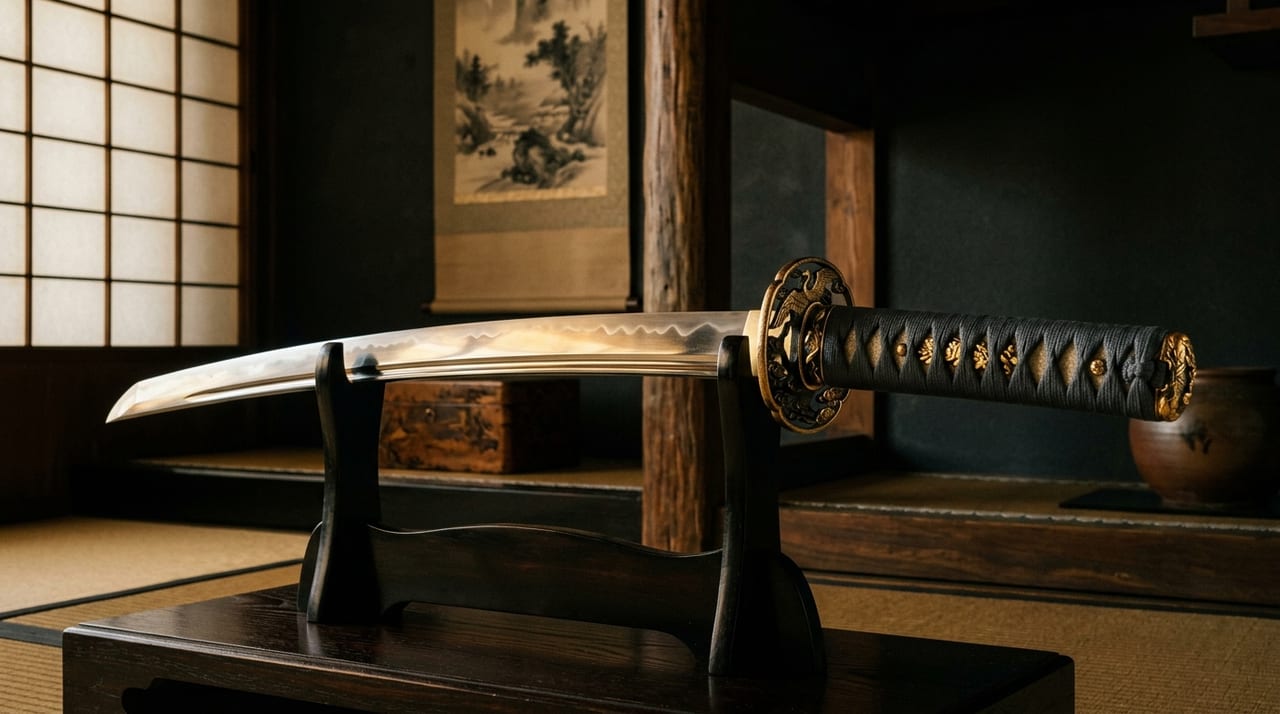 * Image is for illustrative purposes only.
Table of Contents
What Kind of Tōsōgu Craftsman Was Tsuchiya Yasuchika?
Tsuchiya Yasuchika (c. 1670–c. 1744) was a sōken kinkōshi — a craftsman and artist who worked exclusively on tōsōgu (sword fittings) such as the tsuba (hand guard), kozuka, kōgai, and menuki — and remains to this day one of the great masters representing the golden age of Edo metalwork.
Yasuchika is counted alongside Yokoya Sōmin and Nara Toshinaga as one of the "Edo Sanmeikou (Three Great Craftsmen of Edo)". Depending on how school lineages are classified, there is also a view that he belongs to the "Nara Sansaku (Three Nara Masters)" together with Nara Toshinaga and Sugiura Jōi; under either classification, he is uncontestedly regarded as one of the supreme figures in sword-fitting metalwork of the mid-Edo period.
The Master Nara Tatsumasa and the Relationship with Yokoya Sōmin
Yasuchika's master was Nara Tatsumasa, of the Nara school in Edo. It is also said that before entering the service of the Shōnai domain, he studied under Shōami Chinkyū. Yokoya Sōmin, who was active in the same era, was not Yasuchika's master but rather a master from a separate lineage — the two are celebrated as equals, counted together as members of the "Three Great Craftsmen of Edo."
Yokoya Sōmin was a revolutionary figure who established a new style called "machihori" — a technique of using colored metals such as shakudō and shibuichi as the ground, and expressing three-dimensional sculptural form through refined takabori. Standing alongside this Sōmin at the pinnacle of Edo metalwork, Yasuchika was assessed by later appraisers as having surpassed contemporary craftsmen on both counts: technical perfection and diversity of materials.
Yasuchika's Techniques — Complete Command of Takabori, Iro-e, and Materials
Let us examine the technical elements that characterize Yasuchika's works.
Takabori: The method of taka-ukibori (high relief), in which the horimono (carving) rises prominently from the ground. Yasuchika's takabori is extremely precise, with each scale, mane (tategami), and individual claw of a dragon rendered as a complete and independent form. The depth of the carving and its three-dimensionality allow no imitation by other metalworkers, and generations of art researchers have assessed that "to call Yasuchika's takabori sculpture would not be an overstatement."
Iro-e technique: Iro-e — producing a coloristic effect by combining metals of different hues such as shakudō (reddish black), shibuichi (grey-toned), gold, silver, and suaka (copper-red) — was one of the techniques in which Yasuchika excelled. By deploying gold, silver, and shakudō selectively across a dragon's body, he achieved a visual richness that monochrome horimono (carving) could not reach.
Kebori: Kebori — in which countless fine lines are incised using an extremely fine needle-like tool — is used to render fur, scales, feathers, and similar textures. Yasuchika's kebori excels in controlling the density and direction of the fine lines; to the naked eye it appears as a "smooth texture," yet on close examination countless precise incision marks can be discerned.
"Yasuchika's Dragon" — A Masterpiece Among Masterpieces
The signature motif of Yasuchika is the dragon (ryū), and "Yasuchika's Dragon (Yasuchika no Ryū)" is known worldwide as one of the supreme sculptural forms in Japanese tōsōgu art.
The dragons Yasuchika depicts have the following characteristics.
- A dynamic pose with such three-dimensionality that the horimono (carving) seems about to leap from the surface at any moment
- Each individual scale rendered as an independent horimono (carving), giving the whole a sense of living vitality
- Environmental elements such as clouds, waves, and flames also carved in fine detail, completing the world of the dragon
- The deep blackness of the shakudō ground enhances the dragon's dignity
Yasuchika's dragon horimono works are held by first-rate institutions including the Tokyo National Museum, the Japanese Sword Museum, the Museum of Fine Arts Boston, and The Metropolitan Museum of Art in New York, and research and exhibition continue to this day.
False Mei and the Identification of Genuine Works — Evidence of the High Regard
It is recorded that a large number of forgeries and spuriously attributed pieces bearing Yasuchika's mei (signature) circulated from the late Edo period through the Meiji era, which in turn attests to the high economic and cultural value of Yasuchika's works.
Identifying genuine works requires the following verification, and the discovery and re-authentication of genuine pieces continues even today.
- Confirmation of kanteisho (appraisal certificates) from the Hon'ami family and appraisal organizations
- Close examination of Yasuchika's distinctive carving techniques (the three-dimensionality of the takabori, the density of the kebori, and the material choices in the iro-e)
- Expert confirmation of the mei ("Yasuchika" — the typeface and individual character of how it is engraved)
What Yasuchika Left Behind — Pupils and Successors
Yasuchika's pupils and successors formed the "Yasuchika-ha (Yasuchika school)" and carried on their master's style throughout the late Edo period. However, no pupil fully reproduced Yasuchika's precision, and the assessment that "no one reached Yasuchika's level" has become established.
When discussing the art of tōsōgu (sword fittings) — the "attire of the sword," which possesses the same high aesthetic and technical standards as the sword itself — the name Tsuchiya Yasuchika is invariably cited alongside Masamune and Yoshimitsu as one of the supreme figures. To appreciate Yasuchika's works is to experience simultaneously both the aesthetic sensibility and the craftsmanship of Edo-period Japan, and that significance grows greater still in the present day.
Yasuchika's Tsuba (Hand Guard) — Integration of Function and Beauty
Yasuchika's tsuba (hand guard) are regarded as in a class of their own as "Yasuchika-tsuba," and consistently command high prices in the tōsōgu market. The characteristics of Yasuchika-tsuba are as follows.
Thin ground (ji): Many of Yasuchika's tsuba feature a thin design that eliminates unnecessary thickness, giving them a lightness that does not disturb the balance of the sword as a whole. Nevertheless, the three-dimensionality of the takabori is not compromised, realizing an at-first-glance contradictory aesthetic of being "thin yet weighty."
Finishing of the ground: The ji of the tsuba is treated with ground patterns such as "nanako-uchi" or "ishime-ji," creating an optimal texture as a background for the horimono (carving). The precision of this ground treatment is also one of the factors that underpins Yasuchika's reputation.
Treatment of the sen: The treatment of the tsuba's rim (sen) is trim and precise, and combined with the refinement of the horimono (carving), elevates the overall dignity of the tsuba as a whole.
Yasuchika and the Present Day — The Rise of International Esteem
In recent years, interest in Japanese tōsōgu — particularly works by metalworkers of the Edo period — has grown among Western museums and collectors, and Yasuchika's works have earned high acclaim not only domestically but also in the international art market. World-class institutions including the Museum of Fine Arts Boston, the British Museum, and The Metropolitan Museum of Art hold and display Yasuchika's works, contributing to the international dissemination of Japanese craftsmanship.
Moreover, within the cultural context of "the global re-evaluation of Japanese craft," Yasuchika's work has come to attract the attention of contemporary designers and craftsmen as "the integration of the highest levels of craftsmanship and artistry."